


















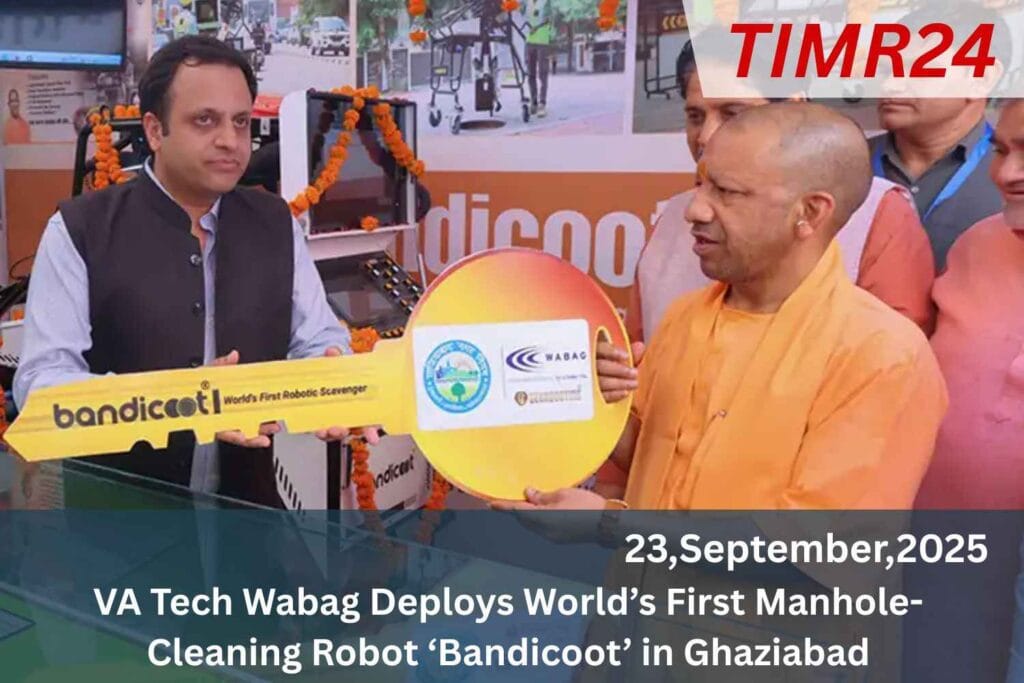
VA Tech Wabag has introduced the world’s first manhole-cleaning robot, Bandicoot, in Ghaziabad as part of its “One City, One Operator” model to modernize the city’s sanitation system. The robot, developed by Genrobotics Innovations, eliminates the need for human entry into hazardous sewer spaces and is equipped with a robotic arm, stabilizing legs, and an integrated bucket system. The initiative extends Uttar Pradesh’s state-wide mechanized sewer maintenance program and is also running training programs for sanitation workers. The collaboration between government, industry, and technology aims to replace manual scavenging with safer, more efficient, and modern sanitation systems.
In the evolving landscape of India’s urban infrastructure, the deployment of advanced technologies is no longer a luxury but a necessity. The latest breakthrough has come from VA Tech Wabag, a global leader in water technology, which has successfully introduced the world’s first manhole-cleaning robot, Bandicoot, in Ghaziabad under the “One City, One Operator” model. This landmark step is reshaping sanitation practices, eliminating dangerous manual scavenging, and setting new benchmarks for safe and sustainable city management The significance of Bandicoot lies not only in its ability to mechanize hazardous work but also in the way it integrates with broader urban.
Development initiatives such as the Swachh Bharat Mission, Safaimitra Suraksha Challenge, and Smart Cities Mission, where technology is being positioned as the backbone of public welfare. To understand the broader implications, one needs to explore the context of manual scavenging, the innovation behind Bandicoot, the operational strategy adopted in Uttar Pradesh, and the socio-economic impact on sanitation workers and citizens alike For decades, manual scavenging has been a deeply entrenched challenge in India, often costing workers their health and dignity. Despite legal bans, many sanitation workers are still forced to physically enter manholes.
Exposing themselves to toxic gases, infections, and life-threatening conditions. By deploying Bandicoot, Ghaziabad takes a progressive step toward eradicating this practice The robot, developed by Genrobotics Innovations, is engineered with a robotic arm, stabilizing legs, and an integrated bucket system that mimics human dexterity but eliminates human risk. It enters the manhole, dislodges hardened sludge, removes blockages, and restores flow all without the need for a person to step into dangerous underground environments. The adoption of such robotics makes cities safer, and aligns with India’s larger sanitation reforms where mechanization replaces hazardous manual labor.
Ghaziabad’s “One City, One Operator” Model
The One City, One Operator model is central to Uttar Pradesh’s urban governance reforms. By assigning the responsibility of sanitation services in a city to a single operator, it ensures accountability, consistency, and efficiency. In Ghaziabad, VA Tech Wabag has been tasked with the role, and Bandicoot has become the centerpiece of its operational strategy The robot’s deployment here follows its earlier success in Agra, where it cleaned more than 1,500 manholes within six months since its introduction in February 2025. This remarkable performance has validated the robot’s capacity to handle diverse sewer conditions and reduce human exposure. With Ghaziabad now embracing the same model, and upcoming plans in Bulandshahr, a wave of technological adoption is sweeping across the state.
Our detailed piece on the (One City) further explains how this framework is transforming urban services across multiple cities A critical element of this transition is the workforce. The move toward robotics is not designed to replace workers but to upskill and reskill them. VA Tech Wabag, in collaboration with Genrobotics, is conducting training programs to certify sanitation workers as robotic operators. This initiative provides them with new career opportunities, shifting their roles from physically demanding and hazardous work to technology-enabled tasks that require technical knowledge and precision For workers, this is not just a job shift but a dignity shift.
They are empowered with safer, modern roles and are no longer exposed to the perils of toxic gases and infections. This socio-economic upliftment ensures inclusivity, a core goal of the Safaimitra Suraksha Challenge, which emphasizes the dignity and safety of sanitation workers The deployment of Bandicoot is not an isolated move; it ties directly into national missions. Under Swachh Bharat Abhiyan, India has been pushing for cleaner cities and the elimination of manual scavenging. The Smart Cities Mission emphasizes the adoption of intelligent infrastructure and sustainable practices. Ghaziabad’s mechanized sanitation aligns perfectly with both agendas, showing how innovation can strengthen government policies.
Technology And Operational Benefits
Moreover, the Safaimitra Suraksha Challenge has been a driving force, mandating mechanized cleaning in cities and penalizing manual scavenging. By deploying Bandicoot, Ghaziabad is not only complying with these requirements but also positioning itself as a leader in innovative urban governance From a technical standpoint, Bandicoot brings multiple advantages. It is capable of navigating narrow sewer lines, handling hardened blockages, and performing continuous operations that would be unsafe or exhausting for humans. This translates into higher efficiency, faster turnaround times, and lower health-related risks for the workforce The robot also supports.
Preventive maintenance, which reduces the likelihood of major sewer collapses or blockages that can disrupt city life. In cities like Ghaziabad, which face rapid urbanization and rising population pressure, such preventive measures are critical The Ghaziabad deployment is just the beginning. As Bandicoot proves its efficiency, more cities in India are likely to adopt the model. With over 4,000 urban local bodies nationwide, the potential scale is massive. Each successful implementation strengthens the case for mainstreaming robotics into urban sanitation At the same time, partnerships between technology providers like Genrobotics and operators like VA Tech Wabag will continue to.
Evolve. Such collaborations highlight the importance of public-private cooperation in achieving large-scale impact The deployment of Bandicoot in Ghaziabad is more than just a technological milestone; it’s a symbol of dignity, safety, and progress. It demonstrates how innovation can address long-standing social challenges while also enhancing efficiency. By combining robotics with policy reforms and workforce empowerment, Ghaziabad sets an example for other cities in India and beyond As urban populations grow and sanitation challenges intensify, solutions like Bandicoot will become not just desirable but essential. VA Tech Wabag’s initiative is a testimony to how.