













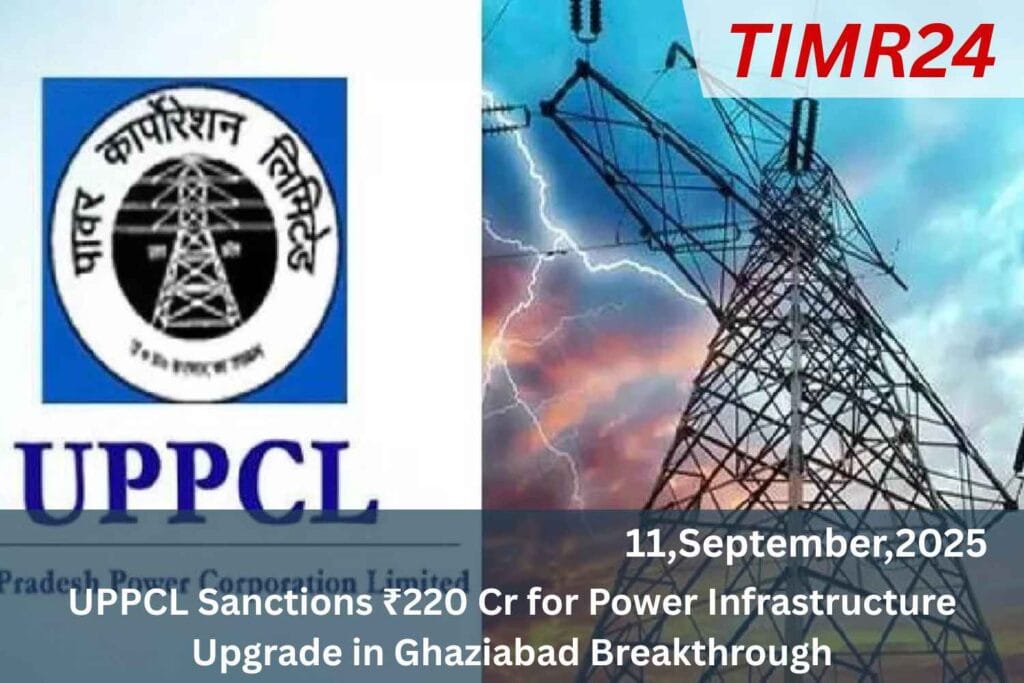
Uttar Pradesh Power Corporation Limited has approved ₹220 crore for FY26 to upgrade power infrastructure and repair 1,369 projects across Ghaziabad, including capacity enhancement, transformer installation, line strengthening, feeder division, low-tension wire replacement, and new lines construction. The Uttar Pradesh Power Corporation Limited (UPPCL) has approved a significant investment of ₹220 crore to overhaul and modernize the power infrastructure in Ghaziabad, one of the fastest-growing urban districts of the National Capital Region (NCR). This announcement has been welcomed as a breakthrough move, considering the growing electricity demand of the city.
Which is home to a rapidly increasing population, large-scale real estate developments, and expanding industries. The decision not only represents a financial commitment but also marks the state’s dedication to ensuring that energy delivery systems are efficient, reliable, and future-ready. Much like the recently launched which aimed to strengthen infrastructure in western Uttar Pradesh, the Ghaziabad power upgrade symbolizes how urban centers in the state are being prioritized in the government’s modernization agenda At its core, the project is driven by the need to address the long-standing problem of electricity shortages, frequent outages, and transmission losses.
That have been a challenge for residents and industries in Ghaziabad. UPPCL’s investment will be channelled into modernizing substations, laying down stronger distribution lines, introducing automation in monitoring systems, and upgrading the grid to handle increasing loads effectively. This is not just a technological improvement but also a strategic initiative that connects with broader state-led reforms like the (NHAI) which highlighted the importance of sustainable infrastructure across sectors. From the perspective of residents, this upgrade is set to improve quality of life significantly. A stable power supply means reduced dependence on diesel.
Deaerators and inverters, fewer disruptions in household activities, and an overall sense of security during peak seasons when power demand usually surges. Ghaziabad has seen exponential growth in housing projects, with areas like Indirapuram, Raj Nagar Extension, and Vasundhara becoming prime residential hubs. For these neighbourhoods, consistent electricity will directly translate into improved liveability. This echoes the benefits witnessed in the where infrastructure readiness was a core factor in enhancing residential value Industries in Ghaziabad stand to gain just as much from this upgrade. The city has long been recognized as an industrial.
Powerhouse, home to manufacturing units, electronics hubs, and small-to-medium enterprises. Inconsistent power supply has historically resulted in higher operational costs, delays, and equipment damage. With UPPCL’s modernization, industries can expect uninterrupted operations, stable voltage, and lower chances of downtime. This positions Ghaziabad as a more attractive investment destination, aligning with Uttar Pradesh’s vision of boosting industrial growth and employment opportunities. In fact, it mirrors the progress achieved by (Ambuja Cements) which showed how strong infrastructure can support industry-specific sustainability.
A key feature of this ₹220 crore upgrade is the planned integration of smart grid technologies. By adopting automation, real-time monitoring, and data-driven decision-making, UPPCL aims to reduce transmission losses while improving system efficiency. Smart grids also allow for better demand management, ensuring that peak loads do not result in blackouts. This move aligns with India’s larger mission of adopting modern energy practices, much like the which was designed to reduce reliance on fossil fuels while enhancing sustainability. In Ghaziabad, smart grids could also pave the way for smoother integration of renewable energy sources in the future, especially as solar adoption grows across residential and commercial spaces.
Beyond technological benefits, the upgrade also holds strong sustainability implications. By strengthening power infrastructure and minimizing losses, Ghaziabad will reduce its carbon footprint indirectly. Efficient systems consume less energy, meaning fewer emissions from backup sources like diesel generators. This supports India’s climate commitments under international frameworks and mirrors steps taken by companies like that have been championing renewable power adoption across the country. The investment also opens doors for future collaborations with private players in renewable energy, positioning Ghaziabad as a forward-looking city that balances growth with sustainability.
The social impact of this investment cannot be ignored either. Reliable electricity supply is deeply connected to public welfare, education, healthcare, and overall safety. Schools and colleges in Ghaziabad will benefit from uninterrupted digital learning, hospitals can operate advanced equipment without the fear of sudden outages, and small businesses can thrive with reduced operational risks. The state government has previously highlighted similar social benefits during the where infrastructure was directly linked to community upliftment Looking at the bigger picture, this investment is not just about upgrading wires and transformers; it’s about creating an ecosystem where economic.
Growth, sustainability, and social welfare meet. Ghaziabad’s transformation will likely encourage other NCR regions and Tier-2 cities in Uttar Pradesh to push for similar modernization. The ripple effect of this could extend across the state, much like how influenced cultural tourism while also strengthening local infrastructure The timeline for this project is expected to be phased, with certain upgrades being rolled out in high-demand zones first. Critical areas with frequent outages will be prioritized, followed by expansion to residential colonies and industrial clusters. By adopting a phased approach, UPPCL ensures that the most pressing concerns are addressed immediately.
While building capacity for future demand. The ₹220 crore allocation has been designed to cover both short-term fixes and long-term sustainability. This model is consistent with the approach taken during, where staged development ensured maximum impact with minimal disruption the sanctioning of ₹220 crore by UPPCL for power infrastructure upgrade in Ghaziabad is a breakthrough that goes far beyond immediate improvements in electricity supply. It is a blueprint for how Indian cities can prepare for rapid urbanization while aligning with global sustainability goals. By combining smart technologies, industrial benefits, residential comfort, and environmental consciousness.
Ghaziabad’s transformation stands as a model for other districts in the state and across the country. As urban India continues to expand, projects like these reinforce the belief that strong infrastructure is the backbone of progress. Just as earlier initiatives like demonstrated how state-level investments can solve systemic challenges, UPPCL’s bold move in Ghaziabad highlights the power of forward-thinking strategies in driving holistic growth.
Q1. Why has UPPCL sanctioned ₹220 crore for Ghaziabad’s power upgrade?
To modernize infrastructure, improve distribution, and reduce power cuts.
Q2. How will this project benefit Ghaziabad residents?
By ensuring stable electricity, fewer outages, and better load management.
Q3. Will industries in Ghaziabad benefit from the upgrade?
Yes, reliable power will boost industrial efficiency and attract new investments.
Q4. What kind of technology will UPPCL adopt in this project?
Advanced substations, automated monitoring systems, and smart grids.
Q5. When will the project be completed?
UPPCL has set phased timelines, with significant improvements expected within 2 years.