

















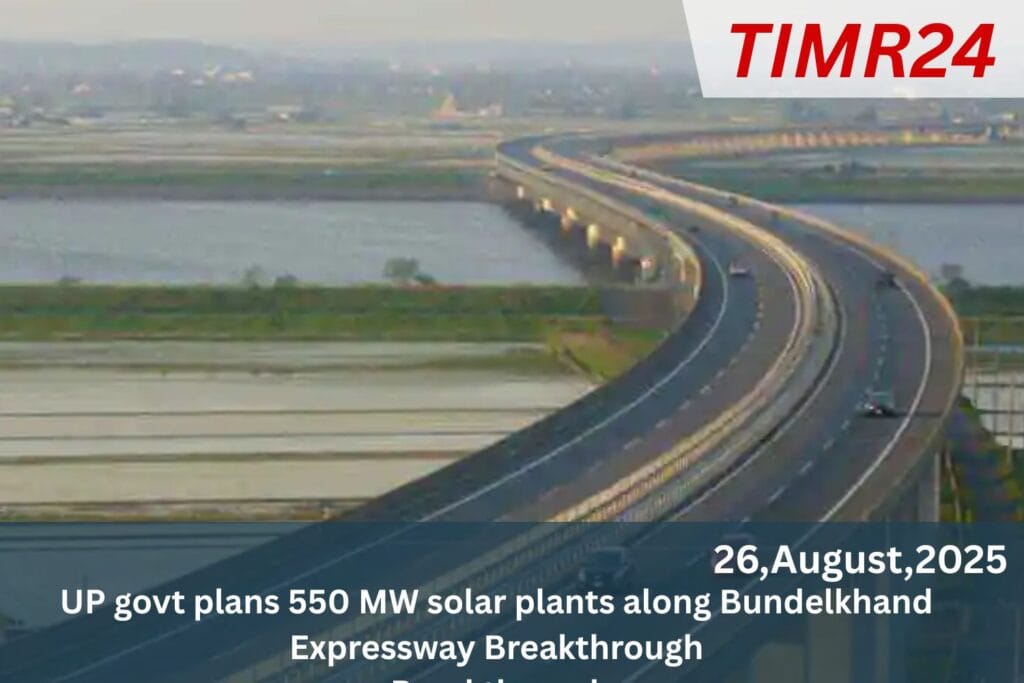
Uttar Pradesh government plans to establish 550 MW solar plants along Bundelkhand Expressway, attracting interest from companies like Tusco, Torrent Power, and Avaada Energy. The initiative aims to provide sustainable energy, reduce emissions, create local jobs, and support economic growth. The Uttar Pradesh government has taken a major step toward clean energy transition by announcing the installation of 550 MW solar plants along the Bundelkhand Expressway, a move that not only accelerates renewable energy adoption but also strengthens the socio-economic fabric of the Bundelkhand region The project is expected to provide reliable electricity, reduce.
Dependence on conventional fuels, and create employment opportunities, while simultaneously transforming an underdeveloped region into a hub of sustainable growth Over the past few years, Uttar Pradesh has made notable progress in renewable energy adoption. Under the UP New Solar Policy 2022, the state has invited investments in large-scale solar projects and rooftop solutions, aiming to increase its installed renewable capacity. The Bundelkhand Expressway project, with a 550 MW solar capacity, is set to become a landmark initiative that complements India’s target of 500 GW renewable energy by 2030, as outlined by the (Renewable Energy). By strategically utilizing land along the expressway, the government ensures that infrastructure development and clean energy production progress hand in hand.
For readers interested in regional energy initiatives, our detailed coverage provides more insights into the state’s green roadmap. The Bundelkhand Expressway, which was inaugurated to improve connectivity in central and southern districts of UP, is now being integrated with clean energy infrastructure. Solar plants built alongside the highway will not only utilize vacant land efficiently but also contribute electricity to nearby towns and industries. This innovative model blends transportation growth with renewable energy adoption, reducing transmission losses and making the project more cost-effective. The integration also signals a new era where expressways and highways serve as both transport corridors and energy producers. To explore how expressways have shaped economic growth in UP, check out our analysis on.
Driving Employment and Investments
One of the most significant outcomes of the solar project will be the creation of employment opportunities. Thousands of skilled and unskilled workers will find jobs during construction, operations, and maintenance phases. Additionally, the project is expected to attract domestic and foreign investors keen on expanding their solar footprint in India. According the renewable energy sector has already drawn billions in investment, and Bundelkhand’s project will add momentum to this trend. Beyond direct jobs, indirect opportunities in allied sectors such as logistics, raw materials, and services will also expand, uplifting the local economy and reducing migration from Bundelkhand to urban centers.
The ecological impact of this project is equally remarkable. By adding 550 MW of clean energy, the state will be able to offset millions of tonnes of carbon dioxide over the project’s lifetime. This aligns with India’s climate commitments made at, where the country pledged to achieve net zero emissions by 2070. Alongside reducing pollution, the availability of clean electricity will help schools, healthcare facilities, and small industries in Bundelkhand function more efficiently. Reliable power will improve educational outcomes, enhance medical facilities, and support entrepreneurship, thereby raising the overall standard of living. To understand the broader impact of climate goals, you can explore our article on (India’s)
Beyond urban and industrial benefits, this solar initiative is also a lifeline for rural Bundelkhand. Farmers will particularly benefit through programs like the PM-KUSUM scheme, which promotes the use of solar-powered irrigation pumps. With energy costs coming down, agricultural productivity can improve, water resources can be used more efficiently, and farming incomes can stabilize. This makes the project not only an energy initiative but also a rural development tool. For more details on how solar schemes are changing agriculture, refer to the official KUSUM by MNRE.
The decision to establish 550 MW solar plants along the Bundelkhand Expressway demonstrates how Uttar Pradesh is merging infrastructure growth with renewable energy. It represents a future-forward model where highways are not just roads but also clean power corridors. With benefits spanning energy security, employment, environment, and rural empowerment, this project is bound to create long-term transformation in Bundelkhand. By lighting up the expressway with solar power, the government is also lighting up the lives of millions in the region, setting an example for other states to follow.
Q1 What is the capacity of solar plants planned along Bundelkhand Expressway?
The UP government plans to install 550 MW of solar power projects along the expressway.
Q2 How will the solar plants benefit Bundelkhand?
They will generate clean energy, create jobs, attract investment, and support sustainable development.
Q3 Which scheme supports this project?
The initiative aligns with the PM-KUSUM scheme and India’s renewable energy roadmap.
Q4 Will the project reduce pollution levels in the region?
Yes, it will significantly cut carbon emissions by replacing fossil fuel-based power.
Q5 When will the solar project start?
The project timeline will be announced after approvals and private participation agreements.