




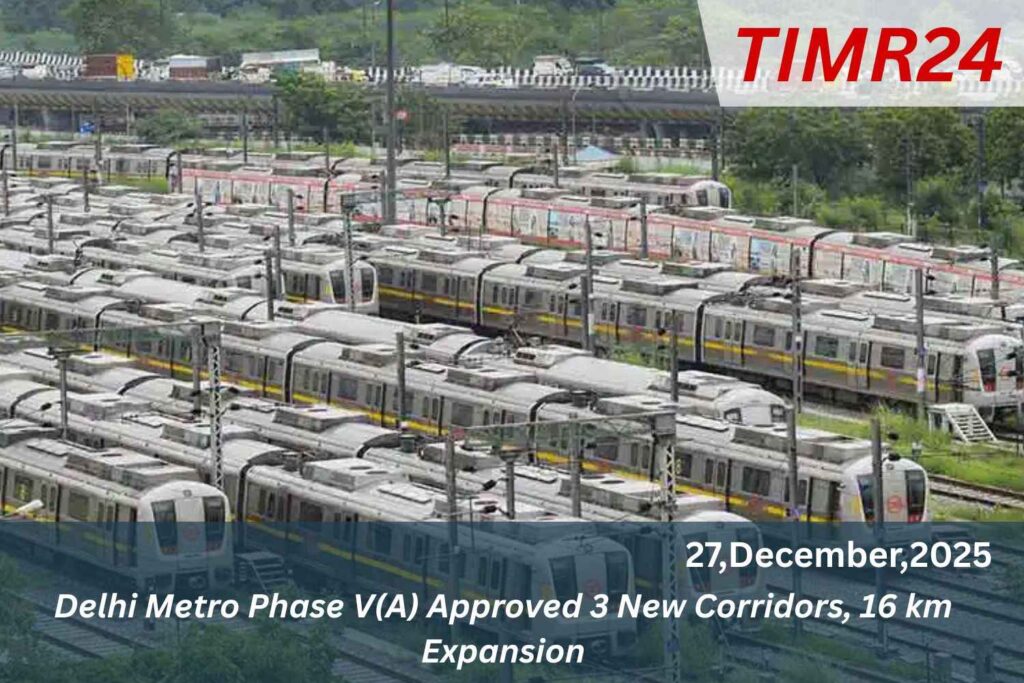
The Union Cabinet has approved the addition of 16 km to the Delhi Metro network under Phase V(A), with a budget of Rs 12,014 crore, funded by the Central and Delhi governments along with international lenders. The new corridors are R K Ashram Marg–Indraprastha, Aerocity IGD Airport Terminal-1, and Tughlakabad–Kalindi Kunj, enhancing connectivity in central, south, west, and north Delhi. The R K Ashram Marg–Indraprastha corridor will facilitate access to key locations, serving approximately 60,000 office-goers and two lakh daily visitors. The Aerocity–IGD Terminal-1 and Tughlakabad–Kalindi Kunj corridors will improve access to the domestic airport and last-mile connectivity for areas like Saket and Chhatarpur.
Strategic Corridors Significantly
The Union Cabinet’s approval of Delhi Metro Phase V(A) marks another decisive chapter in India’s urban infrastructure journey, reinforcing the national capital’s position as a leader in mass rapid transit development. With an estimated investment of ₹12,014 crore, the newly sanctioned phase will add 16 kilometres of metro network across three strategic corridors, significantly enhancing last-mile connectivity, reducing congestion, and supporting sustainable urban growth. This expansion aligns closely with India’s broader vision for climate-resilient infrastructure and smart urbanisation, building upon the success of earlier metro phases that transformed commuting patterns across.
Delhi and the National Capital Region The newly approved Phase V(A) has been carefully planned to address long-standing transport bottlenecks in rapidly urbanising pockets of Delhi. As population density increases and peripheral zones witness accelerated real estate and commercial development, the demand for efficient public transport has grown exponentially. The new corridors are designed to integrate seamlessly with existing metro lines, bus networks, and multimodal transit hubs, ensuring commuters benefit from smoother interchanges and shorter travel times. According to official disclosures via the Press Information Bureau, the project reflects extensive coordination between central.
Allied Sectors Beyond Direct Job
State authorities to ensure timely execution and financial sustainability From an economic perspective, the approval of Delhi Metro Phase V(A) is expected to generate a powerful multiplier effect. Large-scale infrastructure investments of this magnitude stimulate employment across engineering, construction, rolling stock manufacturing, and allied sectors. Beyond direct job creation, improved metro connectivity tends to unlock land value appreciation, catalyse transit-oriented development, and attract private investment into commercial and residential projects. Similar trends were observed during earlier phases of Delhi Metro expansion, which reshaped.
Corridors such as Dwarka, Noida, and South Delhi. Readers interested in related infrastructure-led growth A defining feature of Phase V(A) is its strong emphasis on sustainability and environmental stewardship. Metro rail systems are among the most energy-efficient modes of urban transport, offering a viable alternative to private vehicles that contribute heavily to air pollution and carbon emissions. The new corridors will incorporate energy-efficient rolling stock, regenerative braking systems, and advanced signalling technologies, reinforcing Delhi Metro Rail Corporation’s reputation as a global benchmark in green mobility. As outlined on the official Delhi Metro Rail Corporation.
While Earlier Phases Focused
The organisation continues to pursue carbon neutrality through solar energy adoption and resource-efficient construction practices The strategic importance of the three new corridors lies in their ability to bridge existing transit gaps. While earlier phases focused on core city connectivity, Phase V(A) prioritises emerging residential clusters, institutional zones, and mixed-use developments that currently rely heavily on road transport. This approach ensures that metro infrastructure keeps pace with Delhi’s evolving urban form rather than reacting to congestion after it becomes unmanageable. Such forward-looking planning mirrors best practices seen in global.
Cities like Singapore and Seoul, where transit infrastructure guides sustainable urban expansion rather than merely responding to it Financing and governance also play a crucial role in the success of large metro projects. The ₹12,014-crore investment will be structured through a combination of central and state funding, along with institutional financing where required. Strong project governance mechanisms, refined over decades of Delhi Metro implementation experience, are expected to minimise cost overruns and delays. The Ministry of Housing and Urban Affairs has consistently emphasised the importance of disciplined project execution, a stance further on.
Reliable Public Transport
Its official portal at mohua.gov.in. This institutional maturity gives Phase V(A) a solid foundation compared to metro projects in many other global cities Beyond mobility, the social impact of Delhi Metro Phase V(A) is equally significant. Reliable public transport enhances access to education, healthcare, and employment, particularly for lower-income groups who depend heavily on affordable commuting options. By reducing travel time and improving safety, metro expansion directly contributes to improved quality of life. Women, senior citizens, and students are among the key beneficiaries, as metro systems offer predictable schedules, well-lit stations, and integrated security measures.
Technological integration remains another cornerstone of the new phase. Advanced signalling systems, communication-based train control, and real-time passenger information platforms will ensure higher frequency and operational efficiency. These systems are critical in managing increasing ridership without compromising safety or comfort. The expansion will also support (India) digital ticketing and interoperability with other mobility platforms, aligning with India’s broader push towards smart city ecosystems. Such developments resonate with the national digital infrastructure narrative shaping sectors far beyond transportation.
Continued Political Commitment
Delhi Metro Phase V(A) is more than just an addition of kilometres and corridors; it represents a strategic investment in the future of urban living. As Indian cities grapple with congestion, pollution, and spatial inequality, metro rail systems offer a proven pathway towards balanced and sustainable growth. The Cabinet’s approval signals continued political commitment to public (India) transport-led development, reinforcing Delhi’s role as a model for other metropolitan regions across the country. With execution now set in motion, Phase V(A) is poised to redefine daily commuting experiences for millions while strengthening the capital’s economic and environmental resilience.
Q1. What is Delhi Metro Phase V(A)?
Delhi Metro Phase V(A) is a newly approved expansion phase adding 16 km of metro network across three corridors in Delhi.
Q2. What is the total cost of Phase V(A)?
The project has an approved outlay of ₹12,014 crore.
Q3. How many new corridors are included?
Three new metro corridors have been sanctioned under Phase V(A).
Q4. Who approved the Delhi Metro Phase V(A) project?
The Union Cabinet of India approved the expansion.
Q5. Why is Phase V(A) important for Delhi?
It improves connectivity, reduces congestion, promotes sustainable transport, and supports long-term urban growth.