
















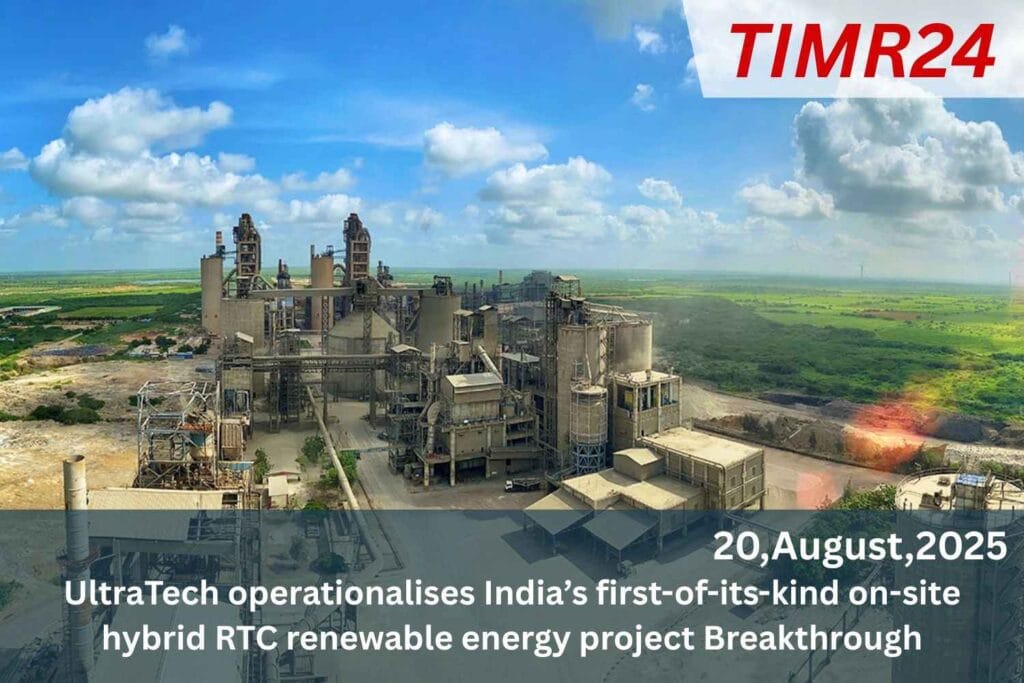
India’s largest cement company, UltraTech Cement Limited, has implemented a 7.5 MW RTC hybrid renewable energy project at its Sewagram Cement Works in Gujarat. The project, in collaboration with clean energy solutions company Gentari, uses solar, wind, and battery storage to provide uninterrupted energy during the cement manufacturing process. This marks the country’s first industrial power consumption and demonstrates advanced system integration for emissions reduction and energy cost optimization. UltraTech aims to increase green energy share in its power mix to 65% by 2027 and 85% by 2030. UltraTech Cement has once again taken a leadership position in the sustainability journey of Indian industry by operationalising
The nation’s first-of-its-kind on-site hybrid Round-the-Clock (RTC) renewable energy project, a landmark that not only redefines clean power adoption but also signals a paradigm shift for energy-intensive sectors. This hybrid system uniquely integrates both solar and wind power within the plant premises, thereby ensuring consistent availability of green energy while reducing dependency on conventional (Bullet Train) thermal sources. Unlike traditional renewable setups that often face intermittency challenges, the RTC model guarantees reliability by complementing solar generation during the day with wind energy that peaks in the evenings and night, making it a self-sustaining mechanism
That addresses one of the biggest bottlenecks in the clean energy ecosystem. UltraTech’s project is significant because the cement sector has always been viewed as one of the hardest-to-abate industries, and such initiatives highlight a roadmap towards net-zero ambitions in line with India’s renewable energy goals and commitments under the Paris Agreement. By adopting this breakthrough solution, UltraTech is not just decarbonising its own operations but also setting a strong precedent for other heavy industries to follow, thereby contributing to the larger vision of a greener economy. The project stands out because it goes beyond merely installing renewable capacity; it is strategically designed as an on-site model, eliminating transmission losses and ensuring maximum
Utilisation of generated power. In comparison to off-site power purchase agreements that are susceptible to grid congestion or supply fluctuations, on-site RTC systems guarantee efficiency and control, empowering UltraTech to stabilise energy costs while lowering its carbon footprint significantly. This integration of hybrid technologies comes at a time when India’s energy landscape is rapidly evolving, with ambitious targets of 500 GW renewable capacity by 2030, and demonstrates how industrial players can align business growth with climate-conscious strategies. More importantly It paves the way for innovative collaborations between technology providers, policy makers, and manufacturing
Giants to accelerate adoption of hybrid power across sectors such as steel, aluminium, and data centres that face similar challenges of round-the-clock demand. Readers interested in learning about other transformative initiatives in the infrastructure and manufacturing space can also explore (NHAI’s) which showcase how different industries are adopting technology-driven sustainability measures. Another striking aspect of UltraTech’s initiative is its integration with digital monitoring and smart energy management tools. The hybrid RTC plant is designed to leverage advanced Analytics, allowing the company to track performance in real time, predict maintenance requirements, and optimise
Energy distribution across operations. This reflects the larger trend of digitalisation in the Indian industrial landscape, where companies are merging sustainability with Industry 4.0 practices for long-term competitiveness. The cement giant’s decision to invest in such innovative solutions also underscores the importance of private sector leadership in India’s transition to renewable energy. While government-backed projects such and through first mile connectivity showcase state-driven progress. UltraTech’s RTC project demonstrates how corporates can accelerate change by investing in future-ready technologies. This synergy between private innovation and public infrastructure is essential
For creating a sustainable industrial ecosystem where renewable energy adoption becomes mainstream rather than niche. Furthermore, UltraTech’s hybrid project will have ripple effects on the local economy and environment. By harnessing clean power on-site, the company not only reduces air pollution and carbon emissions but also minimises stress on regional power distribution networks, which often rely on fossil fuel sources The project creates opportunities for renewable technology providers, engineering services, and local employment, thereby generating socio-economic benefits beyond the factory gates. In addition, the RTC framework supports UltraTech’s broader
ESG commitments, strengthening its appeal to investors and stakeholders who are increasingly prioritising climate resilience and sustainable business models. For the Indian cement industry at large, which contributes a significant share of global carbon emissions, this breakthrough is a testimony that innovation and responsibility can co-exist without compromising profitability or growth Those keen on tracking similar green energy milestones can look at or which represent how large-scale projects across India and globally are embedding sustainability at their core UltraTech’s operationalisation of India’s first on-site hybrid RTC renewable energy project is far more than an
Industrial upgrade—it is a symbol of transformation where reliability, sustainability, and innovation converge to create long-term value for business and society. By demonstrating that round-the-clock renewable energy is not only possible but practical, UltraTech has laid a foundation for replicable models across multiple sectors Ensuring that India’s journey to a low-carbon future is not just aspirational but achievable. As industries search for pathways to balance energy security, cost competitiveness, and environmental responsibility, this hybrid RTC solution provides a blueprint that others can adapt and expand upon The project reinforces the message that India’s clean energy.
Q1. What is UltraTech’s hybrid RTC renewable energy project?
It is India’s first on-site system combining solar and wind to supply 24×7 renewable power.
Q2. Why is this project a breakthrough?
It ensures round-the-clock clean energy, solving the issue of intermittency in renewables.
Q3. How does the hybrid RTC model work?
Solar generates power during the day, while wind complements supply at night, ensuring reliability.
Q4. What are the benefits for UltraTech?
It reduces carbon emissions, stabilises energy costs, and aligns with net-zero targets.
Q5. How will this project impact the industry?
It sets a benchmark for heavy industries to adopt reliable on-site renewable energy solutions.