













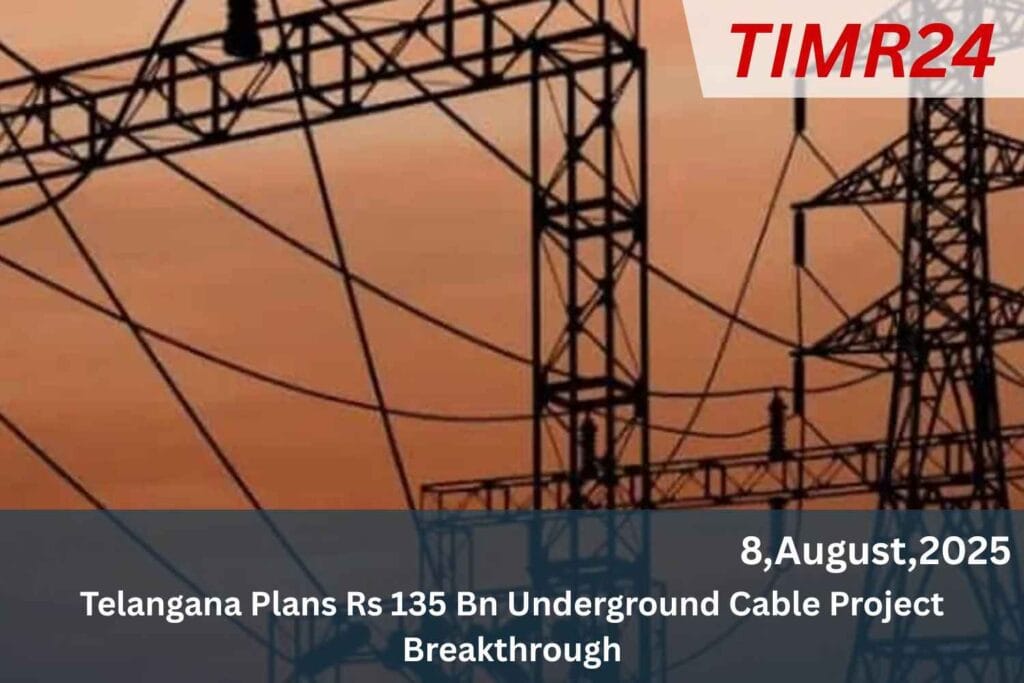
The Telangana government has announced a Rs 135 billion initiative to replace 25,000 km of overhead power lines with underground cables across the Core Urban Region, including Greater Hyderabad and Bharat Future City. The project aims to modernize the city’s electrical infrastructure, reduce outages, and lower maintenance costs. The initiative is expected to save approximately Rs 5 billion annually by curbing power losses, theft, and upkeep costs. Successful implementation will require tight coordination with civic utilities and traffic authorities. The Telangana government has unveiled an ambitious ₹135 billion underground cable project aimed at transforming the state’s power distribution system. This initiative will replace overhead electricity lines with underground cabling in urban and semi-urban areas, significantly improving safety, aesthetics, and reliability.
Project Scope and Coverage
The project will be executed in phases, prioritising major cities such as Hyderabad, Warangal, and Karimnagar, before expanding to other urban and semi-urban regions. According to officials, the Telangana State Southern Power Distribution Company Limited (TSSPDCL) and Northern Power Distribution Company Limited (TSNPDCL) will oversee the execution. The underground cabling will not only enhance the appearance of city landscapes but also reduce technical losses and minimise the impact of adverse weather conditions. This move aligns with Telangana’s broader vision of modernising infrastructure while ensuring uninterrupted power supply to its citizens. (Ministry of Power)
Key Benefits of the Underground Cable System
Switching to underground cabling offers multiple advantages:
- Improved Safety: Reduces risk of electrocution and fire hazards from snapped overhead wires.
- Higher Reliability: Minimises power outages caused by storms, heavy winds, or tree falls.
- Urban Aesthetics: Eliminates messy overhead lines, improving the visual appeal of cities.
- Lower Maintenance Costs: Less frequent repairs compared to traditional overhead lines.
Funding and Implementation Strategy
The estimated ₹135 billion cost will be funded through a mix of state government allocations, central government grants, and loans from financial institutions. The project will be rolled out over the next five years, with the first phase focusing on high-density urban areas. Officials have confirmed that advanced trenching and cable-laying technologies will be used to reduce disruption to daily life during installation. The underground network will use XLPE (Cross-Linked Polyethylene) insulated cables, which are known for their durability, heat resistance, and ability to handle higher loads. Additionally, a GIS-based monitoring system will be integrated for real-time fault detection and faster restoration of power in case of disruptions.
Challenges and Risk Mitigation
While underground cabling offers long-term benefits, it involves significant initial investment and complex planning. Potential challenges include navigating existing underground utilities, high excavation costs, and coordination among multiple agencies. Telangana’s power department has assured that a detailed feasibility study and trial runs will help address these challenges efficiently. (Infrastructure Projects) Telangana’s ₹135 billion underground cable project marks a significant milestone in the state’s journey towards modern, safe, and efficient power infrastructure. With strategic planning, advanced technology, and phased execution, the initiative is set to provide long-lasting benefits to residents while setting a benchmark for other regions in India.
In a landmark step towards modernising its power network, the Telangana government has rolled out a ₹135 billion underground electricity cable project. The initiative is designed to replace traditional overhead lines with advanced underground systems across key cities and towns. Officials say the move will not only improve power supply reliability but also enhance the visual appeal of urban spaces. The project will start with Hyderabad, Warangal, and Karimnagar, followed by expansions into other districts. Priority will be given to zones with high population density, frequent outage issues, and critical infrastructure. Power utilities TSSPDCL and TSNPDCL will supervise the rollout, ensuring that existing connections are seamlessly transitioned to the underground system.
Q1. What is the Telangana ₹135 billion underground cable project?
It’s a state initiative to replace overhead electricity lines with underground cables for safer, more reliable, and visually cleaner power infrastructure.
Q2. Which areas will be covered first?
The first phase will focus on Hyderabad, Warangal, and Karimnagar, followed by other urban and semi-urban regions.
Q3. What are the key benefits of the project?
Improved safety, fewer outages, better city aesthetics, and lower long-term maintenance costs.
Q4. How will the project be funded?
Through state budget allocations, central government support, and institutional loans.
Q5. When is the project expected to be completed?
It will be implemented in phases over the next five years.