

















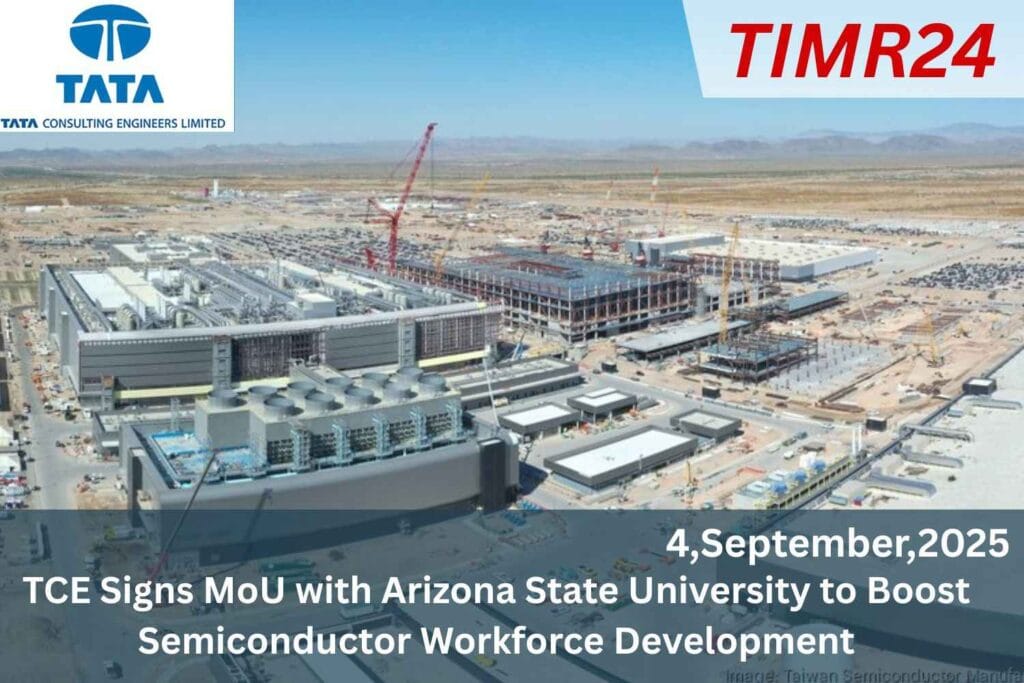
Tata Consulting Engineers Limited (TCE) has signed a Memorandum of Understanding (MoU) with Arizona State University (ASU), USA, to collaborate on critical and emerging technologies, starting with semiconductor workforce development. The agreement, signed in New Delhi, marks a significant step towards strengthening India’s semiconductor ecosystem through global partnerships in education, training, and applied research. The first initiative under this collaboration will be a joint learning and development programme by ASU’s Ira A. Fulton Schools of Engineering and TCE. The programme will offer technical professionals a comprehensive introduction to semiconductors.
Manufacturing processes, plant construction, and controlled environments. The initiative will focus on semiconductor fabrication, cleanroom systems, contamination control, and sub-fab infrastructure, preparing engineers and professionals for future semiconductor facility development in India. Tata Consulting Engineers (TCE) has entered into a groundbreaking partnership with Arizona State University (ASU) through a Memorandum of Understanding (MoU) aimed at strengthening semiconductor workforce development. This initiative is not just an academic collaboration; it represents a strategic alignment between industry and education to prepare the next generation of semiconductor engineers, researchers, and innovators.
With semiconductors forming the backbone of modern technology, this MoU comes at a crucial time when India is making significant investments to position itself as a global leader in chip manufacturing, design, and innovation. The world’s dependence on semiconductors has grown exponentially in the last decade. From smartphones and laptops to electric vehicles, medical devices, defense technologies, and artificial intelligence, semiconductors power almost every critical aspect of digital transformation. India, through its (India Programme) has committed to strengthening its domestic semiconductor industry, reducing reliance on imports, and building capacity for global competitiveness.
Arizona State University’s Academic Leadership
However, one of the biggest hurdles in this journey has been the shortage of skilled professionals who can meet the demands of this rapidly evolving industry. This is where the TCE-ASU MoU becomes highly significant, as it directly addresses workforce training and development. Arizona State University is recognized as one of the most innovative universities in the United States. Its programs in engineering, technology, and applied sciences are globally respected. By collaborating with ASU, TCE gains access to world-class academic frameworks, research infrastructure, and training methodologies. Students and professionals in India will benefit from international exposure.
Advanced semiconductor-focused courses, and opportunities for joint research. The university’s emphasis on hands-on, experiential learning will be invaluable for professionals who need to be industry-ready in areas such as chip design, fabrication, and semiconductor applications. Interested readers can explore more about the university’s innovation-driven approach on. Tata Consulting Engineers has decades of expertise in delivering large-scale engineering projects across industries. Its deep understanding of industrial applications, combined with a focus on emerging technologies, positions it as a key driver of workforce development in the semiconductor sector.
Workforce Development and Skill Enhancement
Through this MoU, TCE is creating a bridge between academia and real-world industry requirements, ensuring that training and research are aligned with global market needs. This partnership is designed to produce professionals who not only have theoretical knowledge but also practical expertise in semiconductor engineering. To learn more about TCE’s ongoing initiatives in technology, The core focus of this collaboration is workforce development. The semiconductor industry requires a wide range of skills, from design and testing to manufacturing and quality assurance. The MoU emphasizes training programs, internships, faculty development initiatives, and research collaborations that will enhance.
The employability of engineers and researchers. India’s ambition to become a hub for semiconductor production cannot be realized without a steady pipeline of skilled professionals. This initiative ensures that workforce development is not an afterthought but a central pillar of India’s semiconductor mission For students, the collaboration will open doors to advanced modules in VLSI design, photonics, nanotechnology, and artificial intelligence applications in semiconductors. For mid-career professionals, it will provide reskilling opportunities that keep them aligned with global industry standards. This ensures that India’s semiconductor ecosystem remains dynamic, adaptable, and globally competitive.
Impact on India’s Semiconductor Mission
India’s semiconductor market is projected to reach $64 billion by 2026, driven by increasing demand for electronics and digital infrastructure. The government has already announced incentives under the Production-Linked Incentive (PLI) scheme to attract investment in chip manufacturing. However, without a skilled workforce, these investments risk falling short of their potential. The TCE-ASU MoU directly supports the (ASU) and missions by equipping engineers and researchers with advanced skills that contribute to the country’s long-term self-reliance in critical technologies Furthermore, the collaboration is in sync with the US-India Initiative on Critical and Emerging Technology (ice).
Which emphasizes joint research and talent development in sectors like semiconductors, AI, and defense technologies. By strengthening academic and industry partnerships, India is positioning itself not only as a consumer of semiconductors but also as a global hub for innovation and manufacturing. Beyond workforce training, the MoU will facilitate collaborative research in cutting-edge areas such as advanced chip design, photonics, and AI-driven semiconductor applications. Joint research labs, innovation centers, and student exchange programs will ensure that knowledge flows freely across borders, driving innovation that benefits both.
Research, Innovation, and Knowledge Exchange
India and the global technology ecosystem. Faculty exchange programs between TCE and ASU will also enhance academic collaboration, ensuring that students are mentored by world-class experts This focus on research is critical, as semiconductors are not just about manufacturing; they are about innovation at every stage of the value chain. From developing energy-efficient chips to designing processors that power AI algorithms, the opportunities for innovation are vast. By creating collaborative platforms, TCE and ASU are ensuring that India’s engineers play a central role in the global semiconductor innovation ecosystem.
The signing of the MoU is only the beginning of a long journey. Over the next few years, the collaboration is expected to expand into multiple domains, including curriculum development, setting up specialized semiconductor training centers, and fostering entrepreneurship among students. The vision is to create a workforce that is not only employable but also capable of driving innovation, building startups, and contributing to global technology supply chains For India, this partnership represents a significant step toward achieving self-reliance in semiconductors. For TCE, it reinforces its leadership as an enabler of technological advancement. For ASU.
It expands its global footprint while contributing to an international cause: preparing skilled professionals to meet the world’s growing semiconductor needs. The MoU between Tata Consulting Engineers and Arizona State University is a landmark collaboration that directly addresses one of the most pressing challenges in the semiconductor industry workforce development. By combining the academic strength of ASU with the industry expertise of TCE, the partnership promises to create a new generation of engineers and researchers who are globally competitive and innovation-driven. It aligns with India’s national missions, supports global technology.
Q1 What is the purpose of the MoU between TCE and Arizona State University?
The MoU aims to strengthen semiconductor workforce development by combining academic research, industry expertise, and training programs.
Q2 How will this partnership benefit students and professionals?
It will provide advanced training, hands-on exposure, internships, and skill-building opportunities in semiconductor design and manufacturing.
Q3 Why is semiconductor workforce development important for India?
India is aiming to become a global semiconductor hub, and workforce development ensures skilled engineers and researchers for industry growth.
Q4 What role does Arizona State University play in this collaboration?
ASU brings global academic excellence, research infrastructure, and curriculum expertise in semiconductor technology.
Q5 How does this MoU support India’s semiconductor mission?
It aligns with India’s strategic push to reduce dependency on imports, build domestic capacity, and support government initiatives like “Make in India” and “Digital India.”