


















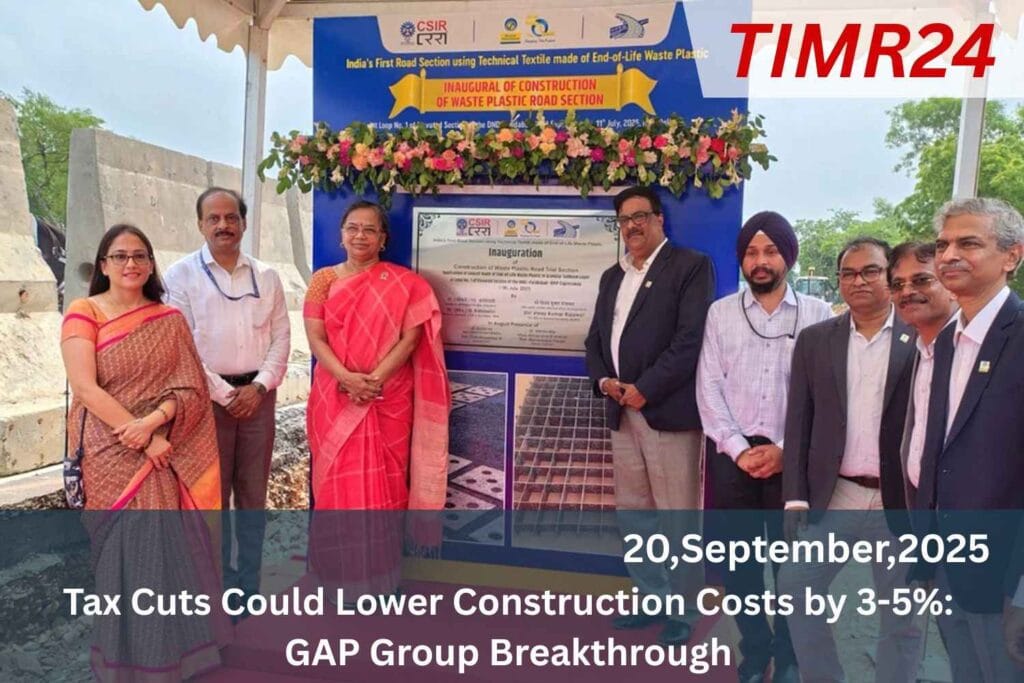
GAP Group, a leading Infrastructure Developer in western India, has praised the recent Goods and Services Tax (GST) reforms as a “transformational moment” for the country’s real estate and industrial sectors. The GST Council’s decision to simplify the GST structure and reduce tax rates on key construction and industrial raw materials is seen as the most significant change since the introduction of the GST framework in 2017. The tax cuts could lower construction costs by 3-5% and overall costs, bringing immediate relief to developers and improving affordability for homebuyers. The reforms are expected to give a fresh push to the affordable housing segment, making projects.
More viable and boosting demand. The real estate sector is expected to play a pivotal role in India’s emergence as a developed nation and becoming a $30 trillion economy. The GAP Group has released an important report suggesting that tax cuts could lower construction costs in India by nearly 3-5%, creating a ripple effect across infrastructure, housing, and the broader economy. This projection has drawn significant attention because construction is one of the most cost-intensive sectors and directly influences real estate pricing, infrastructure delivery timelines, and employment creation. Reduced costs through tax reforms may unlock new opportunities for builders, homebuyers.
And investors alike, while also supporting government-led initiatives aimed at making India a global infrastructure leader The construction sector in India is highly sensitive to input costs, with raw materials like cement, steel, sand, and machinery accounting for a major share of project expenses. Taxes levied on these materials add an additional burden on developers, often leading to inflated project costs. According to the GAP Group, a well-structured tax cut would not only ease these burdens but also allow companies to allocate savings toward faster project delivery, better quality control, and more sustainable practices The potential savings of 3-5% may not sound monumental at first.
Affordable Housing Relief for Builders and Buyers
Glance, but in projects worth hundreds of crores, these reductions can significantly impact financial feasibility. For example, the (Railway Station Redevelopment) program, which involves massive investment in modernizing transport hubs, would benefit from cost efficiencies, ensuring that projects are executed within tighter budgets while maintaining world-class standards. One of the most significant advantages of reduced construction costs is its potential impact on the housing market, particularly in the affordable segment. For years, India’s housing sector has struggled to balance the rising demand for affordable homes with the high cost of construction.
Developers often find it challenging to maintain profitability while delivering low-cost housing. With tax cuts, builders would be able to reduce costs and pass on some of the benefits to buyers, making homes more accessible to middle-class families This move is closely aligned with the government’s vision under Pradhan Mantri Awas Yojana (PMAY), which aims to achieve “Housing for All.” By reducing financial strain on both developers and homebuyers, tax reforms could accelerate progress toward this ambitious goal. The middle-class population, especially first-time homebuyers, would gain more purchasing power, thereby fueling demand in the housing market and improving the overall real estate cycle.
Infrastructure Growth and National Development
Beyond housing, tax cuts will also play a transformative role in large-scale infrastructure projects. India’s ambitions under programs like Bharatmala Pariyojana, Sagarmala, and GatiShakti require massive investments in roads, ports, and logistics networks. A 3-5% reduction in costs could mean billions saved at the national level, allowing the government to expand the scope of its projects or reinvest the savings into new ones This would also improve efficiency in mega projects like the initiatives across cities. With metro rail being a backbone for urban mobility, cost-efficient construction ensures faster connectivity, reduced congestion, and better living standards for urban.
Populations Similarly which span across railways, highways, airports, and smart cities, would gain momentum with these cost savings, reinforcing India’s vision to become a $5 trillion economy The real estate market has long been influenced by the high cost of construction and compliance. By reducing tax burdens, the sector may witness renewed confidence among developers and investors. Commercial projects, luxury housing, and mixed-use developments would all benefit from cost savings that improve profit margins. Developers could also offer more competitive pricing, thereby attracting a larger pool of buyers and tenants Foreign investors, who often compare.
Employment and Economic Growth
Construction and compliance costs across global markets, would find India more attractive under a tax-friendly regime. Increased foreign direct investment (FDI) in construction and infrastructure would not only bring in much-needed capital but also foster technology transfer, introducing modern construction methods that reduce timelines and improve sustainability Another important dimension of tax cuts is their potential impact on employment. The construction sector is one of the largest employers in India, providing jobs to both skilled and unskilled workers. Lower costs would encourage developers to take on more projects, thereby increasing demand for labor.
This creates a multiplier effect, as more employment leads to higher household incomes, which in turn boosts consumption and supports economic growth This impact resonates well with India’s broader development goals, as infrastructure-led growth has consistently proven to be one of the most effective ways to generate jobs and improve social welfare. By reducing costs, tax reforms ensure that more projects are initiated and completed, directly benefiting millions of workers and indirectly supporting related industries like manufacturing, logistics, and services.
Strengthening Global Competitiveness
As India positions itself as a global hub for infrastructure and construction, cost competitiveness becomes crucial. Countries vying for foreign investment often emphasize lower operating costs and investor-friendly policies. By reducing construction costs through tax cuts, India can present itself as a more attractive destination for global firms looking to establish long-term operations In the race to modernize, India’s ability to deliver large-scale projects at globally competitive prices could place it ahead of emerging economies. International collaborations, joint ventures, and cross-border financing would become more feasible under this environment, further solidifying India’s standing as a preferred global investment destination.
The GAP Group’s findings underscore the importance of tax reforms in driving construction sector growth. While a 3-5% reduction in costs may appear modest, its cumulative effect across projects of all scales could redefine the way infrastructure and real estate are developed in India. For the government, it provides an opportunity to align fiscal policy with developmental priorities, while for developers and investors, it opens up new avenues of growth and profitability The broader vision of making India a leader in global infrastructure will require not just tax reforms but also complementary measures like streamlined approvals, transparent land acquisition processes, and sustainable.
Building practices. Yet, the tax cut proposal stands out as a practical and impactful step that could deliver immediate benefits Tax cuts reducing construction costs by 3-5% could become a turning point for India’s development journey. By easing financial pressures on builders, (Railway Redevelopment) boosting affordability for buyers, and strengthening investor confidence, such reforms create a win-win scenario for all stakeholders. Whether it is supporting affordable housing under PMAY, accelerating urban mobility through Metro Expansion, or pushing forward national connectivity under PM Modi’s Infrastructure Initiatives, the benefits of lower costs will ripple through the economy.
Q1. How will tax cuts reduce construction costs by 3-5%?
By lowering tax liabilities on raw materials and services, developers can save significantly on overall expenses.
Q2. Which sectors will benefit the most from tax cuts in construction?
Real estate, housing, road projects, and commercial infrastructure will see the biggest benefits.
Q3. Will homebuyers also benefit from these cost reductions?
Yes, reduced construction costs can translate into more affordable housing prices for buyers.
Q4. How does this support India’s infrastructure growth plans?
Lower costs allow faster execution of government projects under programs like Smart Cities Mission and Bharatmala.
Q5. Are global investors likely to be attracted by this reform?
Yes, lower costs and better margins improve India’s attractiveness for foreign construction and infrastructure investments.