


















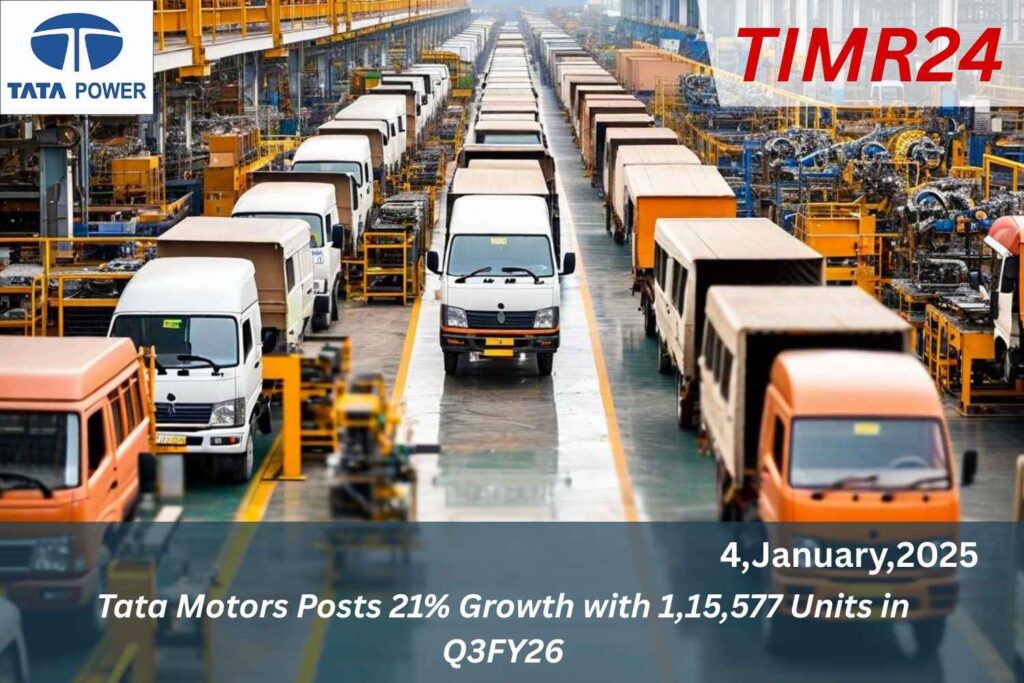
Tata Motors reported strong commercial vehicle sales of 115,577 units in Q3FY26, reflecting a 21% year-on-year increase from 95,770 units in Q3FY25. December 2025 sales reached 42,508 units, up from 33,875 the previous year, driven by growth across heavy, intermediate, and light commercial vehicle segments, supported by a rebound in construction and mining activities. The sales performance also benefitted from high demand for small commercial vehicles and pickups. Domestic and international sales in the medium and heavy commercial vehicle sector reached 57,080 units. The company anticipates further demand growth in Q4FY26 due to ongoing.
Customer Engagement Tata Motors
Infrastructure projects and expansion in key sectors, reinforced by an optimized product portfolio and stronger customer engagement Tata Motors has delivered a strong operational performance in the third quarter of FY26 by reporting a robust 21 percent year-on-year growth in domestic sales, reaching 1,15,577 units. This performance underlines the company’s continued leadership in the Indian automobile sector, supported by sustained demand across passenger vehicles, commercial vehicles, and electric mobility segments. At a time when the automotive industry is navigating cost pressures, evolving emission norms, and shifting consumer preferences.
Tata Motors’ growth signals resilience, strategic clarity, and strong execution capabilities The Q3FY26 performance is particularly significant as it reflects the company’s ability to maintain momentum during a traditionally competitive quarter. Tata Motors has effectively leveraged its diversified portfolio, spanning entry-level cars to premium SUVs and heavy commercial vehicles, enabling it to tap into multiple demand cycles simultaneously. This multi-segment presence continues to be a key differentiator for the company within the Indian automobile market Passenger vehicles once again played a central role in driving Tata Motors’ growth during the quarter.
Indian Consumers Urban Buyers
The company’s SUV-led strategy, backed by popular models such as Nexon, Punch, Harrier, and Safari, has resonated strongly with Indian consumers. Urban buyers continue to show preference for feature-rich, safety-focused vehicles, while semi-urban and rural markets are witnessing increased acceptance of compact SUVs and hatchbacks. Tata Motors’ emphasis on design, safety ratings, and value positioning has allowed it to maintain strong order books even amid intense competition from domestic and global manufacturers Another important contributor to the Q3FY26 growth story is Tata Motors’ expanding electric vehicle portfolio.
The company remains the market leader in India’s EV segment, benefiting from early investments in electric mobility and charging ecosystem partnerships. Models such as the Nexon EV and Tiago EV continue to see steady demand, supported by rising fuel prices, favorable (India) government policies, and growing consumer awareness around sustainable transportation. Tata Motors’ EV roadmap aligns closely with India’s long-term decarbonization goals, strengthening its strategic relevance in the evolving mobility landscape The commercial vehicle segment also showed signs of recovery and stability during Q3FY26. Improved infrastructure spending, better freight movement.
Fleet Operators And Institutional Buyers
And increased activity in construction and logistics sectors contributed to steady demand for trucks and buses. Tata Motors, with its extensive CV portfolio and strong dealer network, has been well positioned to capture this demand. The company’s focus on fuel efficiency, total cost of ownership, and after-sales support continues to appeal to fleet operators and institutional buyers, reinforcing its leadership in the commercial vehicle space. Broader market dynamics are discussed in our commercial vehicle market overview From a financial and investor perspective, Tata Motors’ Q3FY26 sales performance strengthens confidence in the company’s growth trajectory.
Consistent volume growth provides operating leverage benefits and supports margin stability, especially as commodity prices remain volatile. Market participants closely tracking the auto sector have viewed these numbers positively, reflecting optimism around demand sustainability and product pipeline strength. Investors can monitor Tata Motors’ stock performance and disclosures through platforms such as the National Stock Exchange of India and the Bombay Stock Exchange Beyond volumes, Tata Motors’ performance highlights the effectiveness of its long-term strategic initiatives. Continuous investments in product development, digital retail platforms, and customer experience.
Eepeat Purchases And Strong Brand
Enhancements have helped the company adapt to changing market conditions. The brand’s focus on safety, reflected in high Global NCAP ratings for several models, has also strengthened consumer trust. This trust translates into repeat purchases and strong brand recall, which are critical in a highly competitive market like India Tata Motors appears well positioned to sustain growth momentum in the coming quarters. The company’s planned product launches, expansion of EV offerings, and ongoing improvements in supply chain efficiency are expected to support volume growth. Additionally, macroeconomic factors such as stable interest rates.
Infrastructure development, and rising disposable incomes could further aid demand. While challenges such as regulatory changes and competitive pressures remain, Tata Motors’ diversified business model provides a strong buffer against sectoral volatility In the broader context of the Indian automobile industry, Tata Motors’ Q3FY26 performance serves as an indicator of underlying demand strength and consumer confidence. As the industry gradually transitions towards cleaner and smarter mobility solutions, companies with early mover advantages and scalable platforms are likely to outperform. Tata Motors’ consistent execution across segments reinforces.
Percent Growth
Its position as a key beneficiary of this transition. For industry-wide insights, data published by the Society of Indian Automobile Manufacturers offers valuable context on market trends and policy developments Tata Motors’ 21 percent growth with sales of 1,15,577 units in Q3FY26 is (India) than just a quarterly milestone. It reflects strategic foresight, operational discipline, and strong alignment with evolving consumer and policy trends. As the company continues to balance growth with sustainability and innovation, it remains a central player shaping the future of mobility in India.
Q1. How much growth did Tata Motors record in Q3FY26?
Tata Motors reported a 21% year-on-year growth in domestic sales during Q3FY26.
Q2. What were Tata Motors’ total sales in Q3FY26?
The company sold a total of 1,15,577 units during the quarter.
Q3. Which segment contributed most to the growth?
Passenger vehicles, especially SUVs and electric vehicles, were the key growth drivers.
Q4. How did electric vehicles perform for Tata Motors?
EVs continued to show strong demand, reinforcing Tata Motors’ leadership in India’s EV market.
Q5. What does this performance indicate for Tata Motors’ future outlook?
The results indicate strong demand momentum and a positive outlook supported by new launches and EV expansion.