


















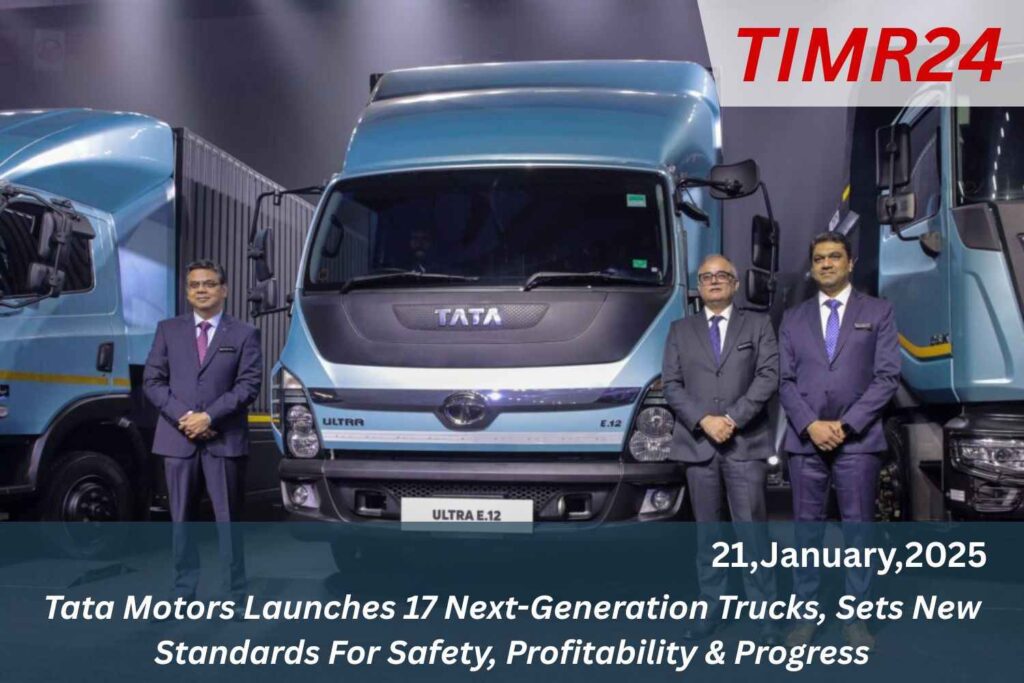
Tata Motors has launched a transformative portfolio of 17 next-generation trucks, ranging from 7 to 55 tonnes, including the new Azura series and Tata Trucks.ev electric range, with significant upgrades to existing models. These trucks adhere to global safety standards (ECE R29 03) and enhance profitability by maximizing payload and fuel efficiency, supported by the Fleet Edge digital services for better fleet management. The Azura series focuses on performance and comfort, suitable for various logistical needs. The electric trucks, based on J-MOEV architecture, promote sustainable logistics with zero-emission capabilities. Tata Motors aims for industry leadership through.
Tata leadership In India’s Commercial Vehicle
Innovation, localization, and customer-centric services, ensuring a robust support ecosystem Tata Motors has once again reinforced its leadership in India’s commercial vehicle industry with the launch of 17 next-generation trucks, a move that clearly signals the company’s long-term commitment to safety, profitability, and technological progress. This large-scale product offensive is not merely an expansion of the portfolio but a strategic transformation of how trucks are designed, built, and operated in the modern logistics ecosystem. By introducing this new generation of vehicles, Tata Motors is responding directly to the evolving needs of fleet owners.
Transporters, and drivers who are facing increasing pressure to improve efficiency, comply with stricter regulations, and adopt smarter mobility solutions. The launch also aligns with the broader vision of strengthening India’s manufacturing ecosystem under the Make in India initiative and supporting sustainable growth in the transport sector At the core of this new range lies a strong emphasis on safety, an area that has become central to commercial vehicle development globally. Tata Motors has integrated enhanced cabin structures, improved braking systems, and advanced driver assistance features across multiple models in this lineup.
Embedding Safety As A Standard Rather
These upgrades are designed to reduce accident risks, protect drivers during long-haul operations, and improve overall road discipline. With Indian highways witnessing a steady rise in freight movement, the importance of safer trucks cannot be overstated. By embedding safety as a standard rather than an option, Tata Motors is setting a new benchmark for responsible manufacturing in the commercial vehicle space. This approach also complements national road safety initiatives and supports the government’s broader goal of reducing accident-related fatalities Profitability remains another defining pillar of this new truck generation. Tata Motors has carefully engineered.
These vehicles to deliver better fuel efficiency, lower maintenance costs, and higher uptime, all of which directly impact fleet economics. The introduction of improved powertrains, optimized gear ratios, and advanced engine management systems helps reduce fuel consumption, (India) which remains the single largest operating expense for transporters. For fleet operators managing hundreds of vehicles, even marginal improvements in mileage can translate into substantial savings over the vehicle lifecycle. By focusing on total cost of ownership rather than just upfront pricing, Tata Motors is positioning its new trucks as long-term profit enablers rather than short-term assets.
Digital Tools Empower Fleet Managers
Technology plays a central role in defining the identity of these next-generation trucks. Tata Motors has integrated smart telematics systems that enable real-time tracking, predictive maintenance, and driver behavior monitoring. These digital tools empower fleet managers to optimize routes, reduce idle time, and schedule maintenance proactively, thereby improving asset utilization. In an era where data-driven decision-making is becoming critical for logistics efficiency, such features offer a competitive edge to operators who are willing to embrace digital transformation. This technological shift also aligns with global trends in connected mobility, where trucks are no longer isolated.
Machines but intelligent nodes within a larger transport network Another significant aspect of this launch is the focus on driver comfort and productivity. Long hours behind the wheel demand cabins that reduce fatigue and enhance alertness. Tata Motors has redesigned the interiors with better seating ergonomics, improved visibility, and reduced noise and vibration levels. These improvements not only enhance driver well-being but also contribute to safer driving behavior and higher operational efficiency. By treating the driver as a critical stakeholder rather than just an operator, Tata Motors is acknowledging the human element that underpins.
India’s Logistics Sector Is Undergoing
The success of any transport operation. This people-centric approach strengthens brand loyalty and improves workforce retention in an industry that often struggles with driver shortages The timing of this launch is equally strategic. India’s logistics sector is undergoing rapid transformation, driven by infrastructure development, e-commerce growth, and policy reforms such as the National Logistics Policy. The demand for reliable, efficient, and technologically advanced trucks is rising steadily across sectors ranging from construction and mining to retail distribution and agricultural transport. By introducing a diversified lineup that caters to multiple use cases.
Tata Motors is positioning itself to capture growth across a wide spectrum of applications. This move also strengthens India’s position as a global hub for commercial vehicle manufacturing, a trend supported by institutions like the India Brand Equity Foundation, whose industry insights are available at From a sustainability perspective, the new truck range reflects Tata Motors’ gradual shift towards cleaner and more efficient mobility solutions. Improved emission control systems, compliance with the latest regulatory norms, and readiness for alternative fuel technologies indicate a forward-looking product strategy. As environmental regulations tighten.
India’s Broader Climate Commitments
And customers become more conscious of their carbon footprint, such readiness will become a decisive factor in purchase decisions. The integration of efficiency and sustainability into mainstream truck platforms also supports India’s broader climate commitments and reinforces the role of the automotive sector in achieving them The competitive landscape of India’s commercial vehicle market makes this launch particularly significant. With multiple domestic and global players vying for market share, continuous innovation is the only sustainable differentiator. Tata Motors’ decision to introduce 17 models simultaneously reflects both its engineering.
Depth and its confidence in market demand. This scale of launch also signals the company’s readiness to defend its leadership position while expanding into emerging segments such as smart fleet solutions and connected trucking Beyond the immediate business impact, this launch has broader implications for India’s economic development. Efficient freight transport is a backbone of industrial growth, enabling faster movement of goods, reducing logistics costs, and improving supply chain resilience. By raising performance standards across the industry, Tata Motors is indirectly contributing to national productivity and competitiveness.
Exports Under Initiatives
This role becomes even more important as India seeks to strengthen its manufacturing base and expand its exports under initiatives the launch of 17 next-generation trucks by Tata Motors marks a defining moment for India’s commercial vehicle industry. By combining safety, profitability, and technological progress in a single, comprehensive product strategy, the company (India) has set new standards that competitors will be compelled to follow. These trucks are not just machines designed to move goods; they are platforms that integrate engineering excellence, digital intelligence, and human-centric design. As the logistics sector continues to evolve.
Q1. How many trucks did Tata Motors launch in this lineup?
Tata Motors launched 17 next-generation trucks across multiple segments.
Q2. What is the main focus of the new truck range?
The focus is on safety, higher profitability, and smart fleet technology.
Q3. Which segments are covered in this launch?
Medium and heavy commercial vehicle segments are mainly covered.
Q4. What new technologies are introduced?
Advanced driver assistance, telematics, and fuel-efficient powertrains.
Q5. How will this benefit fleet operators?
Lower operating costs, higher uptime, and better driver safety.