



















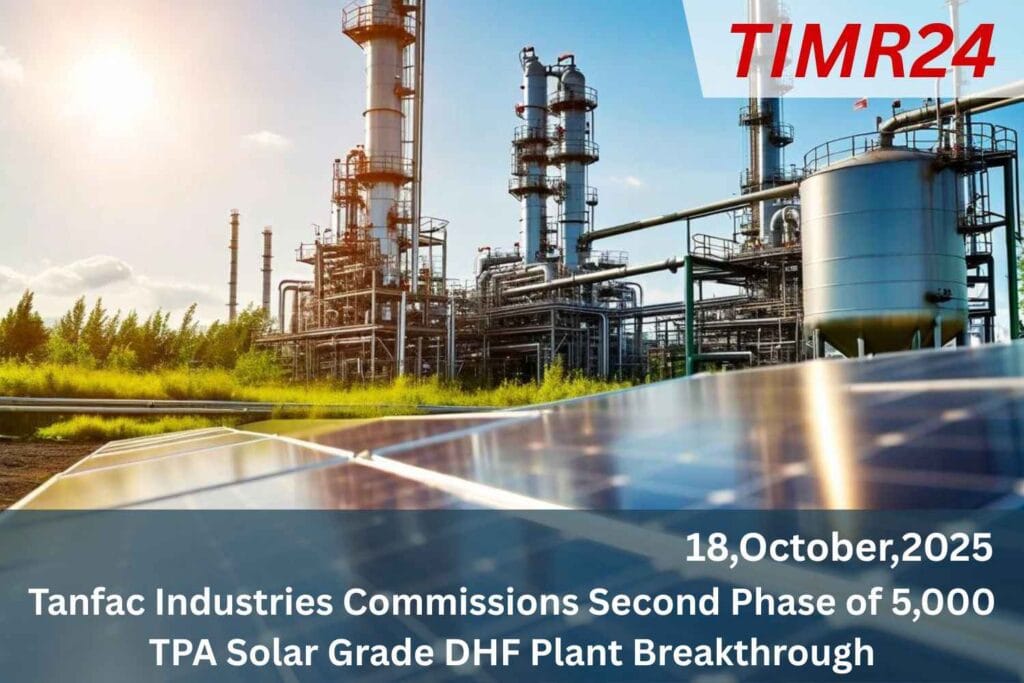
Tanfac Industries, a leading Indian fluorine chemicals company, has commissioned the second phase of its Solar Grade Dilute Hydrofluoric Acid (DHF) Plant, with a capacity of 5,000 TPA, on 6th October 2025. The plant, which met the stringent requirements of key solar energy customers, now stands at 10,000 TPA, making Tanfac the first chemical company in India to achieve this scale. The plant’s expansion has the potential to significantly enhance both top-line and bottom-line growth. Tanfac Industries Limited, a prominent player in India’s fluorochemical industry, has achieved another major milestone by commissioning the second phase of its 5,000 tonnes per annum (TPA).
Solar Grade Di-fluoride (DHF) Plant. This expansion marks a crucial breakthrough in India’s efforts toward self-reliance in high-performance fluorine-based materials used in renewable energy, electronics, and advanced chemical manufacturing. The plant’s commissioning strengthens India’s domestic capabilities in producing solar-grade materials that are essential for photovoltaic applications and the green energy transition Tanfac Industries, a joint venture between Aditya Birla Group and Tamil Nadu Industrial Development Corporation (TIDCO), has consistently focused on innovation and sustainability in chemical manufacturing.
The expansion of the DHF facility reinforces its leadership in India’s specialty chemical ecosystem and aligns perfectly with the national vision of promoting indigenous production under the Make in India and Atmanirbhar Bharat missions The commissioning of the second phase of the DHF plant enhances the company’s annual production capacity to 5,000 TPA, enabling Tanfac to meet growing domestic and international demand. Solar Grade DHF, a critical raw material for producing solar panels and lithium-ion batteries, is essential in the manufacturing chain of high-purity aluminum fluoride, cryolite, and other advanced compounds. With the global solar energy.
Market expanding rapidly, Tanfac’s strategic move positions India as a competitive manufacturer of essential materials in the clean energy ecosystem In the broader context, this expansion also supports India’s goal of achieving 500 GW of renewable energy capacity by 2030. By ensuring a steady domestic supply of solar-grade materials, Tanfac reduces import dependency, strengthens the manufacturing base, and creates new export opportunities for high-purity fluorine-based products. The company’s focus on solar-grade applications reflects a clear vision for integrating industrial growth with sustainable energy goals (India’s Renewable Energy).
Technological Advancements and Sustainable Operations
One of the defining features of this project is its focus on advanced process technologies and environmental sustainability. The second phase of the DHF plant incorporates state-of-the-art automation systems, precision-controlled reactors, and energy-efficient purification units to achieve exceptional purity levels required for solar-grade applications. Tanfac’s commitment to sustainable manufacturing extends to water recycling, waste reduction, and emission control measures embedded throughout the production process The facility’s design is aligned with global best practices in green manufacturing, minimizing carbon footprint and optimizing resource use.
By adopting these technologies, Tanfac demonstrates how chemical manufacturing can be both profitable and environmentally responsible. This aligns with India’s growing industrial policy emphasis on green chemistry and sustainable production frameworks With the commissioning of this phase, Tanfac Industries strengthens its role in supporting industries that rely heavily on high-purity chemicals, including semiconductors, solar photovoltaics, lithium batteries, and aluminum production. The increasing adoption of electric vehicles (EVs) and renewable energy systems worldwide has boosted demand for fluorine-based materials. By expanding its DHF capacity.
Tanfac is poised to supply to both domestic and global clients, enhancing India’s competitiveness in global chemical supply chains Economically, this expansion is expected to generate substantial value for stakeholders through job creation, technology transfer, and increased exports. The plant’s Ministry of Environment, Forest and Climate (MoEFCC) output will also benefit downstream manufacturers by ensuring cost-effective and reliable access to solar-grade intermediates. This contributes to the broader chemical value chain integration, supporting sectors from green energy to advanced electronics manufacturing.
Role of Tanfac in India’s Fluorochemical Ecosystem
Tanfac Industries has established itself as one of India’s leading producers of inorganic fluorine-based chemicals. With a diversified product portfolio that includes Aluminum Fluoride, Anhydrous Hydrogen Fluoride (AHF), and Potassium Fluoride, the company plays a vital role in supplying materials for aluminum smelting, glass etching, and chemical synthesis. The solar-grade DHF expansion enhances its capabilities to deliver high-purity materials tailored for advanced applications The company’s growing emphasis on R&D has enabled it to adapt international standards in chemical synthesis and purification. This research-driven approach allows Tanfac to cater to emerging sectors.
Like renewable energy, semiconductors, and defense manufacturing. Its focus on high-value fluorine derivatives demonstrates a shift from conventional bulk chemicals to precision-based specialty materials, mirroring global industry trends Beyond industrial capacity, Tanfac Industries has positioned environmental stewardship as a cornerstone of its operations. The second phase of the DHF project adheres to stringent environmental regulations set by the Central Pollution Control Board (CPCB) and Tamil Nadu Pollution Control Board (TNPCB). The company has implemented a closed-loop system for chemical handling, ensuring minimal waste discharge and enhanced operational safety.
Moreover, Tanfac continues to invest in green technologies such as fluorine recovery systems and low-emission reactor designs. These efforts align with India’s commitment under the Paris Agreement to reduce industrial emissions and promote sustainable resource use. By integrating corporate responsibility with production efficiency, Tanfac sets a benchmark for sustainable growth in India’s chemical industry. The success of Tanfac’s DHF plant expansion also underscores the importance of public-private collaboration in India’s industrial growth. As a joint venture with TIDCO, the project benefits from state-level support for infrastructure
Partnerships, Policy Alignment, and Industry Collaboration
Logistics, and investment facilitation. This partnership model exemplifies how state industrial corporations and private enterprises can work together to build scalable, sustainable industrial assets Furthermore, the project aligns with India’s National Chemical Policy and PLI Scheme for Specialty Chemicals, which encourage domestic manufacturing of high-value intermediates. The initiative also supports Tamil Nadu’s ambition to become a hub for advanced chemical manufacturing and renewable technology components. Such industrial collaboration creates a synergistic ecosystem that accelerates innovation, employment, and exports Looking ahead, Tanfac Industries.
Plans to leverage this expansion to explore new markets across Asia, Europe, and North America, targeting sectors where demand for high-purity fluorine compounds is rapidly growing. The global solar energy and semiconductor industries require precise and reliable suppliers, and Tanfac’s strengthened capacity positions it as a trusted partner in these advanced supply chains The company is also exploring strategic partnerships for technology exchange and product diversification, particularly in advanced fluoropolymers and electrolyte additives for energy storage. These initiatives will further enhance India’s position as a global hub for sustainable chemical manufacturing.
In the long term, the second phase of the Solar Grade DHF Plant is more than an industrial achievement—it represents a commitment to a cleaner, self-reliant, and innovation-driven future for India’s chemical Tanfac Industries’ commissioning of the 5,000 TPA Solar Grade DHF Plant’s second phase stands as a landmark in India’s industrial and environmental evolution. By combining advanced manufacturing, sustainability, and strategic foresight, the company not only strengthens its own market position but also contributes significantly to India’s renewable energy and specialty chemical ecosystem. As the nation moves toward a cleaner and more self-reliant future,.
Q1. What is the new Tanfac Industries Solar Grade DHF Plant?
It’s a 5,000 TPA (tonnes per annum) Solar Grade DHF plant aimed at producing high-purity chemicals essential for solar cell manufacturing.
Q2. Where is Tanfac’s new DHF plant located?
The plant is situated in Cuddalore, Tamil Nadu, India — a key industrial hub for chemical and energy innovation.
Q3. What are the benefits of this expansion for India?
It supports India’s renewable energy mission, reduces import dependency for solar-grade chemicals, and boosts domestic manufacturing.
Q4. Who are Tanfac’s major partners in this project?
Tanfac Industries, a joint venture between Aditya Birla Group and Tamil Nadu Industrial Development Corporation (TIDCO), leads this initiative.
Q5. How will this project contribute to sustainability?
By producing eco-friendly solar-grade materials domestically, it promotes clean energy adoption and reduces carbon footprints.