














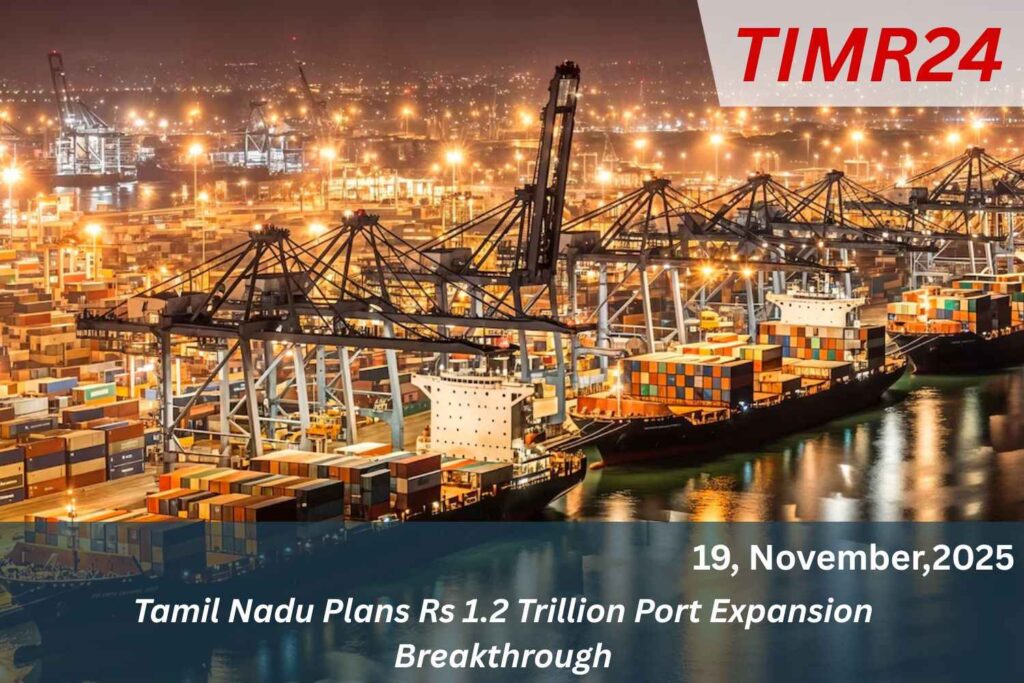
Tamil Nadu has unveiled a Rs 1.2 trillion roadmap to expand port capacity and enhance cargo handling, aiming to establish the state as a key maritime hub. The initiative includes upgrades to public and private ports, focusing on modern berths, deeper draughts, improved evacuation systems, and advanced logistics connectivity. The government targets an increase in cargo throughput through new terminals and enhanced multimodal links, while incorporating digital systems for efficient operations. This expansion aligns with Tamil Nadu’s vision for industrial growth and aims to strengthen its position in international trade, ultimately boosting economic activity and competitiveness in the maritime sector.
Tamil Nadu’s ambitious ₹1.2 trillion port expansion plan marks one of India’s most transformative steps in maritime infrastructure, and the scale of this development carries enormous potential for economic growth, industrial acceleration, and global trade positioning. The state, which already hosts some of the country’s most active ports, aims to modernise and expand its maritime facilities in a way that elevates Tamil Nadu into a world-class logistics hub capable of competing with leading Asian shipping centres. The government intends to strengthen major ports such as Chennai Port, VOC Port in Tuticorin, Kamarajar Port in Ennore, and smaller ports.
Strategy includes developing
Along the southeastern coastline, to handle new-generation vessels, advanced cargo systems, and sustainable port operations that align with India’s Maritime Vision 2047. This expansion is not simply about increasing cargo numbers; the strategy includes developing deep-water berths for large container ships, strengthening breakwaters, modernising cargo-handling equipment, implementing smart surveillance and automation systems, and integrating green energy solutions that reduce carbon footprints. As part of this development, Tamil Nadu aims to connect the ports more efficiently with industrial clusters, special economic zones, export processing zones, and major freight corridors.
Creating seamless movement for sectors like automotive manufacturing, textiles, petrochemicals, electronics, and renewable energy equipment. Internal transport efficiency will rise dramatically with improved rail and road connectivity under the Sagarmala project, which already (Manufacturing) highlights Tamil Nadu as a critical gateway for India’s growing trade with Southeast Asia and the Middle East. This initiative is expected to create lakhs of direct and indirect jobs over the next decade, boosting livelihoods in districts such as Thoothukudi, Chennai, Cuddalore, Nagapattinam, and Ennore. Many industries are dependent on global supply chains, particularly automotive exporters.
Near Chennai and electric vehicle manufacturers emerging across the state, will benefit from faster, more reliable shipping routes. Tamil Nadu’s blueprint also focuses heavily on sustainability: ports will incorporate clean-fuel tugboats, renewable-powered terminals, shore-power systems that allow vessels to switch off diesel engines while docked, and dredging practices that minimise ecological disruption. This aligns with the global shift toward green ports and supports India’s commitment to decarbonised maritime operations. International investors and global shipping lines have shown keen interest in Tamil Nadu due to its strategic location, skilled workforce.
Colombo or Singapore
Well-established industrial ecosystem. By offering deeper drafts, advanced maritime infrastructure, and streamlined logistics, the state expects a sharp rise in transhipment possibilities that could reduce dependence on foreign ports such as Colombo or Singapore. To ensure transparency and governance, the Tamil Nadu Maritime Board is collaborating with the Ministry of Ports, Shipping, and Waterways to accelerate clearances and project approvals, maintaining investor confidence and smooth implementation across multi-year development cycles. Not only will this investment modernise the state’s older ports, but it will also foster the development of completely.
New terminal facilities, including greenfield ports capable of handling LNG, liquid bulk, and specialised cargo. Local communities will also benefit from skill-development initiatives, modernised fishing harbours, and coastal tourism projects integrated within the port expansion framework. As highlighted in the government’s infrastructure vision, Tamil Nadu aims to leverage its coastline to enhance domestic coastal shipping, reducing road congestion and lowering the cost of logistics for industries across South India. This complements the central government’s National Logistics Policy, which seeks to bring down logistics costs to globally competitive levels.
related economic development,
As the expansion unfolds, industries within Tamil Nadu will experience improved export capabilities, especially along routes connecting to Europe, Africa, and ASEAN nations. To strengthen the narrative for readers who follow related economic development, India’s broader development strategy is. Furthermore, readers interested in coastal economy innovations can explore /blue-economy-developments for deeper analysis of how maritime growth supports fisheries, offshore wind, and ocean-based industries. External authoritative references, such as the Ministry of Ports, Shipping & Waterways, Sagarmala program pages, and the Maritim, make it easier for stakeholders.
To track progress. Overall, Tamil Nadu’s ₹1.2 trillion port expansion project stands as a transformative blueprint that links infrastructure modernisation, sustainable maritime practices, coastal development, industrial competitiveness, and employment growth. The integrated (Sagarmala) approach, combining state policy, national maritime vision, and global trade opportunities, positions Tamil Nadu as one of the most important maritime hubs in the Indo-Pacific region, unlocking long-term economic advantages and expanding India’s presence in global shipping networks.
Q1. What is the cost of Tamil Nadu’s port expansion project?
The Tamil Nadu government has announced a ₹1.2 trillion investment plan for port modernisation and expansion.
Q2. Which ports will be included in this expansion?
Major ports like Chennai, Ennore (Kamarajar), Tuticorin (VOC Port), and Cuddalore minor ports are key beneficiaries.
Q3. What benefits will this project bring to the economy?
It will boost exports, enhance shipping capacity, create lakhs of jobs, and strengthen India’s maritime competitiveness.
Q4. When will the expansion begin?
Initial implementation starts in 2025 with phased development over the next decade.
Q5. Will the ports adopt green technologies?
Yes, Tamil Nadu is planning shore-power systems, renewable energy integration, and low-emission logistics corridors.