








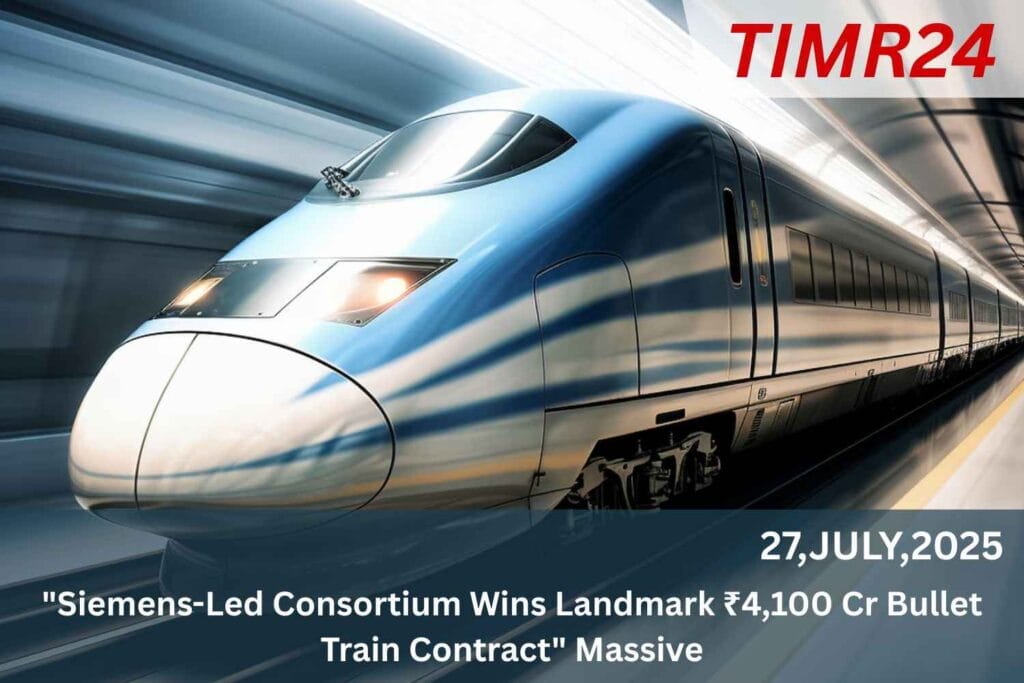
Siemens Ltd has secured a ₹4,100 crore contract from NHSRCL for the Mumbai-Ahmedabad bullet train project, covering design, installation, and maintenance of advanced signalling and telecommunication systems. The project will be executed over 54 months, with Siemens providing 15 years of maintenance support. In a significant leap for India’s high-speed rail ambitions, a Siemens-led consortium has been awarded a ₹4,100 crore contract to supply and install key systems for the Mumbai–Ahmedabad Bullet Train project. The consortium, which includes Siemen.
AG and Siemens Limited India, will focus on the implementation of 25 kV AC overhead electrification systems, SCADA (Supervisory Control and Data Acquisition), and power supply installations essential to the operational efficiency of the Shinkansen-based train network. A Siemens-led consortium has secured a ₹4,100 crore contract for India’s Mumbai–Ahmedabad bullet train project. The deal includes the supply and installation of critical electrification systems to support high-speed operations. This marks a major milestone for the country’s first high-speed rail line, enhancing infrastructure and aligning with India’s push for advanced, sustainable transportation solutions.
Scope of the Contract
The awarded scope includes end-to-end design, supply, installation, testing, and commissioning of advanced rail months, with Siemens providing 15 years of maintenance support. In a significant leap for electrification For more details, refer to the official press release by (National High-Speed Rail Corporation Limited NHSRCL) on the awarded contract.
infrastructure. This includes traction substations, high-voltage transmission lines, and connection to the National Grid. Additionally, the consortium will also oversee the electrical integration of train depots, stations, and control centres. This work is crucial to achieving the 320 km/h operating speed that defines India’s first bullet train.
Strategic Importance
This contract represents a pivotal moment for the National High-Speed Rail Corporation Limited (NHSRCL), the executing agency of the bullet train corridor. By bringing in global rail leader Siemens, the project aims to meet international performance benchmarks. It also signals the Indian government’s commitment to localising advanced rail technologies under the Make in India and Atmanirbhar Bharat initiatives. Siemens will also collaborate with Indian vendors and contractors for various project phases, helping build domestic capacity in high-speed rail systems.
Progress of the Mumbai–Ahmedabad HSR Corridor
The Mumbai–Ahmedabad High-Speed Rail (MAHSR) corridor, a flagship initiative supported by the Japanese government through soft loans and technical collaboration, has made steady construction progress since its launch. Civil works are well underway across Gujarat and Maharashtra, with several station foundations, bridge structures, and tunnel segments nearing completion.(Constructions) in the bullet train corridor.
Siemens’ Growing Rail Portfolio in India
This project adds to Siemens’ growing footprint in India’s rail and metro sectors. The company has previously been involved in the Delhi, Mumbai, and Bengaluru metro systems, as well as freight and mainline electrification projects. The bullet train contract not only elevates its project portfolio but also reflects the confidence placed in Siemens’ technological and execution capabilities.
Environmental and Operational Impact
High-speed rail offers a cleaner, faster, and more efficient transportation option compared to traditional rail and air travel. The Siemens-led electrification will enable seamless integration with India’s green mobility goals, including reduced carbon emissions and energy-efficient operations. Once completed, the corridor is expected to drastically cut travel time between Mumbai and Ahmedabad—from over 6 hours to just around 2 hours.
Q1. What is the value of the contract awarded to the Siemens-led consortium?
₹4,100 crore.
Q2. What will Siemens provide for the bullet train project?
Electrification systems, SCADA, and power supply infrastructure.
Q3. Which high-speed rail corridor is the project part of?
The Mumbai–Ahmedabad Bullet Train corridor.
Q4. Who awarded the contract to Siemens?
National High-Speed Rail Corporation Limited (NHSRCL).
Q5. Why is this contract significant?
It marks a major step in India’s high-speed rail development with global technology integration.