


















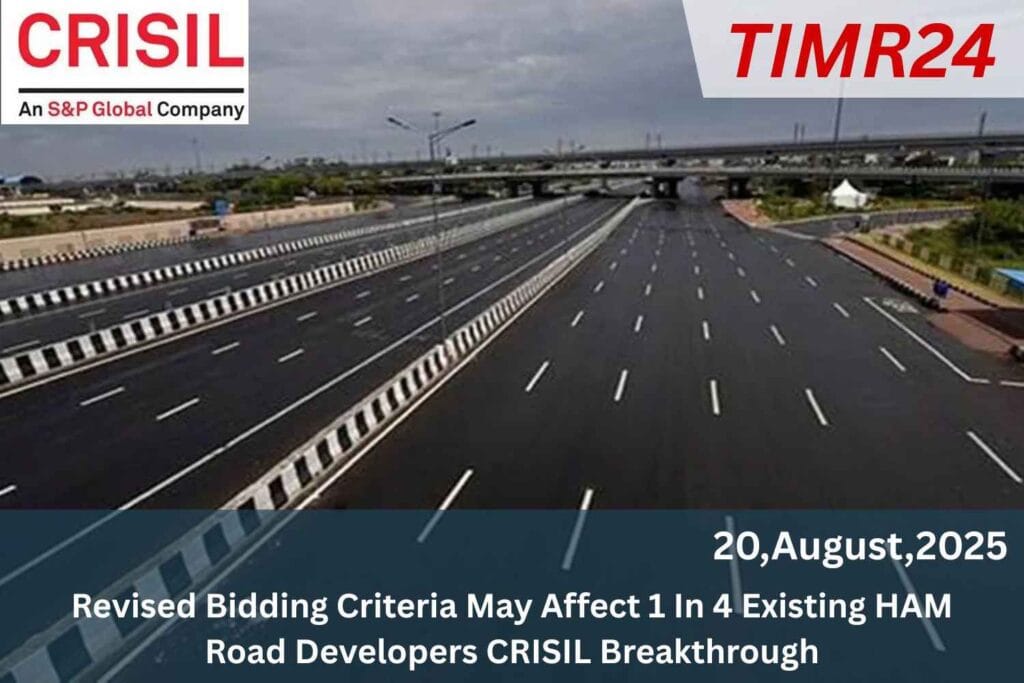
The Ministry of Road Transport & Highways (MoRTH) has announced changes to financial and technical qualifications for hybrid annuity model (HAM) projects. The changes aim to improve bidding discipline and construction quality after a phase of aggressive bidding. Crisis’s analysis of 74 developers who won approximately 90% of HAM projects between fiscals 2022 and 2025 reveals that the revised qualifications could prevent 25% of winners from bidding for new projects in the near term. The minimum available net worth threshold has been increased to 20% of the estimated project cost, and the available net worth will be calculated after deducting 20% of the balance value of existing public-private partnership projects.
The technical qualification threshold has also been increased, requiring developers to demonstrate a track record of executing similar highways or structure-based projects. The revised criteria are expected to result in a balanced distribution of projects and keep aggressive bidding in check. The Indian road infrastructure sector has been one of the most dynamic segments of the economy, especially under public-private partnership (PPP) models like the Hybrid Annuity Model (HAM). However, according to a recent analysis, changes in the bidding criteria proposed by the Ministry of Road Transport and Highways (MoRTH) could significantly alter the competitive landscape.
The revised framework, which emphasizes stricter financial qualifications and execution capabilities, may impact nearly one in four existing HAM developers. This shift is expected to streamline the sector by encouraging financially stronger players while potentially side-lining smaller contractors who have previously thrived under relatively relaxed norms (India’s National Highway Development) The Hybrid Annuity Model has been a cornerstone for national highway development since its introduction in 2016. Unlike the traditional Engineering, Procurement, and Construction (EPC) model, where developers are fully paid by the government, HAM shares risks between
the concessionaire and the state. Under this model, the government pays 40% of the project cost during the construction phase, while the developer arranges the remaining 60%, later recovered through fixed annuity payments over time. This balance has attracted mid-sized developers and improved private sector participation. However, with the revised criteria, many of these players could find themselves unable to The CRISIL study points out that nearly 25% of current HAM developers might struggle to qualify under the new bidding system.
The reforms are expected to tighten eligibility, focusing on stronger balance sheets, higher net worth requirements, and proven track records in large-scale execution. While this will ensure that only credible players with sound financial backing participate, it may also reduce the diversity of competition. For instance, many smaller contractors who entered the sector during the infrastructure boom may no longer be able to bid, thereby consolidating opportunities in the hands of large infrastructure companies.
Impact on Road Developers
For developers, the revised criteria are a double-edged sword. On one hand, companies with strong financials will benefit from reduced competition, potentially securing more projects. On the other, mid-sized firms may face exclusion, limiting their growth opportunities. This could also reshape the subcontracting market, as larger players may outsource certain segments of work to smaller firms who are unable to qualify directly. Investors and financial institutions, however, are likely to view the changes positively, as the emphasis on financial strength reduces risks of project delays and defaults. For further insights, you may explore aimed at strengthening project delivery.
The Government of India has ambitious plans under the National Infrastructure Pipeline (NIP) and the Gati Shakti Master Plan, both of which aim to boost connectivity, logistics, and industrial corridors. Road development, especially expressways and economic corridors, is critical to these programs. With revised bidding norms, the sector is expected to see more financially stable players taking charge, which could improve execution quality. However, there is also a risk of reduced competition leading to higher project costs. Balancing these outcomes will be crucial for the government as it pushes forward with multi-trillion-rupee infrastructure investments.
While the revised criteria may create short-term challenges for smaller players, it could also open doors for mergers, joint ventures, and collaborations. Companies that fail to qualify individually might partner with stronger entities to remain part of the ecosystem. Additionally, these changes could incentivize developers to strengthen (NHAI’s) their financial health, improve operational efficiency, and diversify funding sources. In the long run, such reforms are expected to professionalize the sector and align India’s road infrastructure development with global best practices.
The revised bidding criteria for HAM projects mark a critical shift in India’s road development strategy. With CRISIL highlighting that one in four existing developers may be affected, the industry stands at a crossroads. The new framework is designed to bring stability, credibility, and efficiency, but it also risks side-lining smaller yet capable players. How developers adapt—whether through partnerships, financial restructuring, or business model innovation will determine their future role in the sector. As India moves forward with its ambitious infrastructure vision, striking a balance between inclusivity and financial robustness will be key to sustainable growth.
Q1. What did CRISIL highlight about HAM road developers?
CRISIL noted that revised bidding criteria may affect nearly 25% of existing developers.
Q2. Why are the new bidding criteria significant?
They could alter competition by tightening eligibility and financial requirements.
Q3. How will developers be impacted?
Smaller or financially weaker players may struggle to qualify for new projects.
Q4. What is HAM in road projects?
HAM stands for Hybrid Annuity Model, a PPP framework balancing risk between government and developers.
Q5. What does this mean for future road projects?
Fewer but stronger players may dominate bids, ensuring better financial stability in execution.