














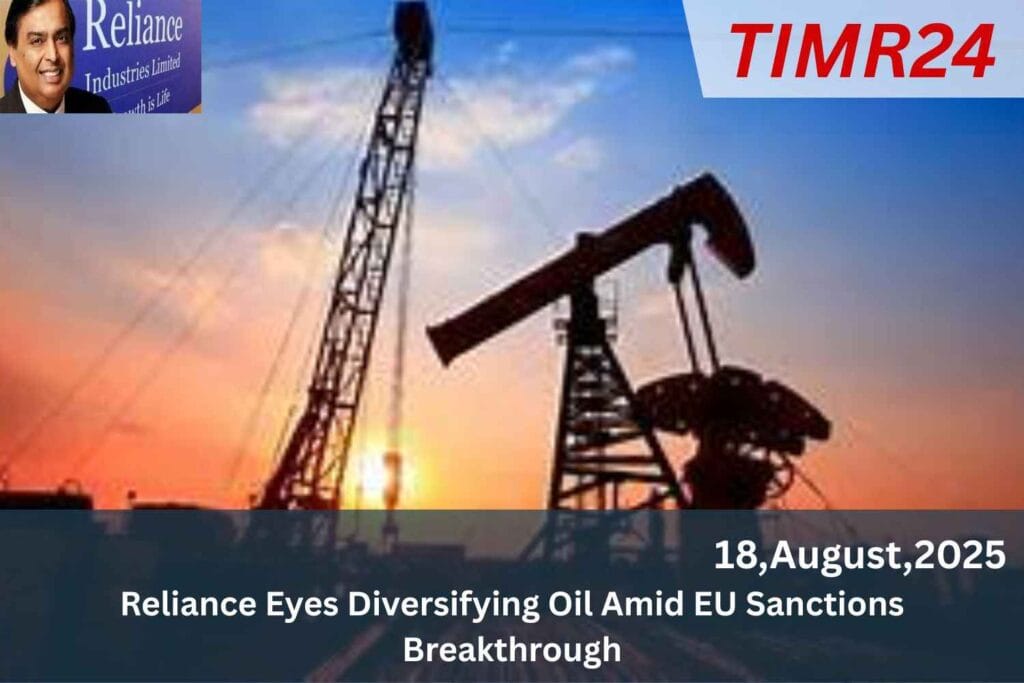
India’s Reliance Industries Ltd. is under scrutiny for its oil procurement strategy following European Union restrictions on diesel produced from Russian crude. The company, owned by billionaire Mukesh Ambani, made a rare purchase of Abu Dhabi’s premium Urban crude, avoiding the costlier UAE grade. The EU’s new restrictions aim to curb the indirect sale of Russian-origin fuel to European markets, placing Reliance under closer regulatory observation. Traders believe Reliance may be testing alternatives from the Middle East, but it remains uncertain how it plans to replace up to 600,000 barrels per day of Russian crude. Reliance Industries, long a dominant player in global refining, has found itself at a geopolitical crossroads in mid-2025. Historically reliant on discounted.
Russian oil, the company is being compelled to rethink its strategy amidst mounting pressure from both the European Union and the United States. Analysts now expect Reliance to pivot from its deep Russian supply once accounting for nearly half of its crude imports to alternative sources in the Middle East, Latin America, and even North Sea crude. Reuters notes that if forced to cut back Russian deliveries under U.S. pressure, the firm could swiftly return to Gulf suppliers, including Saudi Arabia and the UAE, which offer logistical proximity and robust output.
This strategic recalibration is being driven by several macro-policy shifts. The EU’s new sanctions, set to ban any refined petroleum products derived from Russian crude even if processed in third countries are scheduled to take effect in 2026. These rules threaten Reliance’s exports to Europe, which accounted for a significant portion of its exports As The Financial Times points out, nearly 26% (HPCL) of Reliance’s exports head to Europe, with about 30% of its refined oil feedstock still coming from Russia. In parallel, the U.S. has already slapped India with sweeping tariffs 25% initially, with suggestions of escalating to 50%—aimed at penalizing continued Russian energy ties.
Amid this uncertainty, has begun concrete steps toward diversification. Notably, it secured two high-sulphur fuel oil (HSFO) cargoes from Hindustan Petroleum (HPCL) a rare departure from its usual reliance on Russian supply. Each cargo represented about 33,000 metric tons, sourced through August tenders and scheduled for loading from Visakhapatnam. Simultaneously, market data revealed that Russian exports to India significantly dropped from over 750,000 tonnes in July to under 400,000 tonnes recently with most of the cuts tied to Reliance’s operations Additionally, the company made a one-off purchase of premium Abu Dhabi’s Murban crude, signaling a willingness to pay a premium for regulatory clarity and diversified exposure
Recent figures underscore the scale of the challenge. According to ship-tracking data, Russian crude comprised nearly 50% of Reliance’s overall crude feed in 2025, while 20% of its refined exports were destined for Europe Amid this backdrop, the firm has pledged to examine the legal definitions of “substantially transformed” products those that may still be allowed under a “wind-down” period as per comments from RIL’s supply and trading leadership. These discussions are taking place against the backdrop of India’s broader diplomatic efforts, with the government urging a “balanced” stance on secondary sanction’s.
Despite the challenges, private refiners like Reliance continue to outperform state entities due to greater operational flexibility and export capacity. In the first half of 2025, Reliance exported a staggering 21.66 million tonnes of refined products, with Europe remaining its largest market. Its private-sector peer, Nayara Energy, exported around 3 million tonnes, mainly to customers in the UAE and West Africa. However, the EU sanctions have hit Nayara especially hard, given its 49% ownership by Russia’s Rosneft, resulting in asset freezes and restrictions on European insurance and shipping.
If Reliance successfully substitutes Russian crude with more stable, geopolitically palatable sources—such as U.S., Brazilian, or Gulf supplies—it could maintain its refining margins while preserving export lifelines. Such a shift aligns with broader Indian import trends: imports from the U.S. and Brazil have grown steadily, helping India push toward a 40-supplier mix goal, according to analysts. At the same time, India is reinforcing its long-term energy resilience through infrastructure investments: expanding Strategic Petroleum Reserves, investing in LNG terminals and green hydrogen, and deepening ties with Gulf states These moves signal a multi-pronged approach—short-term export continuity paired with long-term strategic restructuring.
In sum, Reliance’s current pivot reflects both necessity and opportunity. Necessity, because EU restrictions effective by early 2026 and looming U.S. secondary tariffs make Russian oil a strategic liability. Opportunity, because diversifying into new geographies and grades enhances logistical flexibility, regulatory compliance, and market access. The coming months and years will be critical: if executed well (Nayara Energy) Reliance may emerge stronger from this energy shifting ground, better aligned with evolving global norms and India’s own energy ambitions.
Q1. Why is Reliance diversifying oil sources?
To reduce risks from EU sanctions and ensure energy security.
Q2. Which markets is Reliance exploring?
Reliance is targeting Middle East, Africa, and Asian suppliers.
Q3. How do EU sanctions impact Reliance?
They restrict traditional trade routes, pushing Reliance to adapt.
Q4. Will diversification affect fuel prices in India?
It could help stabilize prices by balancing supply risks.
Q5. What is Reliance’s long-term energy strategy?
Expanding global oil sources while investing in clean energy.