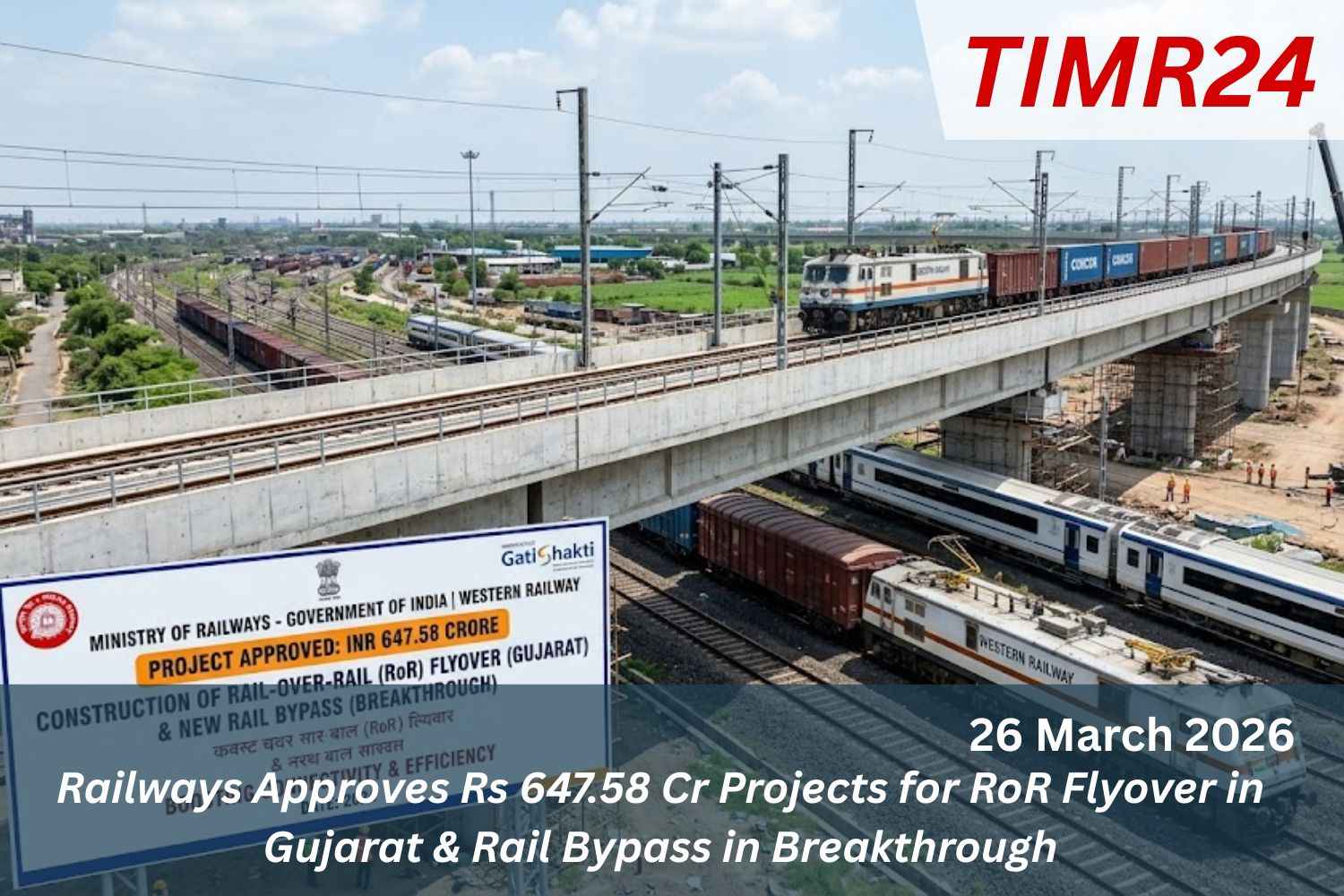
The Ministry of Railways has sanctioned two significant rail infrastructure projects designed to improve connectivity, reduce congestion, and enhance operational efficiency. The first project is the construction of a Rail Over Rail (RoR) flyover at Kosamba for the Kosamba–Umrapada Gauge Conversion section in Gujarat, with an estimated cost of ₹344.38 crore. This flyover will facilitate seamless connectivity and eliminate surface crossings, ensuring uninterrupted train movement The second project is a 13.38 km bypass at Bhagalpur in Bihar, costing ₹303.20 crore, which will link Gonudham Halt and Sabour, alleviating the severe congestion currently experienced at Bhagalpur junction due to overcapacity.
Rising Transportation Demands Approval
These projects aim to strengthen rail connectivity in Gujarat and Bihar, improve safety, and enhance the overall efficiency of train operations, aligning with the Ministry’s focus on capacity augmentation and decongestion to meet rising transportation demands The approval of infrastructure projects worth ₹647.58 crore by Indian Railways marks another significant step in strengthening the country’s transportation network and logistics efficiency. These projects, which include the development of a Roll-on Roll-off (RoR) flyover in Gujarat and a rail bypass in Bihar, reflect the government’s continued focus on modernizing railway infrastructure while addressing key bottlenecks in freight and passenger movement.
As India continues to push toward becoming a global manufacturing and logistics hub, such initiatives play a crucial role in ensuring seamless connectivity and efficient transportation systems The RoR flyover project in Gujarat is particularly noteworthy due to its innovative approach to freight transport. Roll-on Roll-off services allow trucks to be directly loaded onto trains, thereby reducing dependency on road transport. This not only helps in cutting down fuel consumption but also significantly reduces road congestion and environmental pollution. Gujarat, being one of India’s most industrialized states, has a high volume of goods movement, making it an ideal location for implementing such advanced logistics solutions.
Heavily Congested Sections, Ensuring Smoother
In addition to Gujarat’s RoR flyover, the rail bypass project in Bihar is aimed at improving operational efficiency and reducing congestion on busy railway routes. Bihar has long faced challenges related to overcrowded rail networks, which often result in delays and inefficiencies. The construction of a dedicated rail bypass will help divert traffic away from heavily congested sections, ensuring smoother train operations. This will not only benefit freight services but also improve punctuality for passenger trains. Enhanced connectivity in Bihar is expected to contribute to regional economic growth, attracting investments and facilitating trade These projects are aligned with.
The broader vision of the Indian government to develop world-class infrastructure and strengthen multimodal connectivity. By integrating rail and road transport systems, the RoR model supports a more sustainable and efficient logistics framework. It reduces wear and tear on highways, lowers carbon emissions, and provides a safer alternative for long-distance cargo transport. Meanwhile, the rail bypass in Bihar addresses a long-standing issue of network congestion, paving the way for faster and more reliable train services. Together, these initiatives highlight the importance of strategic planning in infrastructure development Another important aspect of these projects is their contribution to.
Economic growth and job creation. Infrastructure development has a multiplier effect on the economy, generating employment opportunities during both construction and operational phases. Improved transportation networks also reduce logistics costs, making Indian goods (India) more competitive in global markets. As businesses gain access to faster and reliable supply chains, they are better positioned to expand operations and explore new markets. This aligns with India’s ambition to become a $5 trillion economy in the coming years The environmental benefits of the RoR system cannot be overlooked. By shifting a portion of freight traffic from roads to railways, carbon emissions can be significantly reduced.
Balancing Economic Growth With Environmental
This is particularly important in the context of global climate change and India’s commitment to sustainable development. Rail transport is generally more energy-efficient compared to road transport, making it a greener alternative for moving goods. The implementation of such eco-friendly solutions demonstrates the government’s commitment to balancing economic growth with environmental sustainability The strategic location of these projects enhances their impact. Gujarat’s industrial corridors and ports make it a critical hub for trade and commerce, while Bihar’s position in eastern India provides connectivity to key regions and neighboring states.
By improving infrastructure in these areas, the government is not only addressing current challenges but also preparing for future growth. These projects are expected to act as catalysts for regional development, improving accessibility and boosting local economies The approval of these projects also reflects the increasing emphasis on efficient project execution and timely delivery. In recent years, Indian Railways has undertaken several reforms to streamline processes and ensure better coordination among stakeholders. The use of advanced technologies, improved project management practices, and increased investment in infrastructure have contributed to faster implementation of projects.
This proactive approach is essential for meeting the growing demands of a rapidly developing economy The ₹647.58 crore railway projects in Gujarat and Bihar represent a significant step toward enhancing India’s transportation infrastructure. The RoR flyover introduces an innovative and sustainable approach to freight movement, while the rail bypass addresses (India) critical congestion issues in Bihar. Together, these initiatives demonstrate the government’s commitment to building a robust and efficient railway network that supports economic growth and environmental sustainability As India continues to invest in infrastructure development, such projects.
Q1. What is the total cost of the approved railway projects?
The total approved cost is ₹647.58 crore.
Q2. What is a RoR flyover?
RoR (Roll-on Roll-off) allows trucks to be transported on trains, reducing road congestion.
Q3. Where will the RoR flyover be built?
It will be constructed in Gujarat.
Q4. What is the purpose of the Bihar rail bypass?
To reduce congestion and improve train movement efficiency.
Q5. How will these projects benefit India?
They will improve logistics, reduce travel time, and support economic growth.