















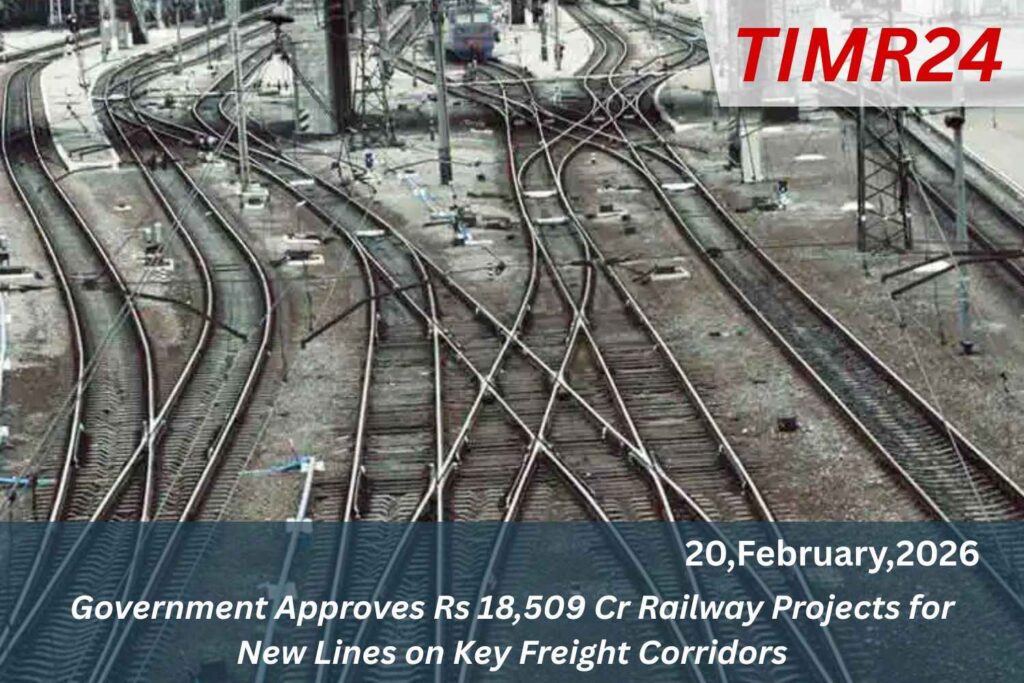
The government has sanctioned three railway infrastructure projects costing approximately Rs 18,509 crore aimed at increasing line capacity and reducing congestion for faster movement of passengers and freight. These projects include constructing third and fourth railway lines on crucial sections, enhancing operational efficiency, increasing train frequency, and strengthening logistics connectivity in key industrial regions. They align with Prime Minister Modi’s Vision of a New India and the PM-Gati Shakti National Master Plan, focusing on multi-modal connectivity. Covering 12 districts across Delhi, Haryana, Maharashtra, and Karnataka, the projects will extend.
Essential Commodities And Contribute
The railway network by about 389 km and improve connectivity for approximately 3,902 villages. They will also facilitate the transport of essential commodities and contribute to significant freight traffic increases while promoting environmental benefits through reduced oil imports and CO2 emissions The Government of India has recently taken a major stride to strengthen the nation’s railway infrastructure by approving Rs 18,509 crore worth of multitracking rail projects aimed at expanding key freight corridors. These projects, sanctioned by the Cabinet Committee on Economic Affairs (CCEA) under the leadership of Prime Minister Narendra Modi, are part of a broader.
Strategy to improve connectivity, support logistics efficiency, and enhance capacity on crucial passenger and goods transportation routes across the country The approved projects consist of constructing third and fourth railway lines on three major routes: the Delhi Ambala corridor, Kasara–Manmad section, and the Ballari–Hosapete stretch. These corridors are lifelines for both freight and passenger trains and are expected to witness significant increases in operational efficiency once the multitracking work is completed by 2030‑31 Indian Railways is one of the world’s largest rail networks and the backbone of the nation’s freight transportation. While traditional rail routes have served.
Improve Service Reliability
The country well, increased economic activity and growing demand for fast logistics solutions have highlighted the need for enhanced rail capacity. By adding additional tracks, the network can support more trains, reduce congestion, and improve service reliability The multitracking projects will increase the total network by about 389 km, directly benefiting key national freight corridors. Specifically, these upgrades are expected to support smoother operations and faster movement of goods, which is critical for industries ranging from agriculture and mining to manufacturing and export logistics One of the major corridors undergoing expansion is the Delhi–Ambala segment.
This region is a significant transit route for trains heading to northern India and links major urban centers with industrial hubs. Adding extra lines here will not only enhance freight movement but also improve passenger train punctuality and frequency The Kasara–Manmad (India) section, stretching across Maharashtra, has historically presented challenges due to steep gradients and operational bottlenecks. The construction of additional lines here is expected to reduce the reliance on banking locomotives engines that assist trains on steep inclines thereby saving operational costs and time The Ballari–Hosapete section lies on the busy Vasco da Gama–Vijayawada network.
Integrate With Broader National Efforts
Strengthening this stretch will support freight operations to ports and industries, especially in southern India, making it a focal point for regional economic growth These projects are not merely expansions but strategic enhancements that address long‑standing capacity constraints in India’s rail network. They are designed to integrate with broader national efforts such as the PM‑Gati Shakti National Master Plan, which aims to synergize infrastructure planning across multiple sectors The railway multitracking projects are expected to yield multiple economic and social benefits. Increased freight capacity means goods can be transported faster and at lower cost.
A crucial factor for industries dependent on efficient supply chains. Enhancements are also expected to create employment opportunities both during the construction phase and in ancillary sectors that benefit from better connectivity Moreover, improved rail connectivity (India) can enhance access to remote regions, linking rural areas to larger markets, healthcare, education, and employment centers. The expansion touches nearly 3,902 villages, directly impacting the lives of millions of people by boosting accessibility and promoting regional development From an environmental perspective, rail transport is significantly more carbon‑efficient compared to road freight.
Rail Projects Marks
Enhancing rail infrastructure encourages businesses to shift freight movement from road to rail, contributing to reduced emissions and aligning with long‑term sustainability goals The Indian government’s approval of Rs 18,509 cr rail projects marks a strategic move to scale up the nation’s rail capacity and efficiency. By adding multitrack lines to key corridors like Delhi‑Ambala, Kasara‑Manmad, and Ballari‑Hosapete, these projects promise to enhance freight mobility, reduce logistical bottlenecks, and support economic growth across major regions of the country. Integrated with national infrastructure plans, the rail network enhancements signal a sustained push toward a more efficient, connected, and future‑ready transportation system.
Q1. What are the Rs 18,509 cr rail projects recently approved by the Indian Government?
The Cabinet Committee on Economic Affairs (CCEA) approved three major multitracking rail projects Delhi‑Ambala, Kasara‑Manmad, and Ballari‑Hosapete corridors involving construction of third and fourth lines to boost capacity on key freight and passenger routes.
Q2. Which regions will benefit from these new rail lines?
These projects span Delhi, Haryana, Maharashtra, and Karnataka, covering 12 districts and adding approximately 389 km to the Indian Railways network.
Q3. What is the purpose of multitracking projects on these corridors?
Multitracking increases rail capacity, reduces congestion, improves reliability, decreases logistics costs, and enhances movement of both freight and passenger trains.
Q4. How do these rail projects fit into national planning?
These projects align with the PM‑Gati Shakti National Master Plan, a strategic initiative to improve multimodal connectivity and national logistics efficiency.
Q5. What economic benefits are expected from these projects?
The enhancements will support millions of tonnes of additional freight capacity annually, create jobs, and improve connectivity for thousands of villages and industries.