

















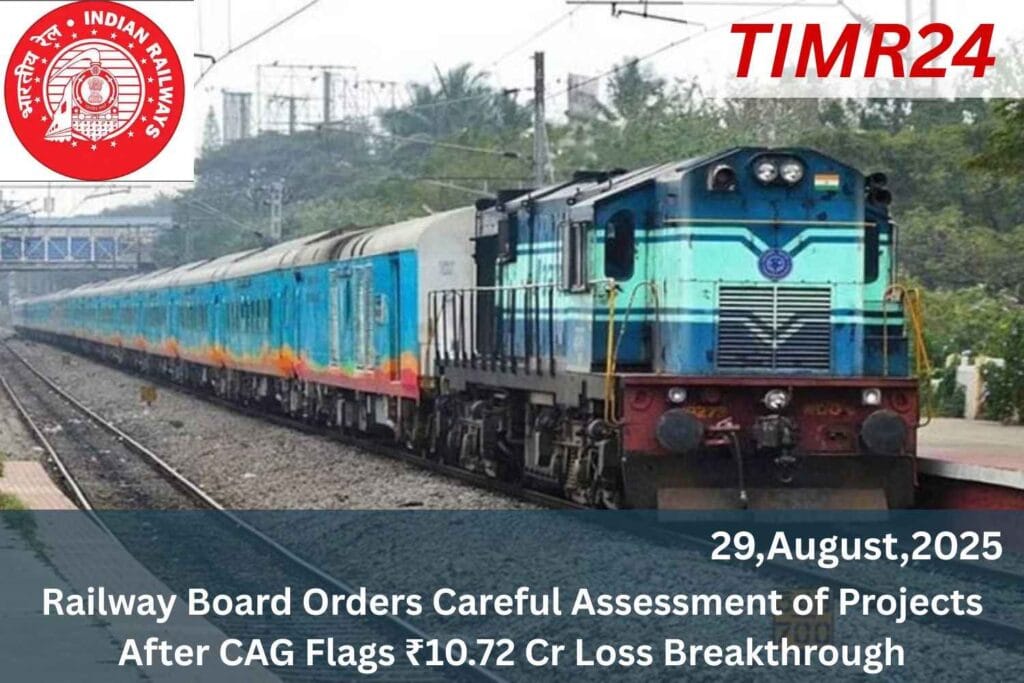
The Railway Board has ordered thorough assessments before infrastructure projects due to a ₹10.72 crore loss due to poor planning in a railway yard with unused pit lines. The Railway Board has recently taken a decisive step by ordering a detailed and careful assessment of ongoing and upcoming projects after the Comptroller and Auditor General (CAG) flagged a loss of ₹10.72 crore. This move has sparked discussions about financial accountability, project planning, and efficiency within Indian, which is often regarded as the backbone of the nation’s transportation network. The decision not only highlights the importance of transparent financial management but also emphasizes how crucial it is to align infrastructure growth with long-term sustainability.
The CAG, known for its strict auditing standards, raised concerns over mismanagement and financial lapses in certain projects. The report highlighted instances where improper planning, cost overruns, and inefficient execution led to avoidable losses. For example, delays in land acquisition, tender finalization, and procurement of essential resources significantly inflated project expenses. By exposing these gaps, the CAG’s findings have pushed the Railway Board to tighten its review processes and ensure better utilization of public funds. Readers interested in understanding similar past issues can also explore (Cabinet Approvals of Railway Projects) where large investments were scrutinized for accountability.
Railway Board’s Response to the Audit Findings
In response to the CAG’s observations, the Board has instructed zonal and divisional authorities to carefully re-examine all ongoing projects. This includes verifying cost estimates, timelines, and resource allocation. The Board emphasized that any new projects must undergo rigorous feasibility studies before receiving approval. This cautious approach aims to prevent future financial leakages and ensure projects deliver on their intended objectives. A comparable policy shift was earlier noticed when signaling how partnerships and structural reforms are increasingly becoming part of the solution. One of the major takeaways from this development is the importance of proper project planning and feasibility analysis. Indian Railways, with its vast network.
Often undertakes large-scale projects such as new lines, electrification, and station redevelopment. However, without a strong feasibility framework, these projects run the risk of incurring losses. The Railway Board’s recent order serves as a reminder that every project must be examined not just for its immediate utility but also for long-term operational and financial sustainability. For instance, projects The decision to conduct careful assessments is expected to influence how future railway investments are planned and implemented. With India aiming to expand high-speed rail corridors, modernize freight infrastructure, and improve passenger amenities, ensuring that funds are utilized effectively becomes paramount.
This shift in strategy may lead to slower approvals in the short term, but in the long run, it will foster greater financial discipline and better outcomes. Readers tracking infrastructure growth may also refer to which demonstrates how industrial investments are aligning with long-term planning models. Indian Railways has always been a symbol of progress and connectivity. However, balancing ambitious growth with strict financial accountability is a challenge. The Railway Board’s move represents an effort to strike this balance by ensuring that modernization efforts do not compromise transparency. The initiative also sets a precedent for other government sectors where large public funds are deployed. In the same spirit, developments like.
CAG’s report is a significant step towards
The Board’s directive also reflects a broader trend in Indian governance where audit findings are being taken more seriously Public sector undertakings are increasingly being held accountable for their financial and operational efficiency. By responding promptly to the CAG’s findings, the Railway Board has reinforced its commitment to good governance, something that will inspire public confidence. This cultural shift is essential as India continues to push for world-class infrastructure across sectors, from highways to renewable energy. The order by the Railway Board to carefully assess projects in the wake of the CAG’s report is a significant step towards greater transparency, accountability, and financial prudence. While the immediate concern is the ₹10.72 crore flagged loss,
The larger message is about building a culture of responsibility in project execution As Indian Railways prepares to expand its network and embrace modernization, this shift in approach will play a pivotal role in ensuring that infrastructure growth is sustainable, financially sound, and aligned with national development goals. For readers looking to explore related updates, the discussion around (Kuno National) also demonstrates how accountability measures influence infrastructure decisions in different contexts. Another key outcome of the Railway Board’s directive is the renewed focus on monitoring mechanisms. Traditionally, railway projects faced issues because of weak review structures where progress reports were either delayed or lacked accuracy.
Now, the emphasis is on establishing real-time monitoring through digital dashboards and advanced analytics. This digital push is expected to minimize gaps between field execution and board-level planning. Similar measures have been implemented in other sectors, such as Zonal railways, which play a central role in implementing projects, will now be made more accountable under the new guidelines. The Board has instructed zones to ensure that periodic audits are conducted internally even before the CAG steps in. This creates a proactive culture of identifying risks early and mitigating them effectively. By doing so, not only will financial mismanagement be reduced, but the overall efficiency of Indian will also improve.
For a public sector giant like Indian, public trust is built on two pillars: safety and financial responsibility. While safety continues to receive maximum attention, financial discipline is equally crucial to maintaining credibility. The CAG’s revelation of a ₹10.72 crore loss may appear small compared to the Railways’ vast annual budget, but it symbolizes deeper systemic concerns. By tightening financial discipline now, the Railway Board is sending a strong message that every rupee of taxpayer money will be protected. This principle of accountability resonates with other large project.
Q1. Why did the Railway Board order a reassessment of projects?
The Railway Board acted after the CAG flagged inefficiencies leading to a ₹10.72 crore loss, urging more careful project evaluation.
Q2. What role does CAG play in railway projects?
CAG audits government spending, highlighting mismanagement, losses, or irregularities, ensuring accountability in railway operations.
Q3. How will this reassessment benefit railway projects?
It will ensure better financial monitoring, cost control, and timely completion of projects, preventing unnecessary losses.
Q4. What reforms are expected in the Railway Board’s process?
Reforms include stricter audits, transparent project planning, improved monitoring tools, and digital tracking systems.
Q5. How does this decision impact passengers and stakeholders?
Efficient projects mean better railway infrastructure, timely services, and stronger trust among passengers and investors.