














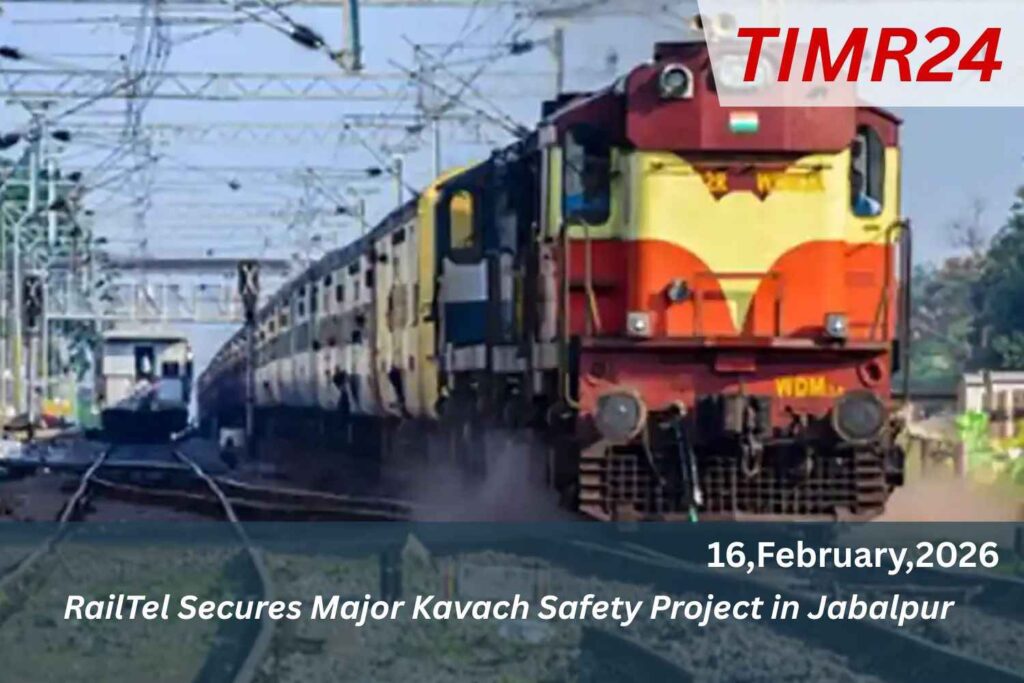
RailTel Corporation of India Ltd has received a Rs 455 crore contract from the Railway Ministry to implement the automatic train protection system Kavach across a 1,067 km route in the Jabalpur Division of West Central Railway. This system aims to enhance passenger safety by preventing collisions, over-speeding, and signal violations. RailTel will conduct comprehensive work including survey, design, supply, installation, testing, and commissioning of the Kavach systems at various sections, stations, and level crossings. The project aims to improve safety infrastructure in a critical railway division India’s railway infrastructure is undergoing a major transformation driven by.
Toward Strengthening Railway Safety
Technological innovation, safety enhancement initiatives, and large-scale modernization projects. In a significant development, RailTel Corporation of India has secured a ₹455 crore order to implement the Kavach automatic train protection system across 1,067 route kilometers in the Jabalpur Division of Indian Railways. The project represents a major step toward strengthening railway safety standards while accelerating the digital transformation of India’s vast railway network. This development reflects the government’s ongoing focus on deploying advanced safety technologies and modern communication systems to ensure reliable and secure train operations across key rail corridors.
The project involves the deployment of the indigenous Kavach system, an advanced safety technology designed to prevent train collisions and enhance operational control. The system uses real-time monitoring, radio communication, and automatic braking mechanisms to maintain safe distances between trains and prevent accidents caused by signal passing at danger. Developed as part of India’s push for self-reliant technological solutions, Kavach represents a major milestone in railway safety innovation. Its implementation demonstrates how modern digital infrastructure can significantly reduce human error and improve operational efficiency.
Division Requires High Standards
The Jabalpur Division plays a strategic role in India’s railway network, serving as an important junction connecting central India with major economic and passenger routes. With substantial passenger movement and freight operations, the division requires high standards of safety and operational efficiency. By installing the Kavach system across more than 1,000 kilometers, the project aims to enhance safety across one of the busiest sections of the railway network. The deployment is expected to support better traffic management, reduce accident risks, and improve overall service reliabilit RailTel’s role in the project highlights the growing importance of digital infrastructure.
Providers in transforming public transportation systems. As a leading telecom and ICT service provider for Indian Railways, the company specializes in network infrastructure, communication systems, and technology deployment across railway operations. The new contract strengthens RailTel’s position as a key technology partner in India’s railway modernization journey. The company’s expertise in optical fiber networks, broadband services, and signaling infrastructure enables efficient implementation of complex safety systems such as Kavach, ensuring seamless integration with existing railway operations The project also aligns with the broader vision of Indian Railways to modernize.
Network Expansion Initiatives
Its infrastructure through advanced technologies and indigenous innovations. Over the past decade, Indian Railways has been actively investing in safety enhancement measures, electrification projects, digital signaling systems, and network expansion initiatives. The adoption of automated train protection technologies like Kavach reflects a strategic shift toward proactive safety management rather than reactive measures. This shift is expected to significantly reduce accidents, improve passenger confidence, and enhance operational performance across the railway network From an economic perspective, the ₹455 crore order contributes to infrastructure development and job creation.
While supporting domestic technology development. Large-scale railway projects generate employment opportunities in engineering, telecommunications, construction, and system maintenance. Additionally, the deployment of indigenous technology strengthens India’s self-reliance in critical infrastructure sectors, reducing dependence on imported solutions and promoting local innovation. Such initiatives also attract investment and contribute to the growth of India’s infrastructure ecosystem Passenger safety remains a central objective of the Kavach deployment. The system continuously monitors train speed and location, automatically applying brakes.
Passenger Trust And Satisfaction
If a train exceeds permissible limits or approaches another train on the same track. This capability significantly reduces the likelihood of collisions and enhances operational reliability. Furthermore, improved safety standards lead to greater passenger trust and satisfaction, supporting the long-term growth of rail transport as a preferred mode of travel in India The implementation of Kavach in the Jabalpur Division also demonstrates the government’s commitment to achieving global standards in railway safety and operational excellence. Many advanced railway networks worldwide have adopted automated train protection systems to minimize risks and improve efficiency.
By investing in similar technologies, India aims to position its railway system among the most technologically advanced and safest in the world. The project reflects a forward-looking approach to infrastructure development, emphasizing sustainability, reliability, and innovation (India) Another significant aspect of the project is its contribution to digital connectivity within railway operations. Modern train protection systems rely on high-speed communication networks and data processing capabilities to function effectively. RailTel’s expertise in telecommunications infrastructure ensures reliable connectivity and seamless integration of safety technologies across.
Importance Of Public Sector Enterprises
The railway network This digital transformation not only enhances safety but also supports future innovations such as smart signaling, predictive maintenance, and automated traffic management systems.The project further reinforces the importance of public sector enterprises in driving large-scale infrastructure development in India. RailTel’s involvement demonstrates how government-backed organizations play a crucial role in implementing strategic projects that support national growth objectives. By leveraging their technical expertise and operational capabilities, such organizations contribute to the modernization of essential public services and infrastructure.
The successful implementation of the Kavach system in the Jabalpur Division is expected to serve as a model for similar deployments across other railway zones. As Indian Railways continues to expand and modernize its network, the adoption of advanced safety technologies will become increasingly important. The project represents a significant milestone in India’s journey toward a safer, more efficient, and technologically advanced railway system RailTel’s ₹455 crore order to deploy the Kavach system across 1,067 kilometers in the Jabalpur Division marks a major advancement in railway safety and modernization efforts.
The initiative highlights the integration of indigenous technology, digital infrastructure, and strategic investment to improve operational efficiency and passenger (India) safety. As India continues to invest in infrastructure development and technological innovation, projects like this will play a vital role in shaping the future of rail transportation and supporting sustainable economic growth.
Q1. What is the Kavach system in Indian Railways?
Kavach is an automatic train protection system developed in India to prevent train collisions and improve operational safety.
Q2. What project has RailTel received?
RailTel received a ₹455 crore order to install the Kavach system over 1,067 route kilometers in the Jabalpur Division.
Q3. How does Kavach improve railway safety?
It automatically controls train speed, prevents signal passing at danger, and applies emergency brakes when required.
Q4. Why is the Jabalpur Division important?
The division is a key rail corridor connecting central India and handling significant passenger and freight traffic.
Q5. How does this project benefit passengers?
It enhances travel safety, improves train reliability, and supports modernization of railway infrastructure.