















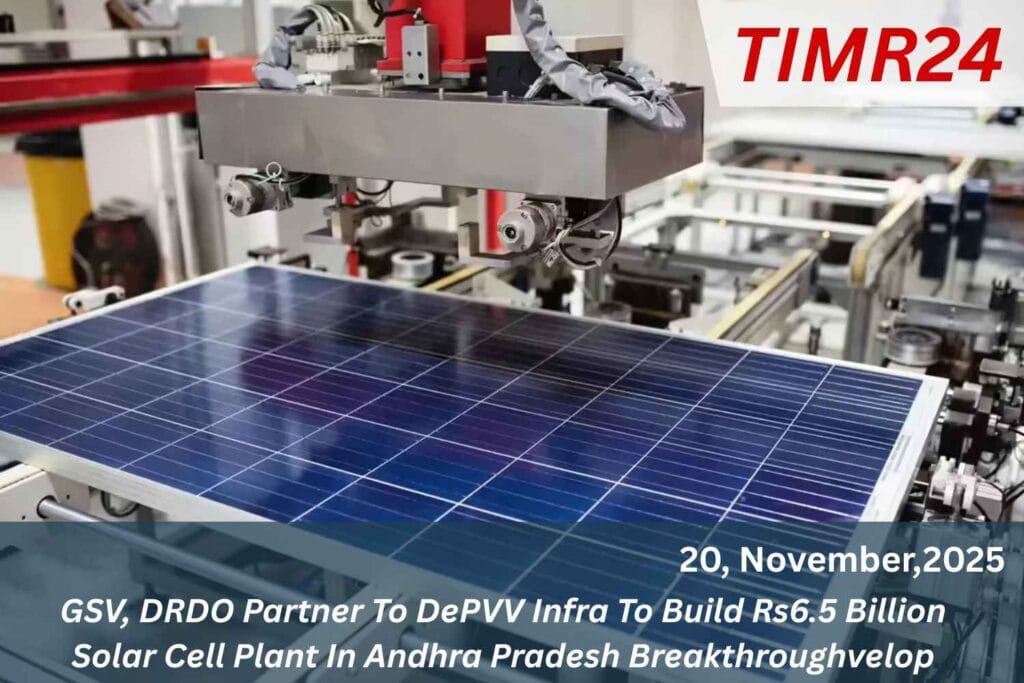
PVV Infra Ltd. has signed an MoU with the Andhra Pradesh Economic Development Board to establish a solar cell manufacturing facility in Visakhapatnam, representing an investment of Rs6.5 billion. The facility, located on a 30-acre site near the airport, aims to create approximately 350 direct and over 450 indirect jobs. PVV Infra will leverage its expertise in investment, technology, planning, design, and equipment sourcing to operationalize the advanced TOPCon solar cell production unit, reinforcing India’s renewable energy infrastructure and promoting sustainable industrial growth in Andhra Pradesh. PVV Infra’s decision to establish a ₹6.5 billion solar cell.
Manufacturing plant in Andhra Pradesh marks a turning point in India’s renewable energy landscape and sets the stage for a new era of domestic clean-tech production that aligns firmly with the nation’s long-term vision for energy independence. With India racing to expand its solar capacity and reduce dependence on imported photovoltaic components, the state-of-the-art facility proposed by PVV Infra comes at a time when global supply chains are realigning and nations are accelerating investment in strategic green technologies. The plant is expected to become a cornerstone project in Andhra Pradesh’s industrial expansion story, supporting both.
Domestic Manufacturing
National renewable energy targets and the state government’s push to attract manufacturing investments that generate local jobs and technological advancement. As India deepens its transition under programs such as the Production Linked Incentive scheme and its broader Atmanirbhar Bharat initiative, PVV Infra’s project introduces a strong domestic manufacturing base that can support the country’s expanding solar infrastructure needs. This is particularly relevant at a moment when demand for high-efficiency solar cells is rising across residential, commercial, industrial, and utility-scale segments, and developers are increasingly seeking reliable, home-grown suppliers to ensure long-term project viability.
The upcoming plant is also expected to support Andhra Pradesh’s growing renewable energy ecosystem, which has been steadily expanding due to the state’s proactive policies, abundant land, strong power infrastructure, and coastal connectivity that aids export potential. PVV Infra’s investment aligns with the state’s economic development blueprint that focuses on green energy, advanced manufacturing, and future-oriented industries that can attract technology partners, supply-chain vendors, and skilled professionals. The new manufacturing facility is likely to cluster around emerging clean-tech corridors, allowing local MSMEs and suppliers to integrate into.
Renewable Energy Strategy
The solar ecosystem, while enabling the state to position itself as a competitive manufacturing hub in India’s broader renewable energy strategy from a technology standpoint, the plant is expected to incorporate advanced machinery and production lines capable of delivering high-efficiency solar cells suited for next-generation photovoltaic modules. As India pushes for higher efficiency standards in solar projects and greater longevity in performance, manufacturers like PVV Infra stepping into the space with modern manufacturing systems will improve overall quality benchmarks across the sector. The facility may also enable collaborations with technology.
Providers, R&D institutions, and testing laboratories ensure continuous upgrades to manufacturing processes. Such developments often encourage parallel investments in module manufacturing, inverter production, and ancillary components, gradually building a more self-reliant solar industry. Interested readers exploring the broader industrial impact of manufacturing projects can refer to infrastructure investments, which provide deeper insights into how such projects influence India’s economic growth. The socio-economic impact of PVV Infra’s plant is also expected to be substantial, as large-scale manufacturing units typically generate significant.
Services, Including Transportation
Direct and indirect employment. Local youth in Andhra Pradesh stand to benefit from opportunities across engineering, quality control, production operations, logistics, and administrative roles. In addition, ancillary services, including transportation, warehousing, fabrication, packaging, and maintenance, are likely to expand as supply-chain networks build around the facility. As clean energy manufacturing grows, training institutions and skill development programs in the region may also adapt their curriculum to meet industry requirements, creating a more future-ready workforce. At the national level, the investment supports India’s goal of reducing reliance on.
Rooftop Solar Incentives
Imported solar cells and modules, particularly from countries that currently dominate the global solar supply chain. This move enhances India’s strategic energy security while positioning the country as a competitive player in the global solar equipment market. As renewable energy projects expand nationwide from utility-scale solar parks to rooftop solar incentives, the demand for domestically manufactured high-quality solar cells will continue rising. Companies like PVV Infra stepping into large-scale production help stabilize supply, improve procurement efficiency, and reduce foreign exchange outflows. In the longer term, this could enable India to emerge.
As a regional supplier of solar components to markets in South Asia, the Middle East, and Africa. For complementary insights on how different states contribute to national renewable energy goals, Government policy frameworks will also play a crucial role in supporting the (Solar) success of this project. Initiatives such as customs duty protections, PLI schemes, interest subvention programs, and single-window approvals in Andhra Pradesh provide manufacturing companies with a conducive environment for long-term growth. These policies are designed to reduce operational burdens and encourage firms to scale production in phases, possibly expanding into modules.
Manufacturing Announcement
Wafers, or vertically integrated solar production chains, are being used as demand grows. The synergy between supportive policy frameworks and industrial capability is essential to building a sustainable solar manufacturing ecosystem in India. As the renewable energy transition accelerates, PVV Infra’s investment represents more than just a manufacturing announcement it underscores a collective national movement toward sustainability, innovation, and self-reliance. The plant not only strengthens India’s clean energy backbone but also enhances.
The technological competitiveness of the domestic solar industry. Its presence in Andhra Pradesh sets the stage for new partnerships, economic upliftment, and technological (Solar) progress that will ripple across the entire green energy value chain. With climate commitments rising and energy needs expanding, such high-impact investments shape the future of India’s energy landscape and broaden the nation’s global influence in the renewable energy marketplace.
Q1. What is the total investment PVV Infra is making in the new solar cell plant?
PVV Infra is investing ₹6.5 billion to set up a modern solar cell manufacturing facility in Andhra Pradesh, aimed at strengthening domestic clean-energy production.
Q2. Where will the new solar plant be located in Andhra Pradesh?
The company is establishing the manufacturing unit within an emerging industrial zone in Andhra Pradesh that supports renewable energy clusters and supply-chain connectivity.
Q3. How will this project benefit the renewable energy sector?
The plant boosts domestic solar cell availability, reduces import dependence, improves module efficiency, and supports India’s solar expansion targets under national clean-energy missions.
Q4. Will the PVV Infra solar cell plant generate employment?
Yes, the project is expected to create significant direct and indirect jobs across manufacturing, operations, logistics, and ancillary services for local communities.
Q5. Does this project align with government clean-energy policies?
Absolutely. It supports the Atmanirbhar Bharat initiative, PLI schemes, renewable energy targets, and state-level industrial development programs focused on clean-tech growth.