


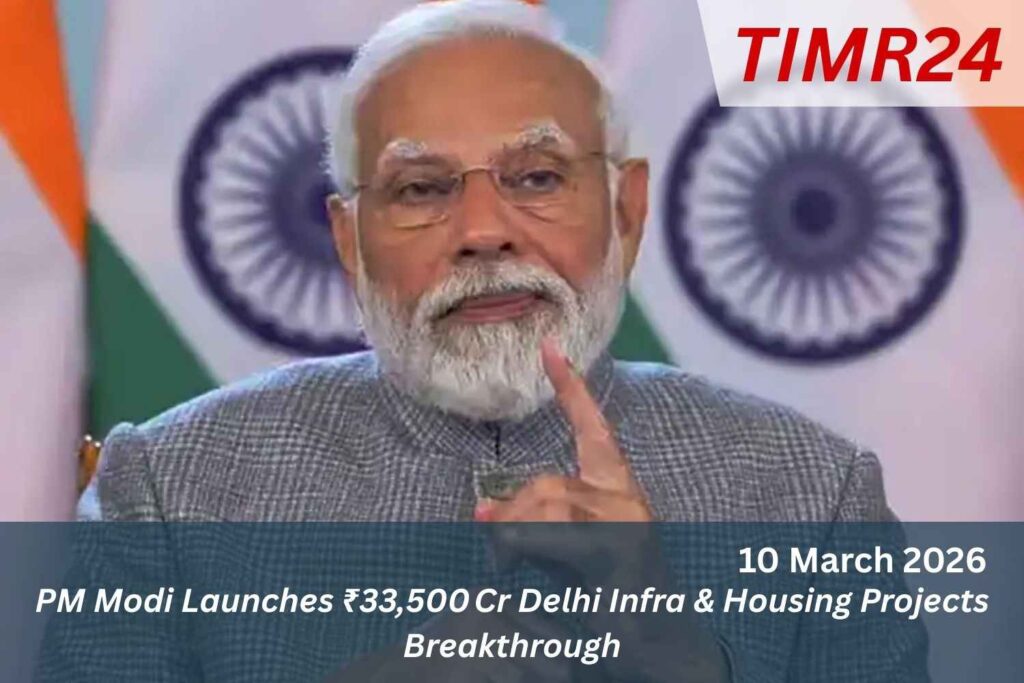
PM Narendra Modi inaugurated and laid the foundation stone for development projects in Delhi valued at approximately Rs 33,500 crore, focusing on metro expansion, government housing redevelopment, and modern office infrastructure. Key highlights include the redevelopment of seven General Pool Residential Accommodation (GPRA) colonies, introducing over 2,700 new government flats and office facilities, along with the foundation for 6,600 additional GPRA flats and eight office towers at the Bharat Business Park. This project, which encompasses around 2.17 lakh square metres, emphasizes energy efficiency, incorporating solar panels, EV charging, and rainwater harvesting.
Initially approved by the Union Cabinet in July 2016, the programme is designed to modernize Delhi’s government housing infrastructure, alongside ongoing metro network expansions and urban transport upgrades In a landmark development for India’s capital, Prime Minister Narendra Modi inaugurated a series of infrastructure and housing projects in Delhi, collectively valued at ₹33,500 crore. These projects, spanning transportation, housing, and urban amenities, aim to enhance the quality of life for Delhi’s residents, reduce congestion, and support sustainable urban growth. This initiative underscores the government’s commitment to modernizing urban infrastructure while ensuring affordable housing for all sections of society.
The launch event, held in the heart of the city, witnessed significant political and administrative presence, with senior officials, city planners, and stakeholders from the construction and real estate sectors in attendance. PM Modi emphasized that the projects are not only critical for Delhi’s development but also play a strategic role in strengthening India’s overall urban infrastructure network.
Key Highlights of the ₹33,500 Cr Projects
Urban Housing Expansion:
The government has earmarked a substantial portion of the budget for the construction of affordable and middle-income housing units across the capital. These projects aim to address the growing demand for residential spaces in Delhi while promoting sustainable urban planning. The housing units are equipped with modern amenities, green spaces, and smart technology integration, reflecting the vision of future-ready urban living.Metro and Transport Infrastructure:
Delhi’s metro system, already a backbone of urban mobility, is set to witness further expansion under this initiative. New metro lines, extensions, and state-of-the-art stations are included to improve connectivity across the city. The projects also focus on enhancing last-mile connectivity, reducing travel time, and promoting eco-friendly transport solutions to combat pollution and traffic congestion.Road and Bridge Development:
A significant portion of the budget has been allocated for constructing new roads, flyovers, and footbridges to decongest critical urban corridors. Modern engineering techniques, including seismic-resistant designs and smart traffic management systems, will be employed to ensure long-term durability and safety. These projects aim to facilitate smoother traffic flow and improve the overall commuting experience for residents.Smart City Features:
The projects also integrate digital and smart solutions such as automated traffic management, intelligent street lighting, surveillance systems, and waste management technologies. By embedding technology into urban planning, Delhi is moving towards becoming a smart and sustainable city capable of addressing the demands of its growing population efficiently.Environmental and Sustainability Measures:
Recognizing the importance of green infrastructure, the projects include urban parks, water conservation initiatives, renewable energy installations, and eco-friendly building materials. The government has also emphasized energy-efficient designs and pollution mitigation measures to ensure that urban development aligns with environmental sustainability goals.
Impact on Delhi Residents
The comprehensive infrastructure plan is expected to have far-reaching benefits for the citizens of Delhi. Improved transport and metro connectivity will make commuting faster and more convenient, particularly for people residing in suburban areas. Affordable housing projects will alleviate the housing shortage and provide dignified living conditions for economically weaker sections. Additionally, the development of roads, bridges, and footpaths will enhance overall urban mobility, reduce traffic congestion, and improve safety for pedestrians and motorists alike.
PM Modi highlighted that these projects are designed to foster inclusivity, ensuring that benefits reach all socio-economic groups. The focus on sustainable and smart infrastructure will also contribute to improving the quality of life, making Delhi a model city for urban planning and development across India.
Government Vision and Long-Term Strategy
The launch of these projects aligns with the government’s broader vision of urban transformation under the Smart Cities Mission and the Housing for All initiative. By investing in state-of-the-art infrastructure, the government aims to create cities that are not only functional but also livable, resilient, and environmentally sustainable. Delhi, being the national capital, serves as a benchmark for other cities, and these projects are expected to set new standards in urban development The initiative also seeks to generate employment opportunities across sectors such as construction, real estate, transport, and technology. By involving local contractors, laborers, and professionals.
Challenges And Implementation Strategies
The projects will contribute to economic growth while building capacity and skillsets in modern infrastructure development. While the projects promise transformative outcomes, their successful execution requires careful planning, coordination, and monitoring. Key challenges include land acquisition, urban congestion during construction, and ensuring adherence to safety and environmental standards. To address these, the government has adopted a multi-pronged approach, including:
Digitally tracking project progress through centralized dashboards
Engaging local communities and stakeholders to minimize disruptions
Implementing strict quality checks and using advanced construction technologies
Prioritizing eco-friendly materials and designs to mitigate environmental impact
These strategies aim to ensure that projects are completed on schedule and meet the intended standards of quality, safety, and sustainability.
Integration With National Urban Development Goals
The ₹33,500 Cr investment in Delhi’s infrastructure and housing is not an isolated initiative but part of a larger effort to strengthen India’s urban ecosystem. The projects complement national schemes such as the Pradhan Mantri Awas Yojana (PMAY), the Smart Cities Mission, and initiatives promoting sustainable transport and renewable energy. By aligning local urban development with national objectives, the government seeks to create cohesive, modern, and resilient cities capable of supporting India’s rapid urbanization.
Public and Expert Reactions
Urban planners, economists, and public policy experts have welcomed the announcement, noting that the scale and scope of the projects are unprecedented in recent years. Experts have particularly highlighted the emphasis on sustainability, smart technology integration, and affordable housing as key differentiators that can make Delhi a global model city.
Residents have expressed optimism, especially regarding improved metro connectivity, better roads, and the availability of affordable housing. Many hope that (India) these projects will reduce daily commuting challenges, enhance urban amenities, and create greener, more livable neighborhoods.
Conclusion
The launch of ₹33,500 Cr worth of infrastructure and housing projects in Delhi marks a pivotal moment in the city’s urban transformation journey. By investing in modern transport systems, affordable housing, smart city solutions, and sustainable infrastructure, the government aims to enhance the quality of life for Delhi’s residents and set a benchmark for urban development nationwide PM Modi’s announcement reflects a holistic approach to city planning, where technology, sustainability, and inclusivity converge to create a future-ready capital. With careful execution and monitoring, these projects have the potential to redefine urban living in Delhi, reduce congestion.
Improve accessibility, and create thriving neighborhoods for generations to come The initiatives also send a strong message about India’s commitment to modern urban governance, sustainable development, and citizen-centric planning. As Delhi embarks on this transformative journey, it exemplifies how large-scale, well-coordinated infrastructure investments can drive economic growth, social well-being, and environmental sustainability, shaping the city as a model capital for India and the world.
With timely execution, public engagement, and a focus on innovation, the ₹33,500 Cr investment is expected to yield long-term benefits that extend beyond (India) urban infrastructure enhancing the city’s cultural, social, and economic fabric while strengthening its role as the political, administrative, and economic hub of India.
Q1. What is the total investment amount for the Delhi projects launched by PM Modi?
A1. The total investment is approximately ₹33,500 crore covering metro expansions, housing redevelopment and urban infrastructure.
Q2. Which metro corridors have been inaugurated in this ₹33,500 crore project?
A2. Two major corridors inaugurated are the Majlis Park–Maujpur Babarpur (Pink Line) and Deepali Chowk–Majlis Park (Magenta Line).
Q3. What is the GPRA redevelopment plan?
A3. The General Pool Residential Accommodation (GPRA) plan aims to modernise ageing government housing colonies with new residential units and improved infrastructure.
Q4. Which new metro corridors have had their foundation stones laid under Phase V‑A?
A4. Foundation stones were laid for three corridors: RK Ashram Marg–Indraprastha, Aerocity–IGI Airport Terminal‑1, and Tughlakabad Kalindi Kunj.
Q5. How will these projects benefit commuters and residents?
A5. These projects improve connectivity, reduce travel time, expand metro reach, modernise housing and support economic activity in Delhi.