












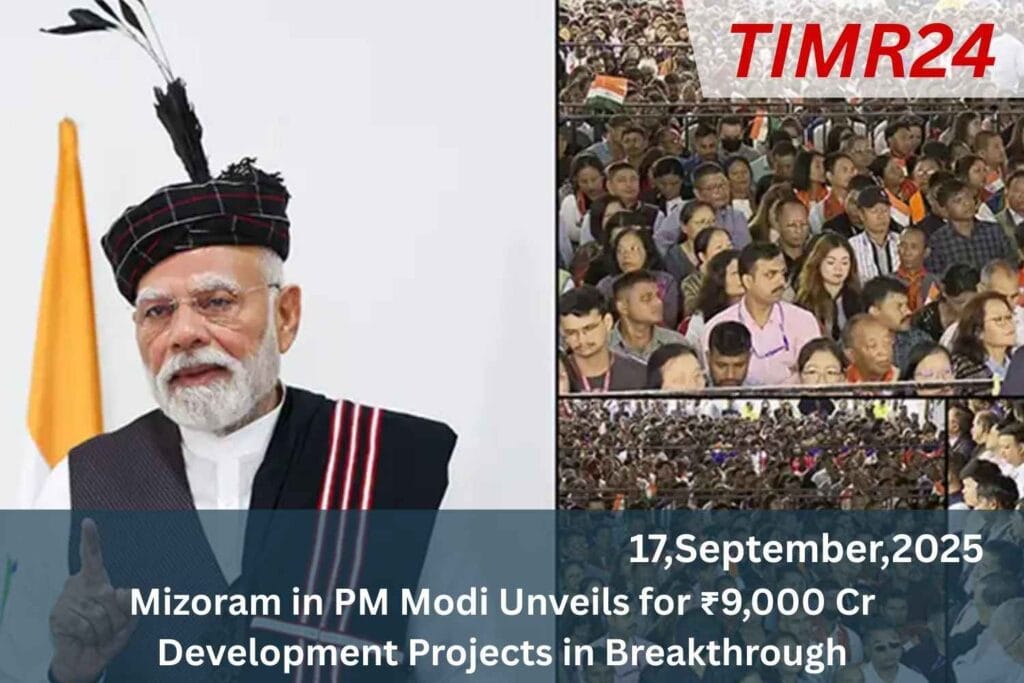
Prime Minister Shri Narendra Modi Inaugurated Development Projects works worth over ₹9,000 crore in Aizawl, Mizoram, marking a historic milestone for the state and the region. The Bairabi-Sairang New Rail line, worth over Rs 8,070 crore, connects Mizoram to the Indian Railways network for the first time, offering safe, efficient, and cost-effective travel options. The rail line Project includes 45 tunnels, 55 major bridges, and 88 minor bridges. Three new express trains, the Sairang-Delhi Rajdhani express, Sairang-Guwahati Express, and Sairang-Kolkata Express, will improve access to hospitals, universities, and markets, strengthening educational, cultural, and economic ties across.
The region. The infrastructure development scheme NESIDS (Roads) will benefit horticulture farmers, dragon fruit growers, paddy cultivators, and ginger processors, while the Khankawn Rongura Road will provide better access to markets and support the planned Ginger Processing Plant. The Chhimtuipui River Bridge will provide all-weather connectivity and support cross-border commerce under the Kaladan Multimodal Transit framework. The Khelo India Multipurpose Indoor Hall for Sports Development will provide modern sports facilities, while the 30 TMTPA LPG Bottling Plant will ensure a steady supply of LPG in Mizoram and neighbouring states. The Prime Minister also inaugurated.
Residential Schools at Karthik and Eklavya Model Residential School at Tangyuan Prime Minister Narendra Modi’s inauguration of over ₹9,000 crore worth of development projects in Mizoram marks one of the most ambitious infrastructure pushes in the state’s history. Spread across transportation, energy, education, and social infrastructure, these projects reflect both a vision for Northeast India’s integration and a strategy to strengthen the region under the Act East Policy. By laying foundations for railways, roads, schools, and fuel facilities, the initiative connects Mizoram more closely with the rest of India and prepares the state for long-term growth.
Railway Connectivity A New Era for Mizoram
At the center of this announcement lies the Bairabi Sairang railway line, a 51.38 km project designed to connect the state capital Aizawl to the Indian Railways network for the very first time. This connectivity is not only symbolic but also transformative, as it enables faster and safer transportation of both passengers and essential goods across the region’s challenging terrain. With multiple tunnels and bridges, this project demonstrates engineering excellence and national commitment to overcoming geographical isolation. For a deeper look at Northeast rail expansion, readers can explore our coverage of Externally, the (Ministry of Railways) provides official technical details of the Bairabi–Sairang line and its role in India’s overall railway modernization plan.
Along with the railway line, Modi flagged off three key train services: the Sairang-Delhi Rajdhani Express (weekly), the Sairang–Guwahati Express (daily), and the Sairang–Kolkata Express (tri-weekly). These links dramatically reduce travel times and improve socio-economic integration by connecting Mizoram directly with important trade, educational, and healthcare hubs. Such long-distance connectivity will make it easier for students to pursue opportunities outside the state and for businesses to expand operations within Mizoram. Our article on the highlights how these links are part of a broader strategic vision for the region.
Road Projects Building Seamless Access
Another major element of the ₹9,000 crore investment is the construction and upgrading of key roadways. Projects such as the Aizawl Bypass Road (western side), the Thenzawl–Sialsuk Road, and the Khankawn–Rongura Road aim to cut congestion in urban centers and reduce travel times in rural belts. The Aizawl Bypass alone is expected to ease traffic pressure significantly, while the southern road upgrades will shorten travel by over an hour and a half. Such infrastructure is vital not only for commuters but also for farmers who rely on roads to move products like ginger, turmeric, and horticultural crops to larger markets.
The announcement also included the Chhimtuipui River Bridge on the Lawngtlai-Siaha Road, a crucial link under the Kaladan Multimodal Transit framework. This bridge ensures year-round connectivity in otherwise remote and flood-prone districts, opening new possibilities for cross-border trade with Myanmar. To understand more about this corridor, see our piece on the External readers may refer to for updates on Kaladan’s trade potential Beyond hard infrastructure, the development package also prioritized educational and sporting facilities. The inauguration of an Eklavya Model Residential School in Tangyuan and a new residential school in Karthik brings world-class learning.
Environments to Mizoram’s tribal youth. With modern classrooms, hostels, and technology integration, these schools are expected to improve enrolment, reduce dropout rates, and nurture future leaders. The government’s approach reflects an emphasis on inclusive education for marginalized communities. More insights are available in our feature on To complement education, sports infrastructure was also addressed through the foundation stone for a Khelo India Multipurpose Indoor Hall at Tikal. This hall will not only promote sports like badminton, basketball, and volleyball but will also act as a community hub for youth development. Sporting investment in Mizoram has historically yielded national-level talent, and this new facility continues that tradition. By linking educational.
Opportunities with sporting facilities, the government is investing in holistic human capital development A major highlight among these projects is the establishment of a 30 TMTPA LPG bottling plant at Mulching, designed to ensure reliable access to clean cooking fuel. In Mizoram, as in other hilly regions, accessibility to LPG has often been a challenge due to transport constraints. With this facility in place, households will benefit from timely, affordable, and sustainable energy supply. This shift away from biomass not only improves public health but also supports India’s environmental commitments. Readers interested in clean energy transitions can see our report on.
Economic & Social Impact: Transforming Mizoram’s Growth Story
(India’s Energy) For official references detailed updates under the PM-DeVine scheme, which has guided many Northeastern infrastructure initiatives. The combined impact of these projects is expected to be far-reaching. Enhanced railway and road networks will encourage local entrepreneurs, improve agricultural trade, and reduce costs for businesses. Educational and sporting infrastructure will foster new opportunities for youth and strengthen the human development index of the state. Energy investments will directly improve quality of life, reduce indoor pollution, and align Mizoram with global sustainability goals Moreover, Mizoram’s improved connectivity strengthens.
A Future-Ready Mizoram
Its role as a vital gateway under India’s Act East Policy, boosting trade and cultural ties with Southeast Asia. The Kaladan corridor, now reinforced with bridges and better roads, holds the promise of making Mizoram a logistics hub for cross-border commerce. This aligns with India’s vision of Northeast India not as a remote periphery but as the “Growth Engine” of the nation. Taken together, the ₹9,000 crore development push is more than just an infrastructure package it is a roadmap for Mizoram’s future. By connecting Aizawl to India’s railway network, building resilient roads, enhancing social and educational infrastructure, and ensuring access to clean fuel, the state is being.
Positioned for inclusive growth. These projects are not isolated investments but parts of a carefully woven fabric of connectivity, social equity, and sustainable development For further exploration, readers can check internal resources such as our article or external sources like the for on-the-ground reporting. Together, they provide a fuller understanding of how Mizoram is entering a new era of opportunity As these initiatives unfold, Mizoram’s citizens will not only gain better access to infrastructure but will also find themselves more deeply (NHAI) connected to India’s development journey. This convergence of physical, social, and economic growth represents a breakthrough moment.
Q1. What are the key projects unveiled in Mizoram worth ₹9,000 crore?
Projects include the Bairabi–Sairang railway line (51.38 km), three new express trains, road projects such as the Aizawl Bypass Road, Thenzawl–Sialsuk Road and Khankawn–Rongura Road, a Chhimtuipui River Bridge, sports & education infrastructure like an indoor hall and schools, and an LPG bottling plant.
Q2. What is the significance of the Bairabi–Sairang railway line?
The Bairabi–Sairang line is the first railway connectivity for the state capital Aizawl to the Indian Railways network. It traverses challenging hilly terrain with tunnels and bridges and is expected to boost connectivity, ease travel, improve movement of goods and improve overall socio-economic integration.