















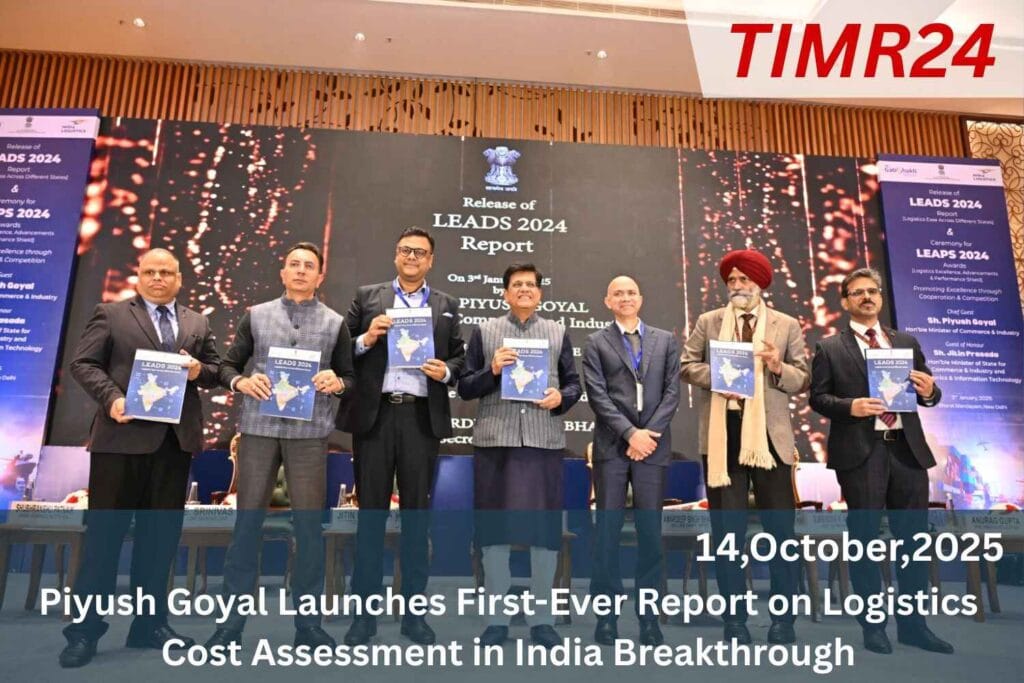
India has achieved a significant milestone in its economic and infrastructure journey as Union Minister for Commerce and Industry, Piyush Goyal, unveiled the first-ever “Logistics Cost Assessment Report of India”. This breakthrough marks a new phase in understanding and optimizing the nation’s logistics sector, which plays a crucial role in the overall competitiveness of Indian industries. The report, prepared by the Division of the Department for Promotion of Industry and Internal Trade (DPIIT) in collaboration with leading research institutions, offers a comprehensive analysis of India’s logistics cost structure. It also presents a strategic roadmap.
To reduce logistics expenditure and strengthen India’s position as a global manufacturing and export The logistics sector forms the backbone of any economy, ensuring the smooth flow of goods and services across regions. In India, logistics has traditionally been one of the most complex and cost-intensive segments. Studies indicate that logistics costs in India hover around 8–10% of GDP, compared to 6–8% in developed economies like the United States and Germany. This higher cost burden affects both domestic industries and international trade competitiveness Piyush Goyal highlighted that the Logistics Cost Assessment Report is a crucial step in bridging the data.
Gap and creating a transparent framework for policy intervention. The report evaluates costs associated with transportation, warehousing, Inventory Management, and administrative inefficiencies across various sectors. The comprehensive data-driven methodology not only helps in understanding the root causes of inefficiencies but also provides actionable insights for policymakers and private stakeholders to streamline operations.
Methodology and Scope of the Report
The assessment adopts a scientific and multi-dimensional approach to quantify logistics costs across supply chains. It integrates primary and secondary data from multiple industries, including automotive, agriculture, textiles, pharmaceuticals, and e-commerce. The report emphasizes the impact of transport modal mix road, rail, air, and waterways on overall logistics efficiency Using international best practices and national data sources such as the National Statistical Office (NSO), Inland Waterways Authority of India (IWAI), and Indian Railways, the study provides a comprehensive cost model. The report further examines how poor last-mile connectivity, inadequate.
Multimodal integration, and limited use of digital logistics platforms contribute to rising costs This robust analysis forms the foundation for developing a National Logistics Policy framework, which aims to transform the sector through better coordination, digitalization, and infrastructure investment Over the past few years, the Government of India has rolled out several initiatives to enhance the efficiency of the logistics sector. The PM GatiShakti National Master Plan (NMP), launched in 2021, is a central pillar of this transformation. It integrates infrastructure planning across ministries and departments, ensuring a unified approach to logistics development.
Through this platform, projects related to highways, railways, ports, airports, and inland waterways are being synchronized to eliminate bottlenecks and duplication The Cost Assessment Report aligns closely with PM GatiShakti objectives by providing an empirical foundation for future decision-making. The findings will guide ministries in optimizing investments under schemes like Bharatmala, Sagarmala, and Dedicated Freight Corridors, all of which aim to boost multimodal logistics connectivity Moreover, the National Policy (NLP), introduced in 2022, continues to play an instrumental role The NLP focuses on improving supply chain.
Key Insights and Findings
Resilience, promoting logistics start-ups, and encouraging digital innovations like Unified Logistics Interface Platform (ULIP). Together, these initiatives are expected to reduce (National Logistics) costs by 4% of GDP by 2030, strengthening India’s goal of becoming a global manufacturing hub under the Make in India initiative The report identifies several major cost drivers in India’s ecosystem. Firstly, the high dependence on road transport, which handles more than 65% of freight movement, leads to higher fuel expenses and time delays. Secondly, warehouse fragmentation and inconsistent standards across states increase inventory and storage.
Costs Thirdly, the lack of integrated transport planning results in inefficiencies during modal transitions Another crucial finding is the low share of coastal and inland water transport, despite India’s vast maritime network. Shifting freight movement towards waterways could reduce costs by nearly 30%, while also cutting carbon Emissions. The report also emphasizes the importance of adopting green practices, promoting electric vehicles, and integrating smart warehousing technologies Additionally, the report calls for greater investment in logistics education and skill development, highlighting that human resource capabilities are essential to building a modern logistics ecosystem.
Role of Digitalization and Innovation
Piyush Goyal underlined that technology is the key enabler for reducing logistics costs and improving efficiency. Platforms like ULIP, which connect various digital systems of stakeholders, are already creating transparency and reducing paperwork. The integration of IoT-based fleet management systems, AI-driven route optimization, and blockchain-based documentation are set to revolutionize the sector Moreover, the report promotes data interoperability across public and private systems to ensure real-time tracking, predictive analytics, and better risk management. This digital transformation will not only benefit operators but also provide end-to-end visibility for manufacturers, exporters, and consumers.
The Logistics Cost Assessment Report serves as a cornerstone for India’s future economic strategy. By systematically addressing inefficiencies, India can significantly enhance its global competitiveness and export potential. Reducing logistics costs from 9% to around 6% of GDP could save the economy over ₹3 lakh crore annually, enabling more affordable goods and boosting industrial productivity Furthermore, the integration of sustainable practices like renewable energy use in transport, optimized routes, and low-emission vehicles will contribute to India’s net-zero emission goals by 2070. The report also encourages public-private partnerships.
Conclusion
(PPP) to develop parks, cold chains, and multimodal terminals. These partnerships can accelerate the pace of infrastructure development while ensuring long-term cost efficiency The launch of the first-ever Cost Assessment Report of India by Piyush Goyal represents a turning point in India’s landscape. It is not just a statistical report but a strategic blueprint for transforming India into a cost-efficient, sustainable, and globally competitive economy. By combining policy innovation, infrastructure modernization, and digital integration, the government aims to make logistics a key driver of economic growth As India moves forward with initiatives like.
PM GatiShakti and the National Policy, the insights from this report will continue to shape reforms, investments, and innovation across the logistics value chain (ADB) Ultimately, this milestone will help fulfil India’s vision of becoming a world-class hub, supporting its manufacturing and export ambitions on the global stage.
Q1. What is the Logistics Cost Assessment Report (LCAR)?
LCAR is a government initiative to analyse India’s logistics cost structure and identify areas for optimization.
Q2. Who launched the report?
The report was launched by Union Minister Piyush Goyal under the Ministry of Commerce & Industry.
Q3. Why is this report important for India?
It aims to reduce logistics costs and boost export competitiveness, helping India reach global trade benchmarks.
Q4. Which organizations collaborated in preparing this report?
The Ministry of Commerce & Industry collaborated with the Asian Development Bank (ADB).
Q5. How will it benefit businesses?
It will streamline supply chains, reduce transportation costs, and improve delivery timelines for MSMEs and exporters.