












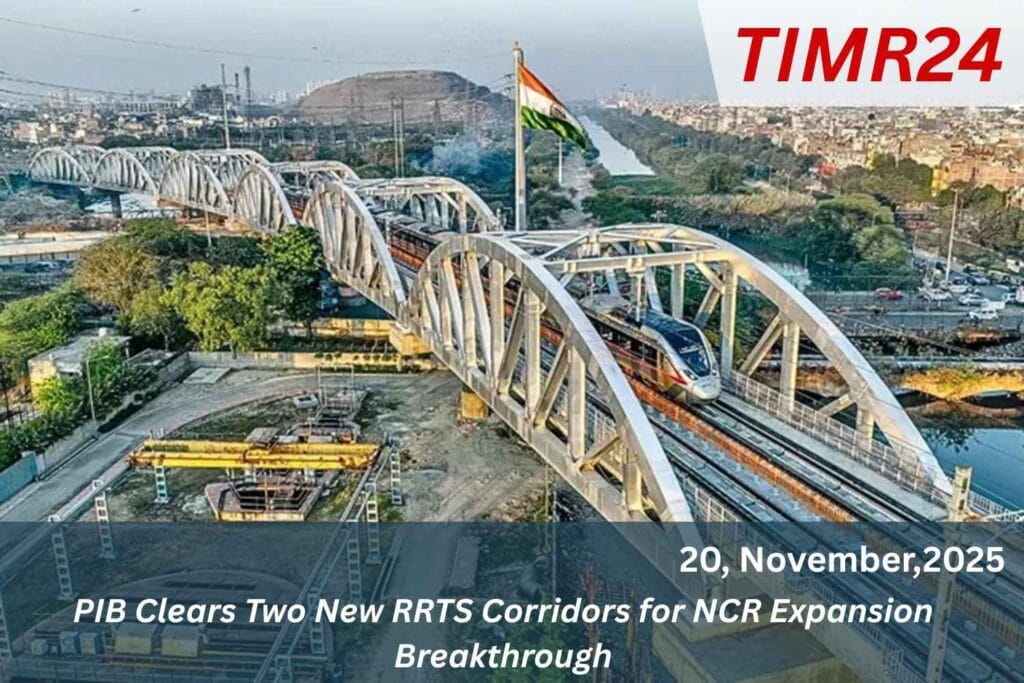
The Public Investment PIB Board has approved two new Namo Bharat rapid rail corridors linking Delhi with urban and industrial hubs in Haryana, valued at Rs 65,000 crore. The 93-km Sarai Kale Khan–Bawal route will have about twenty-two stations and follow the NH-8 corridor, while the 136-km Sarai Kale Khan–Karnal line will connect towns like Sonipat and Panipat. Currently, the only operational RRTS route is the Delhi–Meerut corridor, which has a 55-km segment in service between New Ashok Nagar and Meerut South. The approval of two new Regional Rapid Transit System (RRTS) corridors by the Press Information Bureau marks one of the most influential developments in NCR’s transportation landscape. As NCR’s population continues to swell and economic activities.
Spread across multiple urban nodes, the demand for faster, cleaner, and more reliable regional connectivity has become central to the region’s growth strategy. The newly approved RRTS corridors are designed to complement the existing Delhi–Meerut RRTS, which has already demonstrated how modern rapid rail can redefine the commuting experience. With operational speeds touching 160 km/h, station-area development models, and seamless integration with metro and bus systems, the first corridor became a blueprint for sustainable regional mobility. The new corridors will build upon that momentum, turning NCR into the most integrated regional transport zone in the country. These corridors are not just about speed; they represent a holistic attempt at reshaping.
Productivity losses and logistical delays
The region’s mobility infrastructure. By linking major residential, commercial, and industrial hubs, the RRTS expansion will drastically cut travel times that currently stretch into hours due to road congestion. This is especially important for districts such as Gurgaon, Faridabad, Ghaziabad, Alwar, Sonipat, Rewari, and other fast-urbanizing pockets of NCR. For instance, where daily commutes across state borders currently cause productivity losses and logistical delays, the new corridors promise to bring predictability and efficiency. Many commuters who now rely on personal vehicles encounter bottlenecks on highways such as the Delhi–Gurugram Expressway or the Eastern Peripheral Expressway. By shifting a significant portion of this traffic to high-speed rail.
The region can expect measurable reductions in pollution, congestion, and road maintenance costs. The PIB’s clearance also aligns with the central government’s long-term vision under the National Transit-Oriented Development Policy and the broader frameworks in the National Logistics Policy, which advocate for multimodal, integrated, and future-ready mobility systems. The RRTS corridors will operate alongside existing metro networks, city bus systems, and inter-state bus terminals to create a unified mobility ecosystem. The new corridors are expected to include interchange points with the Delhi Metro, the Rapid Metro, and key multimodal hubs such as Sarai Kale Khan, Anand Vihar, and Gurugram’s railway corridor. By designing these transit points with seamless transitions.
Transformative Role NCR suffers
The RRTS expansion ensures that passengers can access long-distance, intra-city, or last-mile options without unnecessary barriers. Cities like Ghaziabad, which already host India’s first RRTS station, are expected to leverage this expansion to strengthen their own local transport networks through feeder services, e-mobility (India) options, and integrated ticketing systems. Economically, the RRTS expansion stands to play a transformative role. NCR suffers from spatial imbalance while Delhi remains the administrative and economic nucleus, surrounding districts lag in employment opportunities, residential supply, and urban services. The new corridors will decentralize growth by turning secondary cities into major economic contributors. Industrial parks.
Logistics hubs and special economic zones located along the corridor routes are expected to attract higher investments as improved connectivity shortens freight and worker transit times. For example, the Delhi–Meerut RRTS demonstrated a strong uplift in land value and business activity along the Sahibabad, Duhai, and Guldhar zones. A similar ripple effect is expected across the new corridors, helping create distributed economic clusters that reduce pressure on Delhi’s core. Environmentally, these corridors align with India’s climate commitments by promoting a shift from road-based to electric rail-based transportation. With NCR often recording alarming pollution levels, the introduction of green mobility systems is becoming urgent.
Particularly during The Winter Months
The new RRTS corridors will operate with regenerative braking, energy-efficient rolling stock, and renewable energy supply mechanisms, setting high sustainability benchmarks. Reducing car dependency by even 10–15% could substantially cut emissions across the region, particularly during winter months when air quality is at its worst. From a governance perspective, the project showcases strong coordination between central agencies, state governments, and the National Capital Region Transport Corporation (NCRTC). Past experience from the Delhi–Meerut corridor has shown that cooperative planning, timely clearances, land acquisition reforms, and financial structuring play vital roles in large-scale transit projects. The new corridors have benefited from.
These learnings lead to faster approvals and streamlined planning stages. The PIB clearance includes directives on funding patterns, project structuring, and phased execution to minimize disruptions while ensuring timely rollout. By adopting digital surveying, BIM-based design, and automated construction monitoring, the RRTS expansion aims to reduce delays and maintain high-quality standards during construction. As the corridors move toward implementation, urban planners are also focusing on how these rapid-transit lines can shape modern city development. Transit-oriented development zones around RRTS stations will feature mixed-use districts, walkable neighbourhoods, and commercial clusters that reduce travel demand while supporting economic vibrancy.
Public amenities. Overall,
Developers have already begun eyeing opportunities for residential and commercial projects near potential station locations. City administrations are preparing local development plans to manage growth, ensuring that expansion areas have adequate utilities, green spaces, and public amenities. Overall, the PIB’s approval (Logistics) of the two new RRTS corridors is not merely an infrastructure announcement it is a strategic intervention that promises to reshape mobility, economy, and urbanization across NCR for decades to come. As Delhi, Uttar Pradesh, Haryana, and Rajasthan prepare for this next phase, the focus will be on timely execution, community integration, and adopting global best practices. Rapid rail is emerging as one of the most powerful tools for regional development.
1. What are the two new RRTS corridors approved by PIB?
They are expansion corridors planned to integrate additional NCR cities with Delhi through high-speed regional rail.
2. How will these corridors benefit commuters?
They will reduce travel times, ease congestion, and offer comfortable, fast, and predictable regional travel.
3. When will construction begin?
Construction is expected to start after detailed project reports, land acquisition, and tendering are completed.
4. Will these corridors integrate with the Delhi Metro?
Yes, multiple interchanges will be developed for seamless movement between metro, bus, and RRTS.
5. How will this expansion impact real estate?
Properties near stations typically see value appreciation due to improved connectivity and transit-oriented development.