















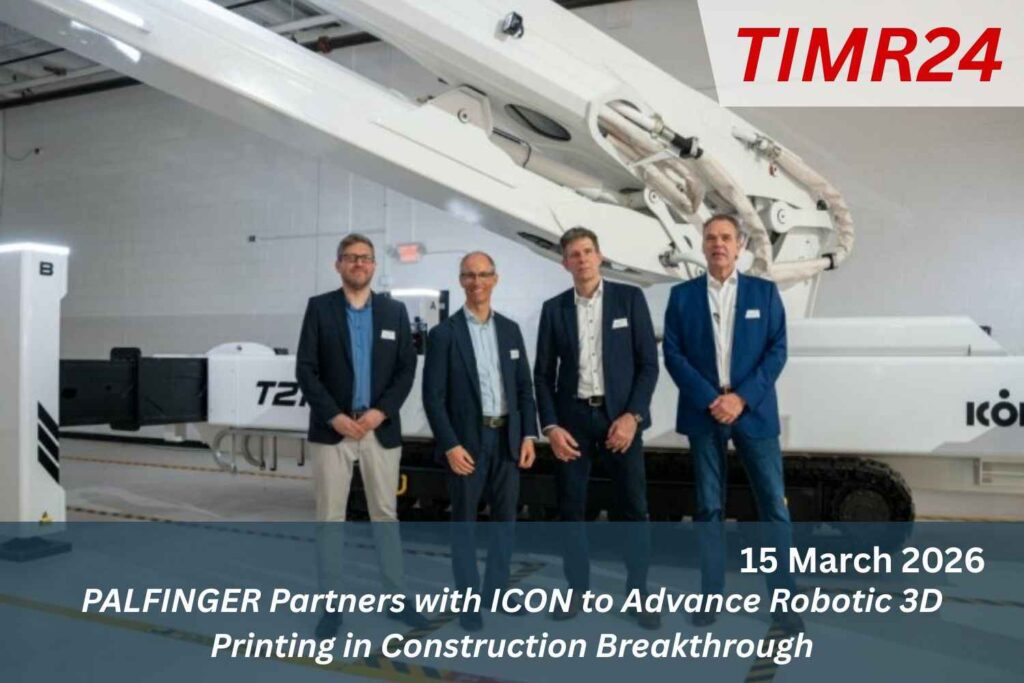
PALFINGER has partnered with ICON, a pioneer in robotic 3D printing, to enhance its capabilities in large-size robotics and digital manufacturing. This collaboration aims to improve construction efficiency, safety, and sustainability through innovative solutions. PALFINGER leverages its 90 years of engineering experience and modular system platforms to contribute to ICON’s ecosystem, particularly with the “Titan” robot system designed for automated construction up to 27 feet tall. The partnership focuses on addressing global issues like labor scarcity and affordable housing, potentially transforming industrial construction. Initial prototypes of “Titan” have been successful.
Promising reduced building costs and faster project execution. This strategic alliance not only strengthens PALFINGER’s position in automation but also benefits ICON through enhanced industrialization expertise The global construction industry is witnessing a rapid technological transformation, and one of the most promising innovations shaping the future of infrastructure is robotic 3D printing. In a major development that highlights the growing importance of automation in construction, PALFINGER has partnered with ICON to advance robotic 3D
Printing solutions for modern building projects. This collaboration aims to combine PALFINGER’s expertise in heavy lifting systems and hydraulic technologies with ICON’s pioneering work in large-scale construction 3D printing. Together, the two companies are seeking to revolutionize how buildings and infrastructure are designed, constructed, and delivered.
The Growing Importance of Construction Automation
The construction sector has traditionally relied on manual labour and conventional construction methods. However, rising labour shortages, increasing material costs, and the demand for faster project completion have forced the industry to explore new technologies. Automation and robotics are now emerging as key solutions to these challenges Robotic 3D printing allows structures to be built layer by layer using specialized concrete mixtures and automated printing systems. Unlike traditional construction, this approach reduces material waste, improves construction speed, and lowers labour requirements.
Companies such as ICON have been at the forefront of developing this technology through advanced 3D printing systems capable of constructing homes, buildings, and infrastructure components The partnership between PALFINGER and ICON reflects a growing global trend in which equipment manufacturers collaborate with technology innovators to develop integrated construction solutions.
Combining Lifting Technology With Robotic Construction
One of the key objectives of this partnership is to integrate robotic 3D printing with advanced lifting and handling technologies. PALFINGER is globally recognized for its crane and lifting solutions used in construction, logistics, and infrastructure sectors. By combining its expertise with ICON’s large-scale 3D printing technology, the collaboration aims to create more efficient and scalable construction systems Construction 3D printers require precise movement, positioning, and material handling capabilities. PALFINGER’s advanced crane technology can support these requirements by enabling better positioning of printing equipment and materials during construction operations.
This integration could significantly improve the efficiency of automated building processes, especially in complex construction environments In addition, robotic construction systems supported by advanced lifting technologies can operate in locations where conventional construction methods are difficult or expensive to implement. Remote areas, disaster recovery zones, and rapidly developing urban regions could particularly benefit from this approach.
Accelerating The Future Of 3D Printed Buildings
The collaboration between PALFINGER and ICON is expected to accelerate the development and adoption of 3D printed buildings worldwide. Over the past few years, several pilot projects have demonstrated the potential of construction 3D printing ICON has already developed advanced robotic printers capable of constructing residential structures using proprietary concrete mixtures and automated printing systems. These systems can build walls and structural components in a fraction of the time required by traditional methods. The integration of PALFINGER’s equipment could enhance the mobility and deployment of these systems, allowing them to be used across a wider range of construction sites.
The ability to rapidly construct buildings using robotic systems is particularly important for addressing global housing shortages. Many countries face increasing (India) demand for affordable housing, and conventional construction processes often struggle to meet these needs efficiently. Automated construction technologies could provide faster and more cost-effective solutions for building homes and infrastructure.
Improving Sustainability In Construction
Sustainability is another major driver behind the adoption of robotic construction technologies. The construction industry is responsible for a significant portion of global carbon emissions, largely due to the production of building materials and the energy required for construction activities Robotic 3D printing can help address these environmental challenges by optimizing material usage and reducing waste. Unlike traditional construction methods that often generate large amounts of unused material, 3D printing deposits material precisely where it is needed. This approach can significantly reduce the environmental footprint of building projects.
By integrating lifting systems and automated construction technologies, the collaboration between PALFINGER and ICON could further improve construction efficiency and sustainability. The ability to deploy advanced construction robots quickly and efficiently could also reduce transportation emissions and overall project timelines.
Potential Applications Across Multiple Industries
Although the initial focus of the partnership is on construction projects, the technology developed through this collaboration could have applications in several industries. Large-scale robotic printing systems could be used to construct industrial facilities, infrastructure components, and even specialized structures in challenging environments automated construction technologies are increasingly being explored for infrastructure development, disaster recovery, and military applications. In regions affected by natural disasters.
Robotic construction systems could rapidly build emergency shelters and essential infrastructure In addition, the technology may play a role in future space (India) exploration projects. Companies and space agencies are exploring the possibility of using robotic construction systems to build structures on the Moon and Mars using locally available materials.
Strengthening Innovation in the Global Construction Sector
The partnership between PALFINGER and ICON highlights how collaboration between industrial manufacturers and technology companies is driving innovation in the construction sector. As infrastructure demands continue to grow worldwide, the industry must adopt new technologies that improve productivity, reduce costs, and enhance sustainability By combining robotic printing systems with advanced lifting and handling technologies, the two companies aim to create a new generation of construction solutions capable of transforming how buildings are constructed. The integration of robotics, automation, and digital design tools could ultimately lead to fully automated construction sites in the future.
For developers, contractors, and governments, such technologies offer the possibility of completing projects faster while maintaining high levels of precision and quality. As these solutions become more widely adopted, they could reshape the global construction landscape and redefine the way infrastructure is built.
Q1. What is the purpose of the PALFINGER and ICON partnership?
The partnership aims to integrate lifting technologies with robotic 3D printing systems to develop advanced automated construction solutions.
Q2. What is construction 3D printing?
Construction 3D printing is a technology that builds structures layer by layer using robotic printers and specialized concrete materials.
Q3. How can robotic 3D printing benefit the construction industry?
It reduces construction time, lowers labour requirements, minimizes material waste, and improves design flexibility.
Q4. What role does PALFINGER play in the collaboration?
PALFINGER contributes advanced lifting and crane technologies that support the deployment and operation of robotic printing systems.
Q5. Why is this technology important for the future of construction?
It can help address global housing shortages, improve sustainability, and enable faster infrastructure development.