
















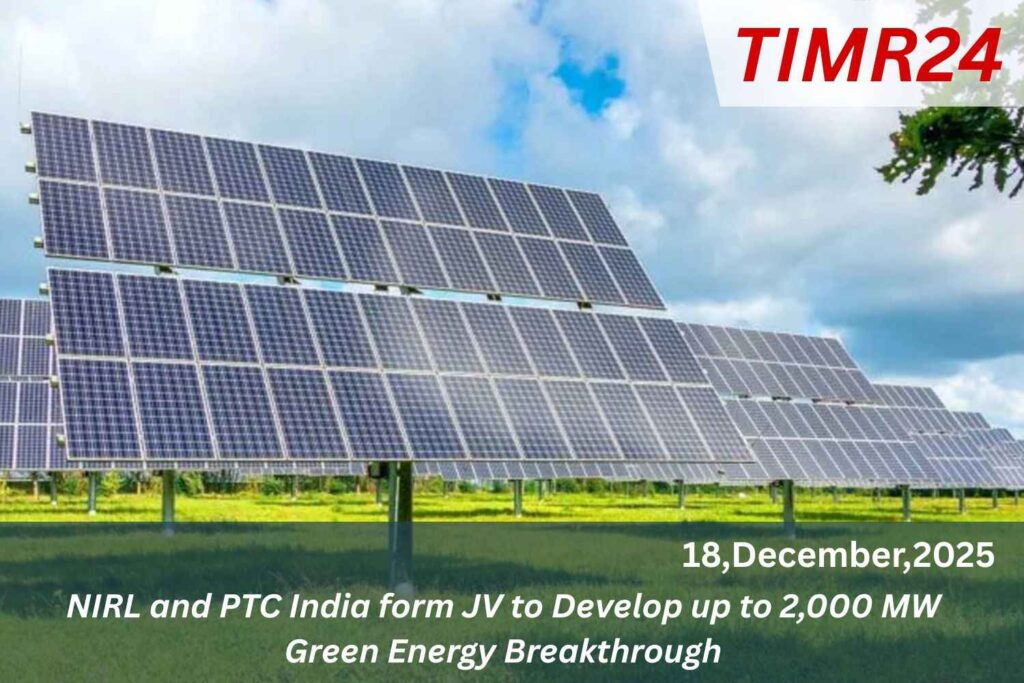
NLC India Renewables (NIRL) has formed a joint venture with PTC India to advance large-scale green energy projects in India, signed on December 12, 2025. This partnership aims to harness NLCIL’s renewable energy portfolio alongside PTC India’s market expertise, targeting a total capacity of up to 2,000 MW, phased in starting with 500 MW. The collaboration encompasses various energy sources, including solar, wind, and hydro power, with energy sales directed at diverse customers under the Electricity Act. This initiative strengthens India’s renewable energy framework NIRL and PTC India forming a joint venture to develop up to 2,000 MW of green energy.
Renewable Energy Projects Across
Capacity marks a strategically important moment in India’s renewable energy journey. As the country accelerates toward its clean energy commitments, collaborations between public sector enterprises are becoming a key driver of scale, financial stability, and execution efficiency. This partnership reflects a growing emphasis on institutional cooperation to meet India’s rapidly rising power demand while keeping sustainability at the center of infrastructure development The proposed JV is designed to focus on the development, ownership, and operation of renewable energy projects across multiple technologies. With solar and wind already forming the backbone of India’s clean power capacity.
The collaboration is expected to explore hybrid solutions, round-the-clock renewable power models, and emerging storage-linked projects. By targeting a sizable capacity of up to 2,000 MW, the JV positions itself as a long-term platform rather than a one-off project vehicle, enabling phased development aligned with market demand and policy incentives NIRL, as a public sector entity with experience in infrastructure and energy assets, brings execution capability and asset management expertise to the table. PTC India, on the other hand, is a well-established name in power trading and renewable power facilitation, with strong relationships across generators.
Broader Renewable Energy Roadmap
Distribution companies, and policymakers. The coming together of these complementary strengths creates a structure capable of addressing both the supply and commercial aspects of renewable power development, reducing risks that often slow down large-scale clean energy projects This JV also aligns closely with India’s broader renewable energy roadmap, which targets 500 GW of non-fossil fuel capacity by 2030. Large institutional partnerships such as this one help bridge the gap between ambition and execution by pooling capital, technical knowledge, and market access. In a sector where project timelines, grid integration, and offtake certainty are critical, such collaborations offer.
Confidence to lenders, equipment suppliers, and state utilities alike From a market perspective, the NIRL–PTC India JV is expected to play a stabilizing role in renewable power procurement. As distribution companies seek reliable sources of green electricity at competitive prices, long-term power purchase agreements from well-structured public sector projects can offer both affordability and supply security. This is particularly relevant as states increasingly mandate renewable purchase obligations and push for cleaner energy mixes Another important dimension of this partnership is its contribution to decarbonization beyond electricity generation.
JV Indirectly Strengthens
Renewable energy projects of this scale support the electrification of industrial processes, electric mobility infrastructure, and green hydrogen production. By expanding clean power availability, the JV indirectly strengthens downstream sectors that depend on low-carbon electricity to meet sustainability targets. This interlinked impact makes the initiative relevant not only to the power sector but also to manufacturing, transport, and urban development The timing of the JV is also significant given the increasing role of hybrid and firm renewable power solutions. With advancements in energy storage and grid management, developers are now able to offer predictable renewable supply profiles.
The JV structure allows flexibility to adopt such technologies over time, ensuring that projects remain commercially viable even as policy frameworks and grid requirements evolve Institutional credibility is another major advantage of this partnership. Public sector-led renewable projects (Arvin) often benefit from smoother regulatory coordination and stronger compliance standards. This can reduce delays related to land acquisition, approvals, and grid connectivity, which have historically challenged private developers. By setting benchmarks in governance and transparency, the JV could also encourage more collaborative models across the energy sector From an investment standpoint.
Attractive Infrastructure Asset Class
The JV signals growing confidence in India’s renewable energy ecosystem despite global economic uncertainties. Long-term demand fundamentals, supportive government policies, and falling technology costs continue to make green energy an attractive infrastructure asset class. Information about PTC India’s role in renewable powe Employment generation and regional development are additional benefits associated with large-scale renewable projects. Construction, operations, and maintenance activities create skilled and semi-skilled jobs across project locations. Moreover, renewable assets often bring infrastructure upgrades to remote or semi-urban regions.
Supporting inclusive economic growth. This aligns with India’s broader development goals, where sustainability and livelihoods are increasingly seen as interconnected priorities the NIRL–PTC India joint venture could serve as a template for future public sector collaborations in (Solar) clean energy. As India transitions toward a low-carbon economy, partnerships that combine execution strength, market access, and policy alignment will be critical. The scale of up to 2,000 MW provides sufficient room for innovation, learning, and replication, ensuring that.
Individual Projects The Formation
The impact of the JV extends beyond individual projects the formation of this JV represents more than just capacity addition; it reflects a strategic shift in how India approaches renewable energy development. By leveraging institutional strengths and aligning with national (India) climate objectives, NIRL and PTC India are contributing to a more resilient, sustainable, and future-ready power system. As these projects progress, they are expected to play a meaningful role in shaping India’s green energy landscape for the coming decade.
Q1. What is the objective of the NIRL–PTC India joint venture?
The JV aims to develop, own, and operate up to 2,000 MW of green energy projects across India.
Q2. Which renewable sources will be covered under the JV?
The partnership is expected to focus on solar, wind, hybrid, and other emerging clean energy technologies.
Q3. Why is this JV significant for India’s power sector?
It strengthens public-sector participation in renewable energy and supports India’s long-term energy transition goals.
Q4. How will this JV benefit power distribution companies?
It will enable long-term power purchase agreements, improving green power availability and price stability.
Q5. Does this JV align with India’s net-zero targets?
Yes, it directly supports India’s commitment to expanding non-fossil fuel capacity and reducing carbon emissions.