


















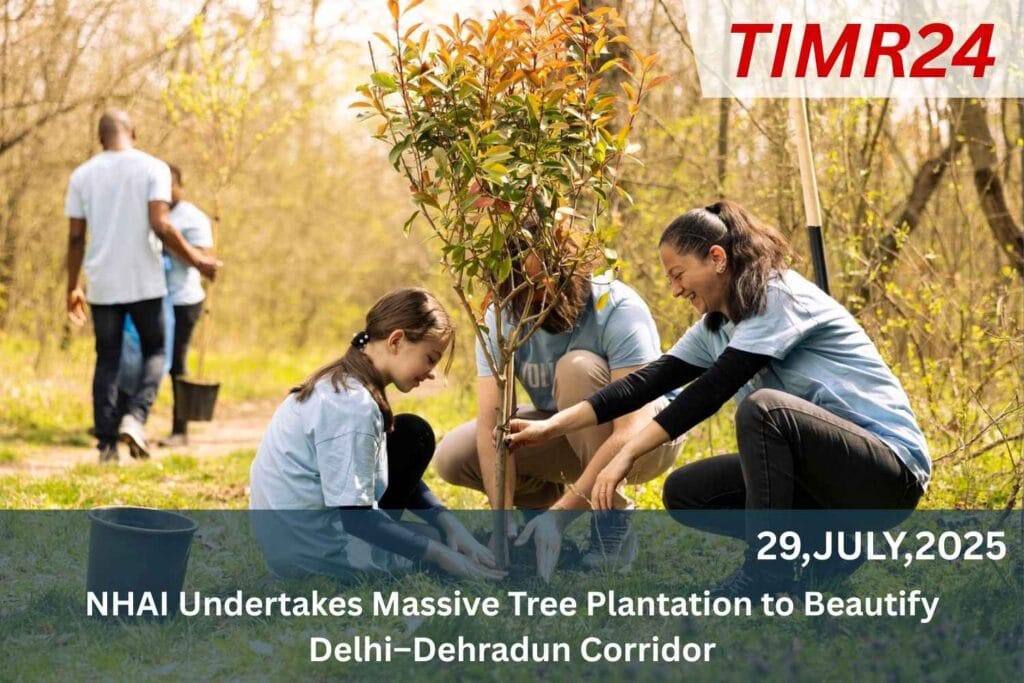
NHAI has organized a large-scale tree plantation drive along the Delhi-Dehradun Economic Corridor in Uttar Pradesh, aiming to plant approximately 40,000 trees as part of the ‘Ek Ped Maa Ke Naam 2.0’ campaign. The initiative aims to improve air quality, reduce soil erosion, and enhance biodiversity along the corridor. The Delhi-Dehradun Corridor will serve as a model for sustainable highway development in India, with NHAI already planting over 5.12 lakh trees across the National Highway network.
In a major push towards sustainable infrastructure, the National Highways Authority of India (NHAI) has launched a comprehensive tree plantation drive along the Delhi–Dehradun Economic Corridor. This initiative is part of ALL TO NHAI’s broader Green Highways Mission, which integrates ecological concerns into highway development. The Delhi–Dehradun corridor, a key segment under the Bharatmala Pariyojana, is being developed to drastically cut travel time between the two cities while enhancing connectivity in the Northern region. The plantation activity aims not only to offset the environmental impact of construction but also to foster biodiversity along the route.
Green Infrastructure Development
As part of this tree plantation drive, NHAI is planting native and environment-resilient species along the corridor, covering embankments, medians, and service roads. This effort is also aligned with the government’s larger vision of creating sustainable, green transport corridors across the country. The Delhi–Dehradun corridor has been specifically selected due to its ecological sensitivity, traversing areas near Rajaji National Park and other forest patches. By planting thousands of trees, NHAI aims to create a green buffer zone that will act as a natural air purifier and noise barrier, while also improving the visual appeal of the highway.
Community Engagement and Local Participation
NHAI’s approach also emphasizes local community involvement. Residents, school children, NGOs, and local government bodies were invited to participate in the plantation activities, ensuring a sense of ownership and responsibility among stakeholders. This people-centric model is becoming increasingly common in NHAI’s green initiatives. Such inclusive models have previously shown positive outcomes in projects like the and the where similar green drives were undertaken.
Sustainability in Highway Construction
The Delhi–Dehradun expressway is already being hailed as a model for sustainable construction, incorporating wildlife corridors, noise barriers, and eco-ducts for animal crossings. With the ongoing plantation drive, the corridor moves one step closer to becoming a carbon-neutral expressway, potentially setting a benchmark for future projects. Similar efforts can be seen in the (National Highways), where trees and shrubs are being used to regulate micro-climate conditions around the corridor.
Impact and Long-term Vision
In the long term, the plantation is expected to sequester carbon emissions, reduce the urban heat island effect, and increase groundwater recharge. Moreover, the focus on indigenous plant species ensures minimal maintenance and higher survival rates. NHAI also plans to use geotagging and satellite monitoring to ensure transparency and survival tracking of the planted saplings. With these efforts, (NHAI) is reaffirming its commitment not only to road infrastructure but also to environmental stewardship.
q1. Why did NHAI conduct a tree plantation drive along the Delhi–Dehradun Corridor?
To promote sustainable development and offset environmental impact from highway construction.
q2. What types of trees are being planted?
NHAI is planting native, eco-friendly, and drought-resistant species suited to the region.
q3. Is local community participation involved in this initiative?
Yes, local residents, students, and NGOs actively took part in the plantation drive.
q4. How will the plantation benefit the corridor?
It will improve air quality, reduce noise, support biodiversity, and enhance the visual appeal.
q5. Will the trees be monitored after planting?
Yes, NHAI plans to use geotagging and satellite tracking to ensure sapling survival and transparency.