


















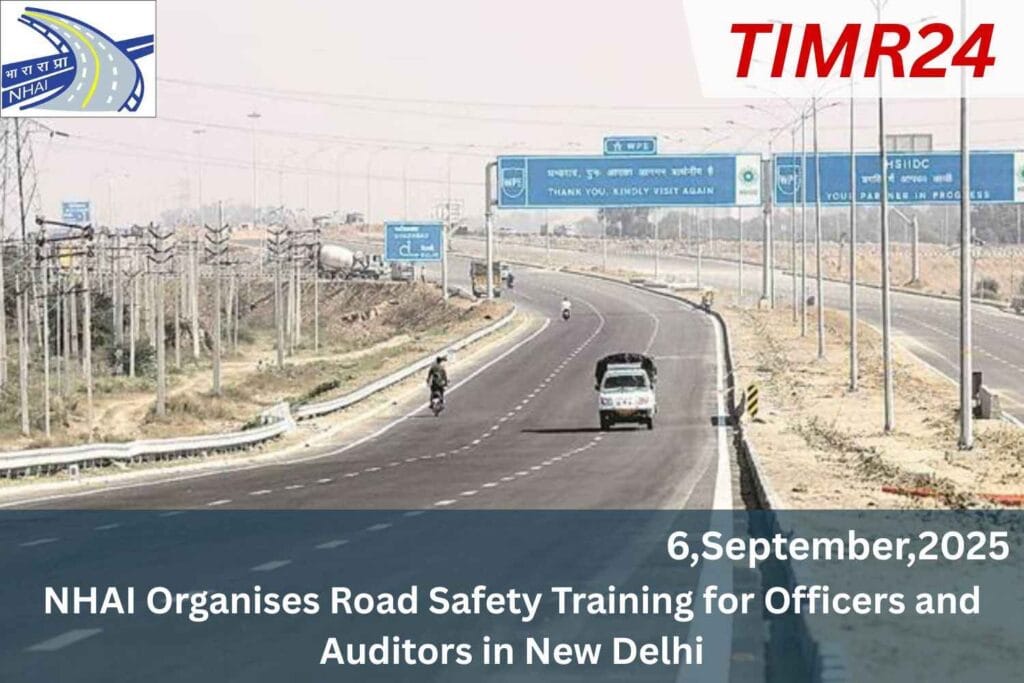
The National Highways Authority of India (NHAI) has conducted a day-long Road Safety training program in New Delhi for its Road Safety Officers and Road Safety Auditors. The training, conducted in collaboration with Save Life Foundation, aimed to enhance road safety measures and build capacity among officials. The session focused on various aspects of road safety through interactive sessions, including the use of a drone-based AI&ML module, detailed inspection procedures, and mitigation measures. The training aimed to help officers develop and implement strategies to enhance road safety Addressing challenges such as user behaviour and violations of rules.
The government has envisioned a Zero Fatality Attainment (ZFA) approach to eliminate preventable road accident fatalities across National Highways. Around 1,083 High Fatality Zones (HFZ) have been identified on 77 National Highways across India. A Road Safety Action Plan has been prepared for 2023 and 2024, including targeted interventions across engineering, enforcement, and trauma care domains. The National Highways Authority of India (NHAI) has been steadily expanding its initiatives to make India’s roadways safer, more efficient, and sustainable. In August 2025, the authority organized a dedicated road safety training program for its officers and auditors in New Delhi, an initiative.
That reflects both urgency and foresight. India continues to grapple with a high rate of road accidents, and the need for capacity-building among professionals responsible for designing, monitoring, and auditing safety measures has never been greater. This training marks a significant step forward in aligning India’s infrastructure development with international safety standards and the United Nations’ Decade of Action for Road Safety 2021 2030 Road safety is not just a regulatory box to tick; it is an essential aspect of saving lives and ensuring seamless transport. India, with its extensive national highways network, carries the lifeblood of economic activity. Trucks, passenger vehicles.
Why Road Safety Training Matters
Buses, and private cars rely on highways for long-distance travel and goods movement. Yet, the highways also remain accident-prone zones, with issues such as over speeding, poor signage, inadequate lighting, and lack of pedestrian crossings contributing to thousands of fatalities annually By equipping officers and auditors with advanced training, NHAI is not only ensuring that compliance standards are met but also fostering a culture of preventive monitoring. This is about shifting the mindset from reactive action after accidents to proactive risk identification and mitigation (NHAI).
The training session held in New Delhi focused on several critical objectives. First, it aimed to enhance the technical expertise of officers and auditors who are on the frontline of monitoring highway projects. They were trained to identify accident-prone “black spots,” evaluate signage and road markings, and use audit tools that can predict risks before they become problems Second, the program introduced innovative traffic management solutions, from electronic surveillance to AI-driven road monitoring. By learning to integrate such technologies into safety audits, NHAI officers can ensure that highways are designed and maintained in a way that accommodates both speed and safety.
Third, the program fostered an exchange of best practices, bringing experts and experienced auditors into dialogue. This exchange ensured that theoretical knowledge was supplemented by real-world case studies (Highway) One of the most important takeaways from the training program was the emphasis on compliance as a continuous process rather than a one-time task. Safety audits must be dynamic, evolving with traffic patterns, climatic conditions, and infrastructure changes. Officers were trained to create feedback loops between on-ground realities and policy-making, ensuring that audit findings directly influence future NHAI road development projects.
Building a Culture of Compliance
Compliance also involves coordination with multiple stakeholders state governments, contractors, law enforcement agencies, and even civil society. By educating officers and auditors, NHAI is essentially strengthening the entire ecosystem of road safety governance The role of technology in road safety is growing rapidly. During the training, officers were exposed to tools such as GIS mapping for identifying accident-prone corridors, AI-enabled cameras for speed detection, and automated systems for monitoring lane discipline. These technologies can help auditors generate real-time data, making safety audits far more accurate and actionable.
Moreover, the program emphasized the importance of data transparency. Accident data, when shared across departments and integrated into planning, can lead to better decision-making. The training encouraged officers to not only use technology but also promote open data policies where relevant The New Delhi training session is not an isolated event but part of a larger vision. India has committed to reducing road traffic fatalities by 50% by 2030, aligning with the United Nations’ Decade of Action for Road Safety. The program reminded participants that their work is directly connected to global efforts, from the World Health Organization’s road safety frameworks to international engineering standards.
Impact on Citizens and Everyday Mobility
By training auditors and officers in global best practices, NHAI is ensuring that India’s road network does not remain outdated but moves in step with innovations adopted worldwide. The benefits of such training are not abstract they translate directly into safer commutes for millions of citizens. With better audits and monitoring, drivers are less likely to face dangerous intersections, poor signage, or neglected maintenance. For pedestrians and cyclists, who are often overlooked in highway design, stronger safety audits mean better crossings, protected lanes, and awareness campaigns that reach beyond vehicles.
Citizens, therefore, stand to gain the most. A stronger safety culture means fewer accidents, faster emergency responses, and a general sense of trust in the road infrastructure managed by NHAI While the training is a step in the right direction, challenges remain. Implementing safety recommendations often requires funding, political will, and inter-agency coordination. Contractors may resist stricter safety norms due to cost concerns, and local enforcement might be uneven. However, the training equips officers with both technical expertise and negotiation skills to advocate for safety as a non-negotiable element of highway construction and maintenance.
The road safety training program organized by NHAI in New Delhi serves as a milestone in India’s journey toward safer, smarter, and more sustainable highways. It represents a shift from traditional construction-focused infrastructure development to a human-centered approach that values lives as much as efficiency. By preparing officers and auditors with advanced tools, knowledge, and global perspectives, NHAI is laying the foundation for a future where highways do not just connect cities they also safeguard those who travel upon them As India continues to expand its highway network, such training sessions remind us that development and safety must move together. For every kilometre of road built, the assurance of safety must follow closely behind.
Q1. What was the objective of NHAI’s road safety training in New Delhi?
The training aimed to strengthen officers’ and auditors’ knowledge on road safety, accident prevention, and compliance monitoring.
Q2. Who participated in the NHAI road safety training program?
NHAI officers, auditors, and highway safety professionals took part in the program.
Q3. How will this training benefit India’s road network?
It will help reduce accidents, improve safety compliance, and enhance traffic management strategies on highways.
Q4. Does NHAI conduct such programs regularly?
Yes, NHAI organizes regular training, workshops, and safety awareness programs nationwide.
Q5. How does this initiative align with global road safety goals?
It supports India’s commitment to the UN Decade of Action for Road Safety 2021–2030.