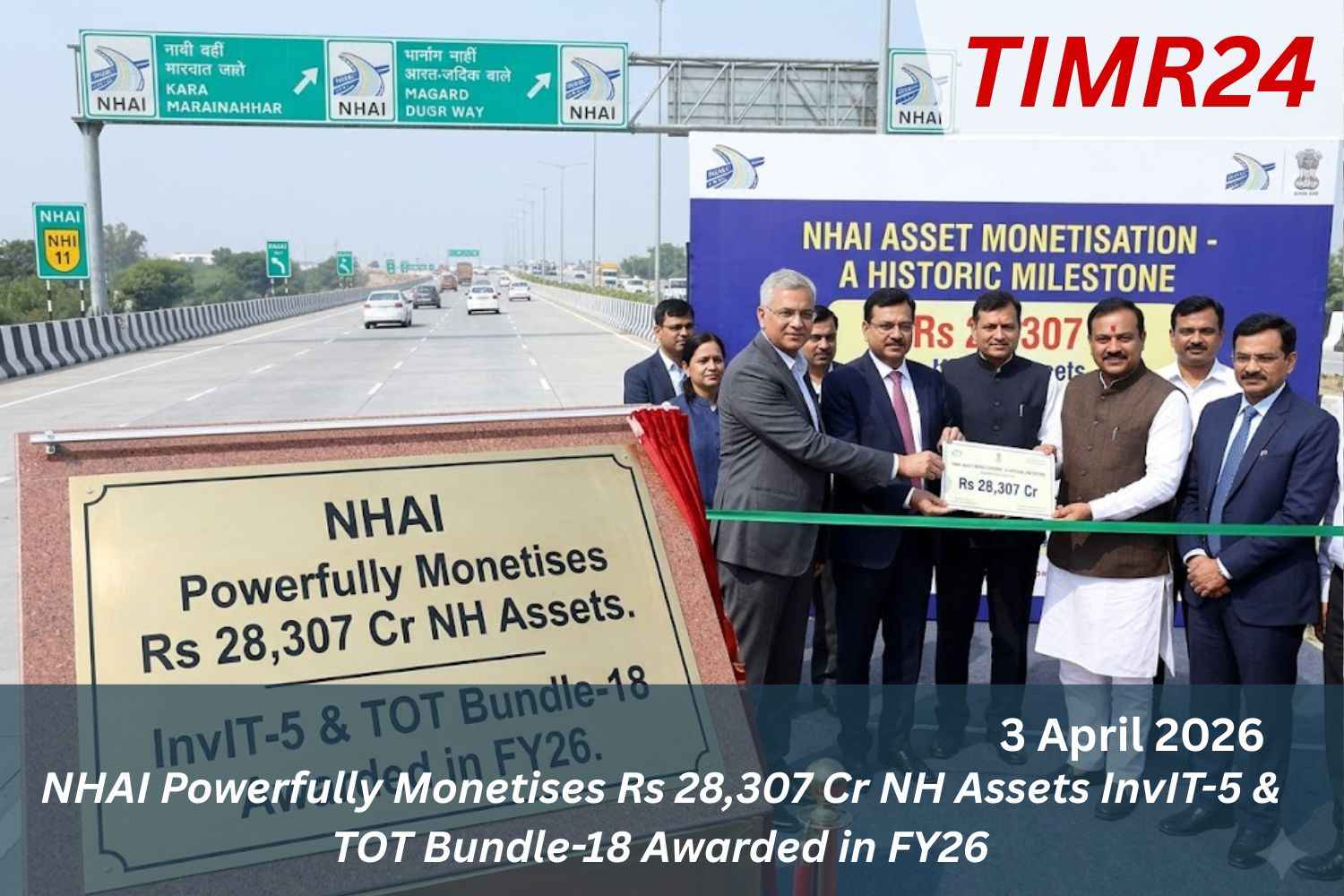



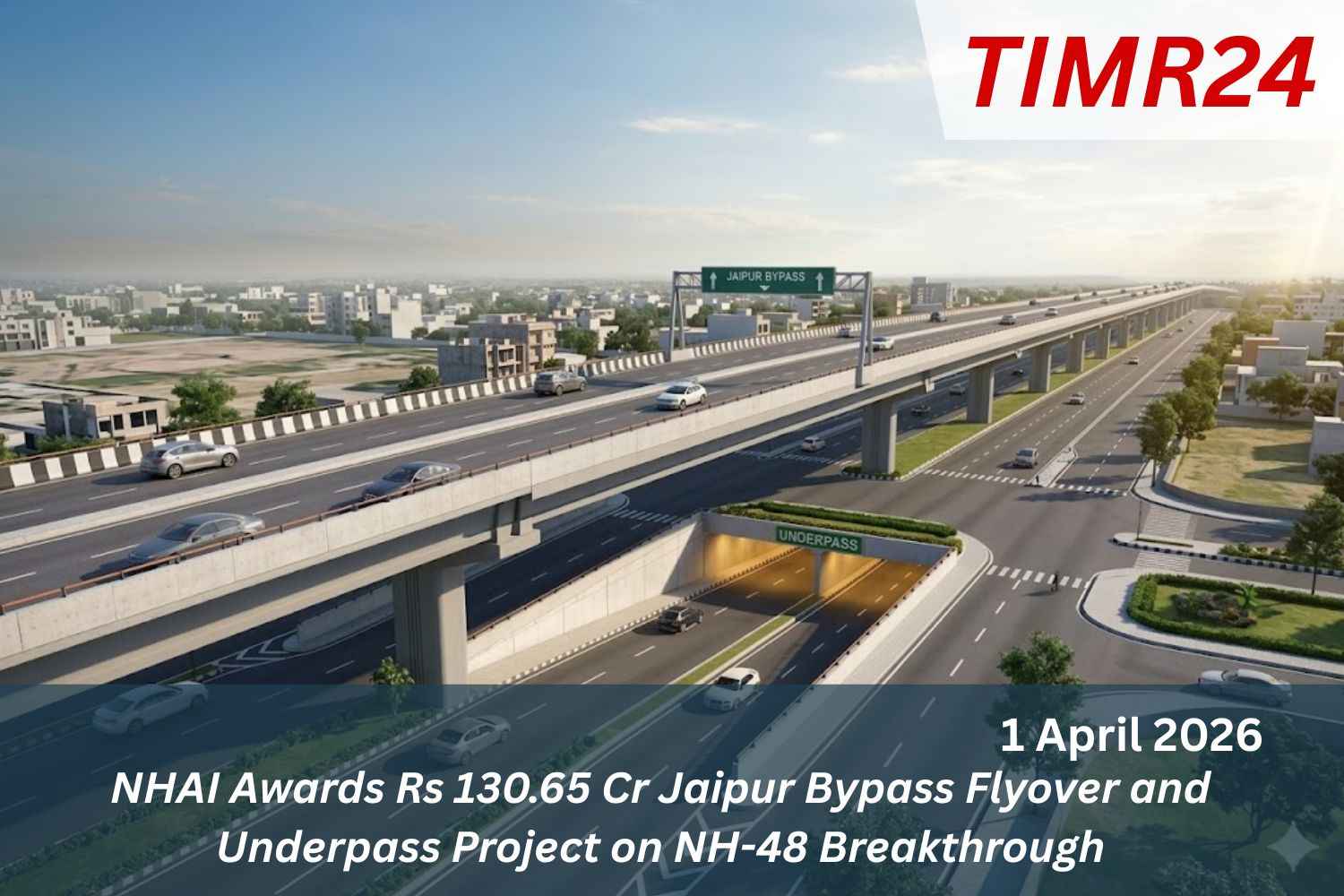


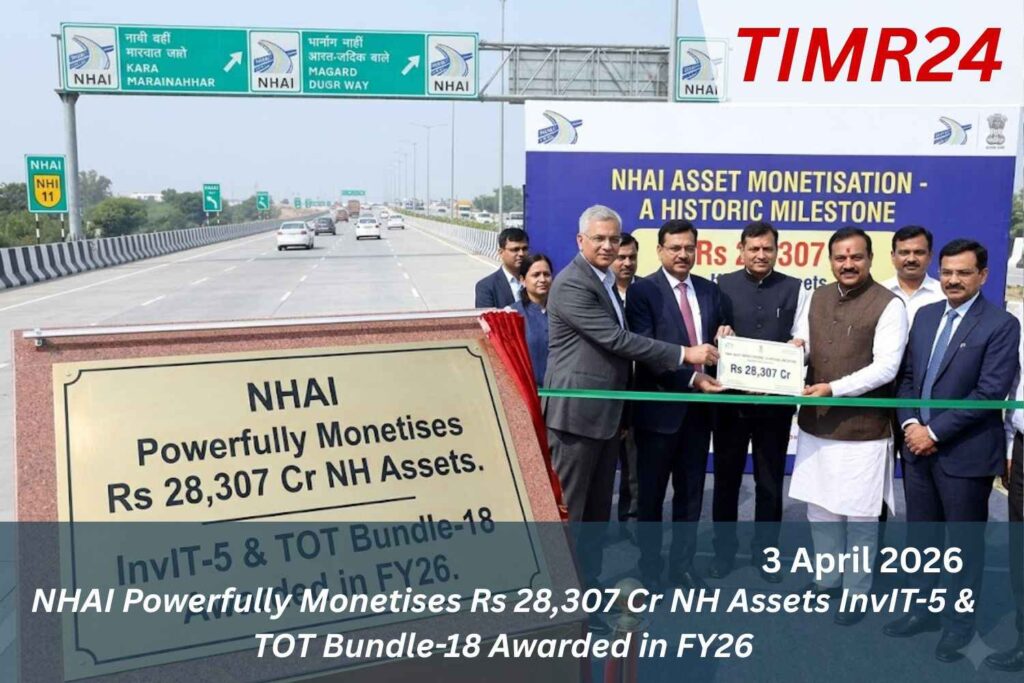
The National Highways Authority of India (NHAI) has monetized national highway assets worth Rs 28,307 crore in FY 2025–26 via InvIT and Toll-Operate-Transfer models. Among the initiatives, NHAI awarded InvIT Round-5 to NHIT Western Projects for Rs 6,366.98 crore, covering the 255.9 km Amravati–Chikhali–Tarsod section of NH 53 and the 54.3 km Gundugolanu Chinna Avutapalli section of NH 16. Additionally, TOT Bundle-18 was awarded to IRB Chandibhadra Tollway for Rs 3,087 crore for the 74.5 km Chandikhole–Bhadrak section of NH-16. These projects align with NHAI’s strategy to monetize operational highway assets to mobilize resources for further infrastructure development.
India’s road infrastructure story is no longer just about laying asphalt and building flyovers. It is increasingly about turning those completed roads into financial instruments unlocking frozen capital and recycling it into new construction. The National Highways Authority of India (NHAI), the country’s apex highway body under the done precisely that in FY 2025–26. In a significant milestone towards achieving the asset monetisation target for the year, NHAI has realised Rs 28,307 crore through a combination of Public InvIT, Private InvIT, and the Toll-Operate-Transfer model, including TOT Bundles 17 and 18
Understanding Asset Monetisation The Concept Behind the Numbers
Before diving into the deal specifics, it is important to understand what asset monetisation actually means in the Indian highway context. Asset monetisation entails a limited-period licence or lease of a public-sector asset to a private-sector entity for an upfront or periodic consideration through a well-defined concession or contractual framework, creating a virtuous cycle where existing assets are converted into a source of funds that are then invested in creating new assets. simpler terms, NHAI builds a road using public money, allows it to become operational, and then leases the toll-collection rights to private players or investors for a fixed number of years.
The money received upfront is immediately pumped back into building more roads. This cycle build, monetise, reinvest is what makes India’s highway expansion financially sustainable without over-relying on sovereign debt Infrastructure Investment Trusts, or InvITs, are instruments modelled on mutual funds, designed to pool money from investors and deploy it in assets that generate cash flows over time. They have been in operation in India since 2014 NHAI has used both private and public InvITs to tap domestic and institutional investors, while the TOT model has primarily attracted strategic infrastructure operators.
InvIT Round-5 310 km of Highways Go to Private Hands
The most significant transaction in this monetisation cycle is the fifth round of NHAI’s InvIT programme. NHAI has successfully monetised over 310 km of National Highways under InvIT Round-5. The InvIT-5 has been awarded to NHIT Western Projects Private Limited for a concession fee of Rs 6,366.98 crore for a period of 20 years. InvIT-5 comprises two key National Highway sections the 255.9 km Amravati–Chikhali–Tarsod section of NH-53 in Maharashtra and the 54.3 km Gundugolanu–Chinna Avutapalli section of NH-16 in Andhra Pradesh.
These stretches are strategically important. The NH-53 corridor in Maharashtra connects major industrial towns and is a crucial freight artery in the Vidarbha region. The NH-16 stretch in Andhra Pradesh supports coastal connectivity. NHIT Western Projects Private Limited, the concessionaire, will now operate, maintain, and collect user fees on these stretches for two decades ensuring a high standard of road quality while also delivering a fixed return stream to InvIT investors. This model aligns private efficiency incentives with public infrastructure goals, a combination that India’s highway planners have worked hard to institutionalise.
TOT Bundle-18 Odisha’s NH-16 Joins the Monetisation Map
Complementing the InvIT transaction, NHAI also closed a major Toll-Operate-Transfer deal. NHAI has successfully realised TOT Bundle-18 for Rs 3,087 crore, which includes the 74.5 km Chandikhole–Bhadrak section of NH-16 in Odisha. TOT-18 has been awarded to M/s IRB Chandibhadra Tollway Private Limited for a concession period of 20 years. Under this arrangement, the concessionaire will undertake operation and maintenance of the National Highway section and collect user fees in accordance with the National Highways Fee Rules.
The Chandikhole–Bhadrak corridor in Odisha is an important stretch on NH-16, which forms part of the Golden Quadrilateral’s eastern leg. IRB Infrastructure, a well-known private roads player in India, brings operational expertise to this corridor. Over the next 20 years, commuters on this stretch can expect improved road quality and better service standards, as the concessionaire’s revenue is directly linked to maintaining the road in a contractually specified condition. This is a model that also indirectly benefits the state of Odisha, which gains a well-maintained arterial highway without adding to its fiscal burden.
Raajmarg Infra Investment Trust (RIIT) A Historic Public Listing
Perhaps the most remarkable headline from this monetisation cycle is the public listing of India’s first retail-investor-focused highway InvIT. The maiden public issue of the NHAI-sponsored Raajmarg Infra Investment Trust was listed on the Bombay Stock Exchange on 24 March 2026. RIIT secured rights to five operational National Highway assets located in the states of Jharkhand, Tamil Nadu, Andhra Pradesh, and Karnataka, for a total concession value of approximately Rs 9,500 crore public offering was oversubscribed nearly 14 times, signalling strong investor interest in India’s highway infrastructure and the government’s asset monetisation programme.
The 14x oversubscription is not just a financial milestone it is a powerful signal of how retail investors now view India’s road infrastructure as a credible asset class. Historically, infrastructure investment was the domain of large institutional funds and pension managers. (India) The RIIT listing democratises that access, allowing ordinary investors to earn predictable dividends from India’s busiest national highways, much like fixed-income instruments but with infrastructure backing. You can track RIIT’s listing details directly
Closing the Gap TOT Bundle-19 and the Rs 30,000 Crore Target
With Rs 28,307 crore already realised, NHAI is tantalizingly close to the government’s annual budgeted target. With bids received for TOT Bundle-19, which are under technical evaluation, NHAI is well poised to achieve the Government of India’s budgeted target of Rs 30,000 crore for FY 2025–26 authority has identified a pipeline of road assets spanning over 1,400 km for monetisation during FY26, with additional TOT bundles under evaluation.
The pace at which NHAI has closed these deals across InvIT, public listing, and TOT routes simultaneously — reflects institutional maturity in India’s infrastructure finance ecosystem. The policy framework, valuation methodology, competitive bidding processes, and investor confidence have all come together in FY26 in a way that few expected even five years ago.
Taken together, InvIT-5, TOT Bundle-18, the RIIT public listing, and the impending TOT Bundle-19 closure mark FY 2025–26 as a landmark year in India’s journey (India) towards financially self-sustaining highway infrastructure — one where every completed road becomes a seed for the next one.
Q1. What is NHAI monetisation?
NHAI monetisation means leasing operational highway assets to private investors to generate funds for new infrastructure development.
Q2. What is InvIT-5?
InvIT-5 is the fifth Infrastructure Investment Trust bundle launched by National Highways Authority of India to attract institutional investment.
Q3. What is TOT Bundle-18?
TOT (Toll-Operate-Transfer) Bundle-18 involves leasing highway stretches to private players for toll collection and maintenance.
Q4. How much value was monetised?
NHAI monetised highway assets worth approximately ₹28,307 crore through these projects.
Q5. Why is this important?
It boosts infrastructure funding, reduces government burden, and improves highway quality through private participation.