
















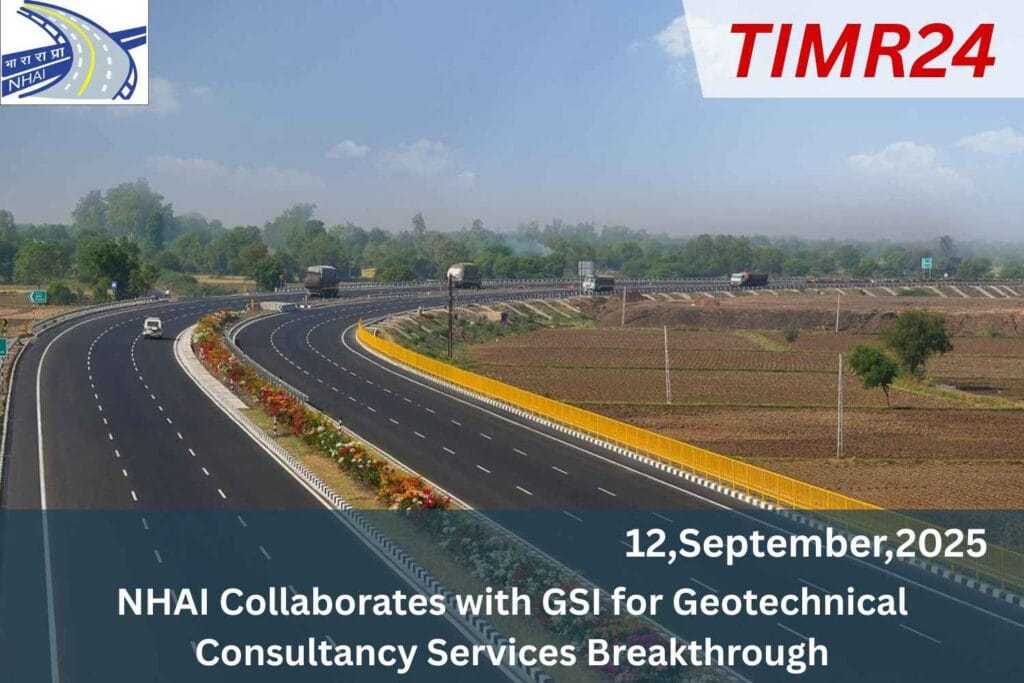
The National Highways Authority of India (NHAI) has partnered with the Geological Survey of India to offer geotechnical consultancy services and help verify detailed project reports. The collaboration aims to improve construction quality and infrastructure development by preparing geological maps, identifying weak zones, and conducting detailed analyses. The Indian infrastructure sector is undergoing a transformation with large-scale projects that aim to enhance connectivity, road safety, and long-term sustainability. One of the most significant steps in this journey has been the recent collaboration between the National Highways Authority of India (NHAI) and the Geological Survey of India (GSI).
For geotechnical consultancy services This partnership is being described as a breakthrough that could redefine the way highways, tunnels, and bridges are built in India. By combining NHAI’s execution expertise with GSI’s geological and geotechnical knowledge, the collaboration promises safer, more resilient, and technically sound infrastructure across the country Before any highway or expressway is constructed, detailed studies of soil, rock, groundwater, and terrain are essential. This is where geotechnical consultancy comes into play. Geotechnical investigations help engineers understand the ground conditions and identify risks such as landslides, soil erosion, weak foundations.
And seismic vulnerabilities. For a country like India, where terrains range from the Himalayan mountains to coastal belts and flood-prone plains, such consultancy is not just important but indispensable. The collaboration with GSI ensures that every upcoming highway project will be backed by scientific insights into geological stability, slope analysis, and soil strength. According to (NHAI) these measures also support the larger vision of Bharatmala Pariyojana, which focuses on building world-class highways and expressways.
Why NHAI Chose GSI as a Partner
The Geological Survey of India has been a trusted name in geological mapping, seismic studies, and mineral resource assessments for more than 170 years. Its expertise in geotechnical consultancy makes it the ideal partner for NHAI. While NHAI’s mandate is the construction and maintenance of highways, challenges such as slope collapses in hilly regions, waterlogging in plains, and soil instability in flood-prone areas often delay projects and increase costs. GSI brings specialized knowledge in tackling these challenges. For example, tunnel projects like the Zojila Tunnel in Jammu & Kashmir or expressways like the Delhi–Dehradun Expressway can face landslides or.
Rockfalls without proper assessment. By leveraging GSI’s capabilities, NHAI aims to minimize such risks and ensure timely completion of critical infrastructure One of the primary goals of the NHAI GSI partnership is improving road safety. Weak foundations, unassessed slopes, and poor soil quality often lead to road damage, collapses, or fatal accidents. Geotechnical consultancy ensures that the highways are built on stable terrain and designed to withstand both natural and man-made stresses. For instance, bridges across rivers such as the Ganga or Brahmaputra require detailed soil and seismic analysis to ensure long-term safety. With GSI’s guidance, NHAI will not only reduce.
Maintenance costs but also extend the lifespan of road and bridge infrastructure. This aligns with the Ministry of Road Transport & Highways’ of reducing road accidents and making Indian roads among the safest in the world India’s growing infrastructure also includes mega tunnel projects and long-span bridges that require high-level geotechnical expertise. The Zojila and Z-MoRTH tunnels, as well as proposed bridges across Northeastern states, involve working in challenging terrains. GSI’s advanced studies of rock mass, soil stability, and slope analysis are critical in such projects. Without this support, delays and cost escalations are inevitable. The collaboration ensures that tunnel alignments.
Integration with Digital Infrastructure
Bridge foundations, and slope reinforcements are designed with scientific precision. This reduces the chances of project failures and ensures commuters’ safety even in high-risk zones. NHAI has already adopted advanced digital platforms such as the Data Lake initiative to track progress and integrate multiple aspects of project management. With GSI onboard, the digital system will now also include geotechnical data, allowing engineers and policymakers to make informed decisions. For example, slope stability maps, soil test results, and seismic data can be digitally stored and analysed for current as well as future projects. This level of integration supports data-driven infrastructure development.
Ensuring efficiency and transparency. Reports in suggest that data integration can reduce delays by nearly 20% and bring down costs in large-scale projects Sustainability has become a central theme in modern infrastructure development. Highways are no longer just about connectivity but also about environmental responsibility. Geotechnical consultancy plays a crucial role in this by minimizing ecological disruptions. For example, landslide-prone slopes can be stabilized through eco-friendly engineering solutions, and soil erosion can be controlled with proper drainage planning. The collaboration between NHAI and GSI also supports climate resilience, ensuring that.
Impact on National Projects like Bharatmala Pariyojana
Highways remain operational despite extreme weather events such as floods or earthquakes. By focusing on sustainable engineering practices, the partnership contributes to India’s long-term infrastructure goals while protecting sensitive ecosystems. Under the Bharatmala Pariyojana, India plans to develop more than 60,000 kilometres of national highways. This requires massive investments in planning, execution, and maintenance. Without scientific backing, such projects could face repeated setbacks due to geological risks. With GSI’s involvement, highways planned under Bharatmala will be supported by detailed geotechnical surveys and risk assessments.
This reduces the likelihood of landslides in Himalayan regions, subsidence in floodplains, or soil erosion in coastal areas. By ensuring structural resilience, the partnership makes Bharatmala vision of world-class connectivity more achievable While the current focus of the NHAI–GSI partnership is on highways, its scope extends far beyond. Metro projects, smart city infrastructure, renewable energy projects, and even defense-related construction in border areas can benefit from such geotechnical expertise. For instance, renewable energy projects like solar parks and wind farms require soil stability analysis for long-term sustainability. Similarly, military roads in high-altitude regions can be made safer through geotechnical surveys.
The collaboration, therefore, opens doors to a broader range of applications, reinforcing India’s overall infrastructure development strategy The collaboration between NHAI and GSI marks a turning point in India’s infrastructure development journey. By integrating geological expertise into highway construction, India is ensuring that its projects are safer, more durable, and environmentally responsible. This partnership highlights the importance of combining technical knowledge with execution capacity to achieve large-scale national goals. As India continues to expand its road network under Bharatmala Pariyojana and other initiatives, the NHAI–GSI collaboration will act as a foundation for sustainable.
Cost-effective, and resilient infrastructure. With geotechnical (Ministry of Road Transport & Highways) consultancy becoming a mainstream requirement, the future of Indian highways looks not only ambitious but also scientifically robust and globally competitive.
Q1. Why has NHAI collaborated with GSI?
NHAI aims to leverage GSI’s expertise in geotechnical services for road and infrastructure safety.
Q2. How will this partnership benefit road projects?
It will provide advanced soil testing, slope stability analysis, and safer construction methods.
Q3. What role does GSI play in infrastructure projects?
GSI provides geotechnical consultancy, geological mapping, and disaster risk assessments.
Q4. Will this collaboration speed up project completion?
Yes, accurate data and consultancy reduce delays caused by soil and terrain challenges.
Q5. Which major projects are expected to benefit?
National highways, tunnels, and expressways across India will gain from this technical support.