















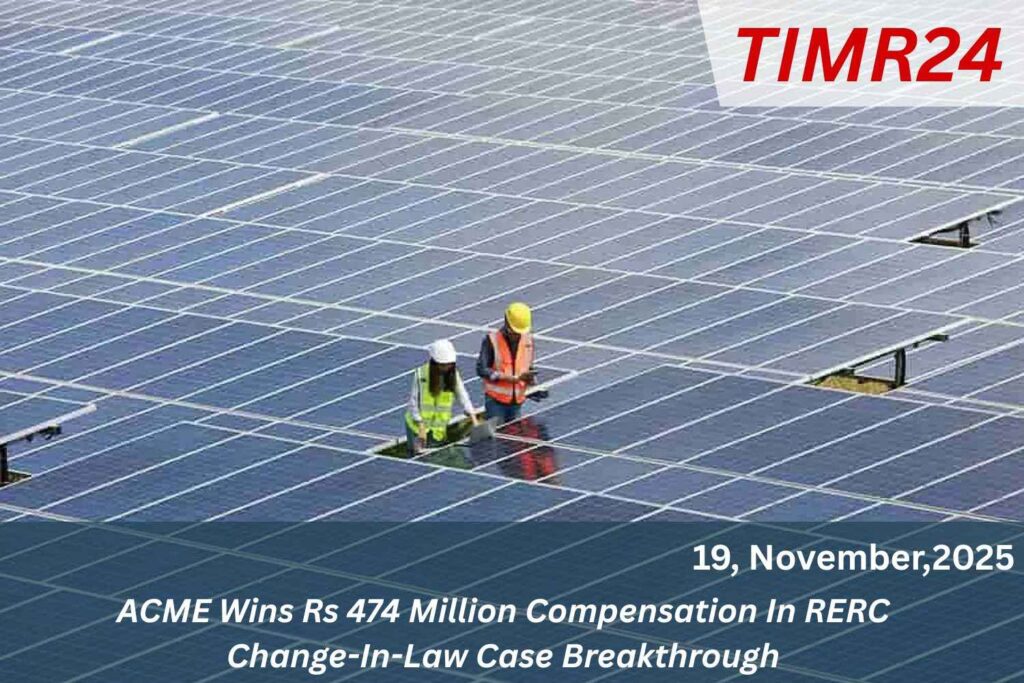
ACME Aklera Power Technology Private Limited has received Rs 474 million in compensation from the Rajasthan Electricity Regulatory Commission (RERC) as change-in-law relief for its 250 MW solar project with SECI. This ruling is expected to enhance revenue and result in a 3.5% increase in income over 15 years, setting a precedent for regulatory clarity in India’s renewable energy sector. The compensation addresses added costs from customs duties and GST increases, paid through an annuity at a 9% discount rate over the period, fostering investor confidence in the supportive regulatory environment for renewable energy growth in India.
ACME’s recent victory in the Rajasthan Electricity Regulatory Commission (RERC) Change-in-Law case, resulting in a ₹474 million compensation award, has become a notable development in India’s renewable energy sector. This ruling is not just a financial win for ACME but also a strong statement about regulatory clarity, investor protection, and the maturing legal framework that governs solar and wind power projects. As the renewable energy industry continues to expand, resolving policy-related disputes becomes increasingly central to stable project development. Readers seeking a broader understanding of national renewable policies may.
Clean Energy Portfolio
The case revolves around ACME’s Rajasthan solar project, a flagship component of the company’s rapidly growing clean energy portfolio. When ACME originally priced the project and submitted its tariff bid, its financial assumptions were based on the policy environment at that moment. Over time, however, several unexpected government notifications altered the project’s economics. These included increases in customs duties, modifications to GST structures, changes in safeguard duties, and other regulatory amendments that directly affected the cost of solar modules, inverters, and ancillary equipment. Such shifts are common in fast-evolving.
Markets like India make long-term project planning more complex. Developers rely on Change-in-Law clauses in their PPAs (Power Purchase Agreements) to protect themselves from unforeseen financial burdens. A detailed list of similar regulatory ACME argued before RERC that these policy changes had materially escalated its capital expenditure, making the original tariff no longer financially viable. The company presented documentation demonstrating how duties, taxes, and compliance requirements imposed after the signing of the PPA increased its overall project cost. ACME’s legal stance emphasized that these costs were directly caused by the government.
Renewable Energy Developers
Decisions beyond the company’s control, and thus, under Change-in-Law provisions, compensation was justified. RERC evaluated the claims and found merit in ACME’s arguments, eventually ruling in its favor and approving compensation worth ₹474 million. This decision not only reinstates financial balance for ACME but also reinforces trust among renewable energy developers who depend on regulatory stability to participate competitively in tariff-based auctions. The RERC ruling is likely to influence a number of other disputes currently lodged by energy developers across India. Because Change-in-Law cases hinge on legal interpretation, every judgment creates.
a precedent that shapes how future regulators and courts evaluate similar claims. Developers across the sector, especially those working on large-scale solar projects in Rajasthan, Gujarat, and Karnataka, will be closely observing how regulators weigh documentation, cost (PDF) analysis, and government notifications in determining compensation. For industry readers wanting to expand their understanding of broader regulatory frameworks, external references such as the CERC and MNRE websites provide foundational policy material and updates on sectoral reforms. This ruling may also affect how future tariff bids are structured. Developers entering a competitive.
Uncontrollable Cost Escalation
Bidding must consider potential risks, including duties and supply disruptions. When regulators consistently uphold fair and transparent compensation mechanisms, developers feel more secure bidding aggressively without fear of uncontrollable cost escalation. The ACME case strengthens that confidence. Meanwhile, industry investors, both domestic and international, view such regulatory certainty as an important indicator of market maturity. It reassures them that India’s renewable energy ecosystem is stable, investment-friendly, and legally predictable. For those wanting regular updates on similar developments, another critical aspect of this case is its broader effect on.
Solar manufacturing dynamics within India. Duties on imported modules, inverters, and solar components were originally imposed to promote domestic manufacturing through policies like the Basic Customs Duty (BCD) and Approved List of Models and Manufacturers (ALMM). While these policies support local industry growth, they also raise costs for existing projects dependent on imports. The ACME decision helps balance these competing priorities by ensuring developers are not unfairly penalized by policy shifts occurring during project execution. International policymakers reviewing India’s regulatory direction often refer to bodies like IRENA.
This provides comparative policy insights for more than 150 countries. ACME’s legal win also strengthens the company’s market image. As one of India’s largest renewable developers with a diverse portfolio of solar, hybrid, and storage projects, ACME has consistently championed policy transparency and investor confidence. Victories like this add credibility to its operational and legal resilience. To know more about ACME’s background and milestones, as India moves toward its ambitious targets of 500 GW renewable capacity by 2030, cases like this underscore the importance of robust regulatory frameworks. Developers must feel protected against.
Attracted Billions in Foreign Investment
Unpredictable policy changes, while government bodies must retain the authority to implement reforms necessary for national energy security. The key is achieving a balance supporting domestic manufacturing, protecting developer interests, and ensuring low electricity tariffs for consumers. RERC’s ruling helps advance that balance by upholding principles of fairness without diluting the intent of government policies. The ACME case can also encourage global investors who evaluate regulatory risk before committing capital to emerging markets. India’s renewable sector has attracted billions in foreign investment, and decisions like this help reduce perceived risk.
When judicial and regulatory bodies provide timely, well-reasoned decisions, investors interpret this as evidence of institutional strength. It demonstrates that India’s renewable expansion is supported not only by policy ambition but also by legal reliability. Overall, ACME’s ₹474 million compensation is more than a financial adjustment; it is a validation of India’s evolving legal structure supporting the renewable energy sector. It sets a meaningful precedent for ongoing and future disputes. It strengthens the comfort level of developers navigating duties and tax uncertainties. It adds another layer of trust among investors, regulators, and policymakers.
Above all, it signals that as India accelerates toward a low-carbon (India) future, fairness, clarity, and accountability will remain foundational pillars of its clean energy growth.
Q1. What is the RERC Change-in-Law ruling for ACME?
It is a regulatory order awarding ACME ₹474 million due to unforeseen policy/tax changes that impacted the project cost.
Q2. Which ACME project benefits from this order?
The compensation applies to its Rajasthan solar project portfolio.
Q3. Why was the compensation awarded?
To offset cost escalations caused by changes in duties, taxes, and government notifications.
Q4. Will this order affect future solar tariffs?
It may shape tariff bids by giving developers more security.
Q5. How does this ruling impact the renewable sector?
It strengthens policy certainty for developers and investors.