














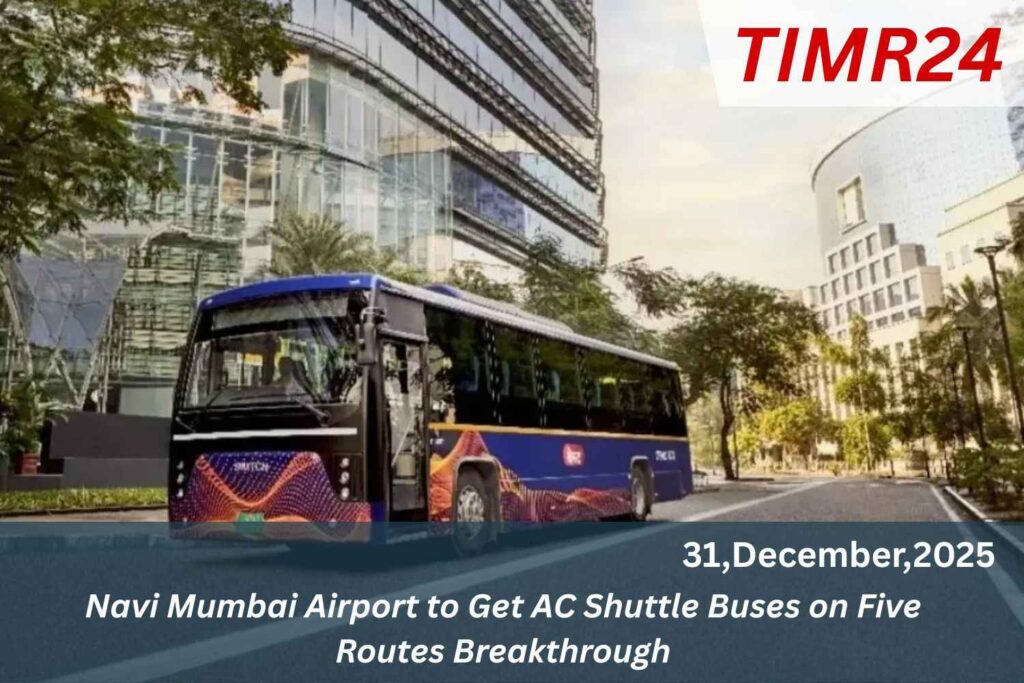
Navi Mumbai Municipal Transport (NMMT) is introducing dedicated air-conditioned shuttle bus services to the Navi Mumbai International Airport starting Thursday, marking the establishment of formal public transport to the new terminal. Services will begin at 6 am with 14 AC buses across five routes connecting major suburban railway stations: Belapur, Nerul, Targhar, Kharkopar, and Khandeshwar. This initiative aims to enhance last-mile connectivity for passengers, allowing access from Targhar railway station, which is approximately 1.5 km from the airport. Additional NMMT services will expand based on passenger demand, with operational preparations having been completed through.
Greenfield Aviation Projects
Trials and logistics planning prior to the launch Navi Mumbai International Airport (NMIA), one of India’s most ambitious greenfield aviation projects, is steadily moving closer to operational readiness, and a key component of its passenger experience strategy is now coming into focus. Authorities have confirmed plans to introduce air-conditioned shuttle bus services connecting the airport to five major routes across Mumbai and Navi Mumbai. This initiative is aimed at addressing one of the biggest challenges faced by new airports in India efficient and affordable last-mile connectivity. With Mumbai’s air travel demand continuing to surge and Chhatrapati Shivaji.
Maharaj International Airport operating near saturation, NMIA’s success will depend heavily on how seamlessly passengers can reach and leave the terminal The proposed AC shuttle bus network is being positioned as a reliable, comfortable, and cost-effective transport option for flyers, airport staff, and transit passengers. Unlike conventional city buses, these shuttles will be designed specifically for airport travel, offering enhanced comfort, predictable schedules, and adequate luggage space. This move aligns with global best practices, where airport-dedicated bus services play a critical role in reducing private vehicle dependence while improving overall accessibility.
Navi Mumbai Airport Hubs
Similar models can be seen at major international hubs, and Indian airports such as Bengaluru and Hyderabad have already demonstrated the effectiveness of such systems One of the central objectives behind launching AC shuttle buses from Navi Mumbai Airport is to integrate the airport into the broader metropolitan transport ecosystem. The five proposed routes are expected to connect key residential, commercial, and transit hubs, ensuring that passengers from different parts of the Mumbai Metropolitan Region (MMR) have convenient access without relying solely on taxis or personal vehicles. This approach also supports the region’s long-term mobility.
Goals by reducing congestion on arterial roads and lowering carbon emissions associated with airport traffic From a passenger convenience perspective, the introduction of these shuttle services is expected to significantly enhance the overall travel experience. Air-conditioned buses offer relief from Mumbai’s humid climate, while fixed routes and schedules reduce uncertainty, especially for first-time users of the new airport. For budget-conscious travelers, the shuttles will provide a more affordable alternative to app-based cabs, which often experience price surges during peak hours. Airport employees, including airline crew, ground staff, and concession workers, are also likely to.
Airport is Being Developed With Sustainability
Benefit from predictable and economical daily transport options The AC shuttle bus plan also reflects NMIA’s broader vision of becoming a future-ready airport. Designed to handle tens of millions of passengers annually in its initial phases, the airport is being developed with sustainability, efficiency, and passenger comfort at its core. Seamless surface connectivity is a crucial element of this vision, complementing ongoing investments in metro rail links, road infrastructure, and multimodal transport hubs In terms of operations, the shuttle buses are expected to be managed either by a public transport undertaking or through a public-private partnership model.
Such arrangements have proven effective in other cities, balancing service quality with operational efficiency. The buses are likely to be equipped with real-time tracking, digital ticketing options, and integration with mobile apps, making them accessible to tech-savvy travelers while remaining user-friendly for all age groups. These features would align well with India’s broader push toward smart mobility solutions The five routes under consideration are expected to cover high-demand corridors linking Navi Mumbai Airport to key nodes such as major railway stations, business districts, and residential clusters. While final route details and fares are yet to be officially.
Indian Airports Suggest That Simplicity
Announced, transport planners are focusing on maximizing coverage while maintaining frequency. This balance is critical, as infrequent services can discourage usage, while overly complex routes may dilute efficiency. Lessons from other Indian airports suggest that simplicity, (India) reliability, and clear communication are essential for long-term success Beyond passenger convenience, the AC shuttle bus initiative carries significant urban planning implications. Airports are powerful economic engines, and their connectivity determines how effectively surrounding regions can tap into new opportunities. Improved access to Navi Mumbai Airport is expected to boost.
Real estate development, hospitality investments, and commercial activity across Navi Mumbai and adjoining areas. Enhanced transport links also support workforce mobility, making it easier for people to access jobs created by the airport ecosystem From an environmental standpoint, shared shuttle services can play a meaningful role in reducing the airport’s carbon footprint. By encouraging passengers to opt for buses instead of individual cars, NMIA can lower per-capita emissions associated with airport access. This aligns with India’s broader climate commitments and the aviation sector’s increasing focus on sustainability. The use of modern, fuel-efficient, or even electric buses in the future.
Could further strengthen this impact. For global perspectives on sustainable airport transport, reference material is available The timing of the shuttle bus rollout is also significant. As Navi Mumbai Airport prepares for phased operations, ensuring that ground connectivity is ready from day one will help build passenger confidence. Early impressions matter, especially for a new airport competing with an established hub like Mumbai’s existing international airport. A smooth, hassle-free journey to and from NMIA can become a strong differentiator, encouraging airlines and passengers alike to embrace the new facility Policy alignment is another important dimension of this initiative.
Expressway Projects Across MMR
The Maharashtra government and local development authorities have consistently emphasized the need for integrated transport planning. The AC shuttle buses complement ongoing investments in metro lines, suburban rail upgrades, and expressway projects across the MMR. When viewed together, these initiatives represent a coordinated effort to future-proof the region’s transport infrastructure. Official updates and policy documents related to NMIA can be accessed through the City and Industrial Development Corporation (CIDCO) portal , which remains a key source of authoritative information In the broader context of India’s aviation growth story.
The Navi Mumbai Airport shuttle bus plan highlights a shift toward passenger-centric infrastructure development. Airports are no longer viewed as standalone facilities but as integral components of urban systems. Efficient surface transport is now recognized as just as important as runways and terminals. This holistic approach is essential if India is to meet its ambitious targets for air travel growth while maintaining quality and sustainability As the launch date for Navi Mumbai International Airport draws closer, expectations are high among travelers airlines, and industry observers.
The planned AC shuttle buses on five routes represent a practical, forward-looking step toward meeting those expectations. By prioritizing comfort, affordability, (India) and connectivity, NMIA is setting the tone for what modern airport access in India can look like. For continued updates on airport developments and transport infrastructure, readers can also explore insights from the Ministry of Civil Aviation’s official platform .
Q1. Why is Navi Mumbai Airport introducing AC shuttle buses?
The shuttle buses are being introduced to ensure comfortable, affordable, and reliable last-mile connectivity for passengers and airport staff.
Q2. How many routes will the AC shuttle buses cover?
The initial plan includes five major routes connecting key hubs across Mumbai and Navi Mumbai.
Q3. Who will operate the shuttle bus services?
The services are expected to be run through a public transport authority or a public-private partnership model.
Q4. Will these buses be affordable compared to taxis?
Yes, the shuttle buses are intended to be a cost-effective alternative to private taxis and app-based cabs.
Q5. How does this plan support sustainability?
Shared shuttle services reduce private vehicle usage, helping lower congestion and emissions around the airport.