



















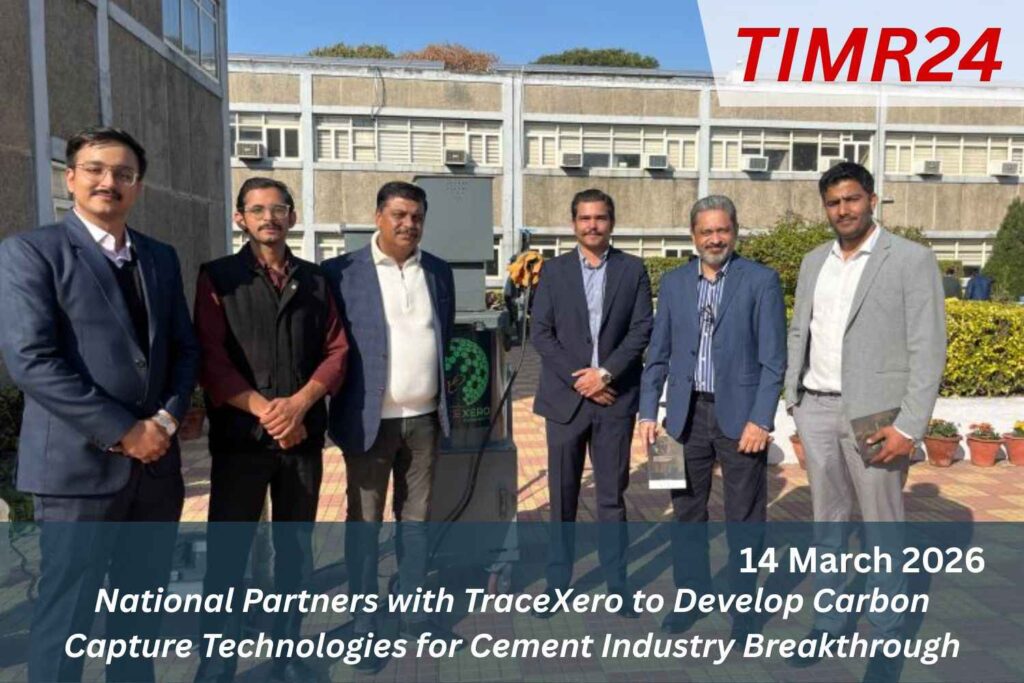
National Council for Cement and Building Materials (NCB) has partnered with TraceXero Technologies to advance Carbon Capture and Utilisation (CCU) technologies for the cement and construction materials sector. This collaboration, signed on 10 March 2026, aims to validate and commercialize solutions to curb the sector’s significant carbon emissions, which account for approximately 7% of global CO₂ emissions. TraceXero utilizes a proprietary solvent process to capture CO₂ and convert it into valuable materials like graphene. NCB provides research and technical support, promoting innovation in sustainability while enhancing the industry’s productivity and competitiveness.
Industrial Practices, The National Council
The global cement industry is facing increasing pressure to reduce carbon emissions as governments, industries, and environmental organizations push for sustainable infrastructure development. In an important step toward cleaner industrial practices, the National Council for Cement and Building Materials (NCB) has announced a strategic collaboration with the technology firm TraceXero to develop advanced carbon capture technologies specifically designed for cement manufacturing processes. This partnership marks a significant milestone for the construction materials sector as it moves toward achieving long-term sustainability goals and reducing.
The environmental impact associated with cement production Cement manufacturing is widely recognized as one of the largest contributors to industrial carbon dioxide emissions worldwide. The production process involves heating limestone and other materials in kilns at extremely high temperatures, which releases significant amounts of CO₂. As global demand for infrastructure continues to grow due to rapid urbanization and industrial expansion, reducing emissions from cement plants has become a critical challenge for policymakers and industry stakeholders. Through this partnership, NCB and TraceXero aim to address this challenge by developing scalable carbon capture technologies.
Building Materials, Supporting Innovations
That can be integrated into existing cement plants without disrupting production efficiency The collaboration combines the extensive research expertise of NCB with TraceXero’s technological capabilities in carbon management and emissions monitoring. NCB has long been recognized for its contributions to research and development in cement and building materials, supporting innovations that enhance efficiency, sustainability, and performance across the industry. By working with TraceXero, the organization intends to accelerate the development of practical carbon capture solutions that can help cement manufacturers meet strict environmental regulations while maintaining productivity.
One of the primary objectives of this partnership is to design advanced carbon capture systems capable of capturing carbon dioxide emissions directly from cement plant exhaust streams. These systems are expected to use innovative capture materials and advanced separation techniques to isolate CO₂ from other gases produced during the manufacturing process. Once captured, the carbon dioxide can either be stored safely underground or reused in industrial applications such as construction materials, synthetic fuels, and chemical production. Such approaches not only reduce emissions but also create opportunities for circular carbon economies.
Cleaner Technologies To Remain Competitive
The initiative also reflects a broader shift within the construction and infrastructure sector toward adopting greener technologies. Governments across the world are introducing stricter emission standards and carbon pricing policies to combat climate change. As a result, industries that traditionally rely on high-emission processes must invest in cleaner technologies to remain competitive and compliant with environmental regulations. By proactively developing carbon capture technologies, the cement sector can reduce its environmental footprint while continuing to support large-scale infrastructure development.
Another important aspect of the NCB–TraceXero collaboration is the focus on developing solutions that are economically viable for cement manufacturers. Many carbon capture technologies currently available are expensive to implement and operate, making them difficult for industries to adopt on a large scale. The research efforts under this partnership will therefore prioritize cost-effective designs, energy-efficient processes, and scalable solutions that can be implemented across multiple cement plants. This approach will ensure that environmental improvements are achieved without imposing excessive financial burdens on manufacturers.
Optimization Successful Pilot
The project will also involve pilot testing of new technologies at selected cement facilities. These pilot programs will allow researchers and engineers to evaluate the performance of carbon capture systems under real operating conditions. Data collected during these trials will help refine the technology, improve efficiency, and identify potential areas for optimization. Successful pilot results could lead to wider adoption of carbon capture systems across the cement industry, significantly reducing the sector’s overall carbon emissions.
In addition to environmental benefits, the partnership could also strengthen India’s position as a leader in sustainable construction technologies. As infrastructure development continues to accelerate across emerging economies, there is increasing demand for materials that meet both performance and environmental standards. Innovations developed through the NCB and TraceXero collaboration may provide scalable solutions that can be adopted not only in India but also in other countries seeking to decarbonize their construction industries.
The collaboration also aligns with global climate goals aimed at limiting temperature increases and reducing greenhouse gas emissions. International (India) agreements such as the Paris Climate Agreement emphasize the importance of transforming high-emission industries through technological innovation and cleaner production methods. Carbon capture and utilization technologies are widely viewed as a key component of this transformation because they allow industries to continue operating while significantly reducing their environmental impact.
Therefore Essential For Achieving Long-Term
Furthermore, the cement industry plays a vital role in modern infrastructure development, including housing, transportation networks, bridges, dams, and commercial buildings. Ensuring that cement production becomes more sustainable is therefore essential for achieving long-term climate goals without slowing economic development. The work being undertaken by NCB and TraceXero could serve as a model for other industrial sectors seeking to balance growth with environmental responsibility Industry experts believe that partnerships between research institutions and technology companies are essential for accelerating innovation in sustainability.
Research organizations bring deep scientific knowledge and laboratory capabilities, while technology companies contribute engineering expertise and practical solutions that can be implemented in industrial environments. By combining these strengths, the NCB–TraceXero collaboration is expected to develop technologies that are both scientifically advanced and commercially viable In addition to carbon capture technology development, the partnership may also explore digital monitoring tools and emissions analytics platforms. These technologies can help cement manufacturers track emissions in real time, identify inefficiencies in production processes, and implement corrective measures quickly.
Integrating digital monitoring with carbon capture systems could further enhance the effectiveness of emission reduction strategies The long-term impact of this collaboration could extend beyond emission reduction. By creating new technologies and processes, the project may (India) stimulate innovation in related industries such as construction materials recycling, green cement alternatives, and carbon-neutral building technologies. Such advancements could reshape the future of sustainable infrastructure development and contribute to a broader transition toward low-carbon economies Additional insights about cement industry sustainability and global carbon.
Reduction strategies can also be explored through external resources such as the International Energy Agency and the Global Cement and Concrete Association, which regularly publish research on decarbonizing heavy industries Ultimately, the partnership between NCB and TraceXero highlights the growing commitment of the cement industry to address climate challenges through innovation. As research progresses and technologies mature, carbon capture solutions could become an essential part of cement manufacturing worldwide. If successfully implemented at scale, these technologies have the potential to significantly reduce industrial emissions.
Q1. What is the NCB and TraceXero partnership about?
The partnership focuses on developing advanced carbon capture technologies for cement manufacturing to reduce carbon dioxide emissions.
Q2. Why is carbon capture important for the cement industry?
Cement production releases large amounts of CO₂, and carbon capture helps reduce environmental impact while maintaining industrial production.
Q3. How will the new technology work?
The technology aims to capture CO₂ from cement plant exhaust gases and either store it safely or reuse it in industrial processes.
Q4. Will this technology be used globally?
If successful, the solutions developed could be adopted by cement manufacturers around the world.
Q5. What are the environmental benefits?
Carbon capture can significantly reduce greenhouse gas emissions and help the cement industry meet climate targets.