




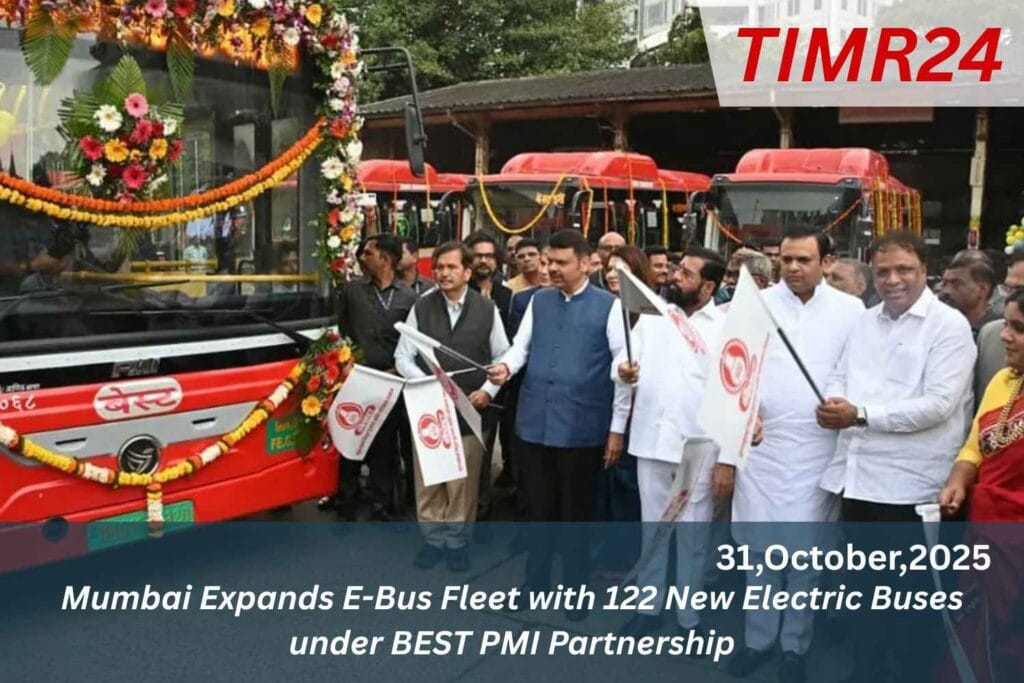
Accelerating its push for sustainable urban transport, PMI Electro Mobility, in collaboration with Brihanmumbai Electric Supply and Transport (BEST), has launched the second batch of twelve 12-metre fully electric buses in Mumbai. The inauguration, attended by Maharashtra’s Chief Minister Devendra Fadnavis and Deputy Chief Minister Eknath Shinde, is part of a plan to deploy 250 electric buses, with 122 deployed in this phase. The Oshiwara-Goregaon Depot has been equipped with 15 high-capacity chargers to facilitate efficient overnight charging. The new low-floor electric buses, designed by PMI, accommodate 36 passengers and have a range of 300 km per charge. Dr. Aanchal Jain.
CEO of PMI, expressed pride in contributing to a cleaner, healthier city and highlighted the commitment to sustainable mobility. PMI Electro Mobility operates across 31 cities in India, promoting electric public transport solutions Mumbai, India’s financial capital and one of the most densely populated urban centers in the world, is taking a major step toward sustainable transportation with the introduction of 122 new electric buses under the BEST-PMI partnership. This ambitious initiative represents not only the city’s commitment to clean energy mobility but also the Indian government’s broader vision under the FAME II (Faster Adoption and Manufacturing of Electric Vehicles) policy.
As the urgency for reducing urban pollution grows, electric mobility is emerging as a vital component of urban resilience, making Mumbai a model for other Indian cities The Brihanmumbai Electric Supply and Transport Undertaking (BEST), which manages the city’s bus services, has long been recognized for providing affordable and accessible transport to millions of commuters every day. However, with the rising challenges of traffic congestion, air pollution, and fuel dependency, the shift to electric mobility has become crucial. Partnering with PMI Electro Mobility Solutions, a leading manufacturer of advanced electric buses, BEST has begun the next phase of its green transport revolution.
This latest addition of 122 e-buses adds to the growing number already on Mumbai’s roads, reinforcing the city’s aim to achieve a 100% electric fleet by 2027 The new electric buses are equipped with state-of-the-art technology, including lithium-ion battery systems, regenerative braking, digital ticketing, and smart tracking features. They are designed for high performance on Mumbai’s congested roads and can operate efficiently across long routes connecting Colaba, Andheri, Borivali, Kurla, and other key urban hubs. With silent engines and zero tailpipe emissions, these buses promise a cleaner, quieter, and more energy-efficient commute for.
Thousands of daily passengers. For readers interested in learning about the manufacturer which provides detailed insights into their product range and innovation in electric public transport The expansion of the electric bus fleet aligns perfectly with India’s National Electric Mobility Mission Plan (NEMMP), launched to promote the adoption of electric vehicles nationwide. By incorporating renewable energy solutions and sustainable infrastructure, cities like Mumbai are leading the charge toward decarbonization. According to the Ministry of Heavy Industries, which oversees the implementation of the FAME initiative.
The adoption of e-buses will reduce dependency on imported fossil fuels and cut greenhouse gas emissions significantly. As per government projections, if all major cities replicate Mumbai’s transition pace, India could avoid millions of tonnes of CO₂ emissions annually. You can learn more about these initiatives on A major strength of the BEST-PMI collaboration lies in its public-private partnership (PPP) model. This structure allows for shared investments, advanced technology transfer, and efficient operation management. PMI will handle maintenance and battery charging infrastructure, while BEST focuses on route integration, scheduling, and commuter services.
Such synergy reflects India’s growing confidence in PPP frameworks for sustainable projects, as seen in similar models for smart city mobility under success of this initiative may encourage other Indian transport authorities to adopt similar collaborative strategies, paving the way for broader e-mobility penetration in tier-1 and tier-2 cities The environmental benefits of electric buses are already being felt across Mumbai. Studies from NITI Aayog and the Centre for Science and Environment (CSE) indicate that electric buses emit up to 40% less carbon dioxide compared to conventional diesel buses. Additionally, the lifecycle cost of electric buses is proving to be lower.
Considering the reduced maintenance requirements and fuel costs. As battery prices continue to decline globally, the financial case for large-scale electric bus adoption is becoming increasingly compelling. For more on India’s EV transition roadmap Commuters too are reaping the rewards of this transformation. The new fleet offers a more comfortable travel experience with air conditioning, GPS-enabled route tracking, low-floor access, and real-time digital ticketing. BEST has also launched an integrated mobile app that allows passengers to check live bus locations and schedules, enhancing convenience and reducing wait times. Such technological integration supports.
The broader Digital India Mission, ensuring that even public transport aligns with the country’s digital innovation goals. As part of this initiative, several charging depots have been established across Mumbai, supported by energy partners like that the buses can operate seamlessly around the clock The rollout of these e-buses also underscores Mumbai’s alignment with global climate goals. With urban populations expected to grow rapidly, the demand for sustainable mobility will only increase. Electric public transport plays a crucial role in achieving net-zero emissions, as envisioned under India’s 2070 climate pledge.
Mumbai’s Smart City Framework
Cities such as Delhi, Bengaluru, and Pune are also accelerating their EV bus adoption programs, mirroring Mumbai’s approach. The success of such transitions depends on consistent policy support, financial incentives, and an expanded charging network areas in which Mumbai is already demonstrating strong leadership From a broader urban development perspective, this project integrates into Mumbai’s smart city framework, combining sustainable design with digital monitoring systems. Real-time data from the buses helps optimize route planning, improve energy consumption patterns, and reduce congestion across key transit corridors.
India’s evolving infrastructure strategy highlighting how innovation and policy are shaping sustainable urban futures The launch event for the 122 new e-buses was attended by senior officials from BEST, PMI, and the Maharashtra government, who emphasized the need to (India) strengthen local manufacturing and create green jobs. PMI’s electric buses are built under the Make in India initiative, ensuring that the production ecosystem remains domestic, thereby supporting employment and skill development. This integration of sustainability and economic growth captures the essence of the Build in India for the World philosophy, which continues to drive India’s technological and industrial evolution.
Q1. How many electric buses has Mumbai added under the BEST-PMI partnership?
Mumbai has added 122 new electric buses to its existing fleet, strengthening its commitment to eco-friendly transportation.
Q2. What are the benefits of these new electric buses?
They provide zero-emission mobility, lower maintenance costs, reduced pollution, and improved commuter comfort.
Q3. Who is PMI, and what role do they play in this initiative?
PMI Electro Mobility Solutions is a leading e-bus manufacturer providing electric vehicles and charging systems for BEST.
Q4. How does this support India’s FAME II initiative?
The deployment aligns with FAME II’s goal to accelerate EV adoption through public transport electrification.
Q5. When will Mumbai achieve a 100% electric bus fleet?
BEST aims to fully electrify its fleet by 2027, making Mumbai one of India’s first zero-emission public transport cities.