
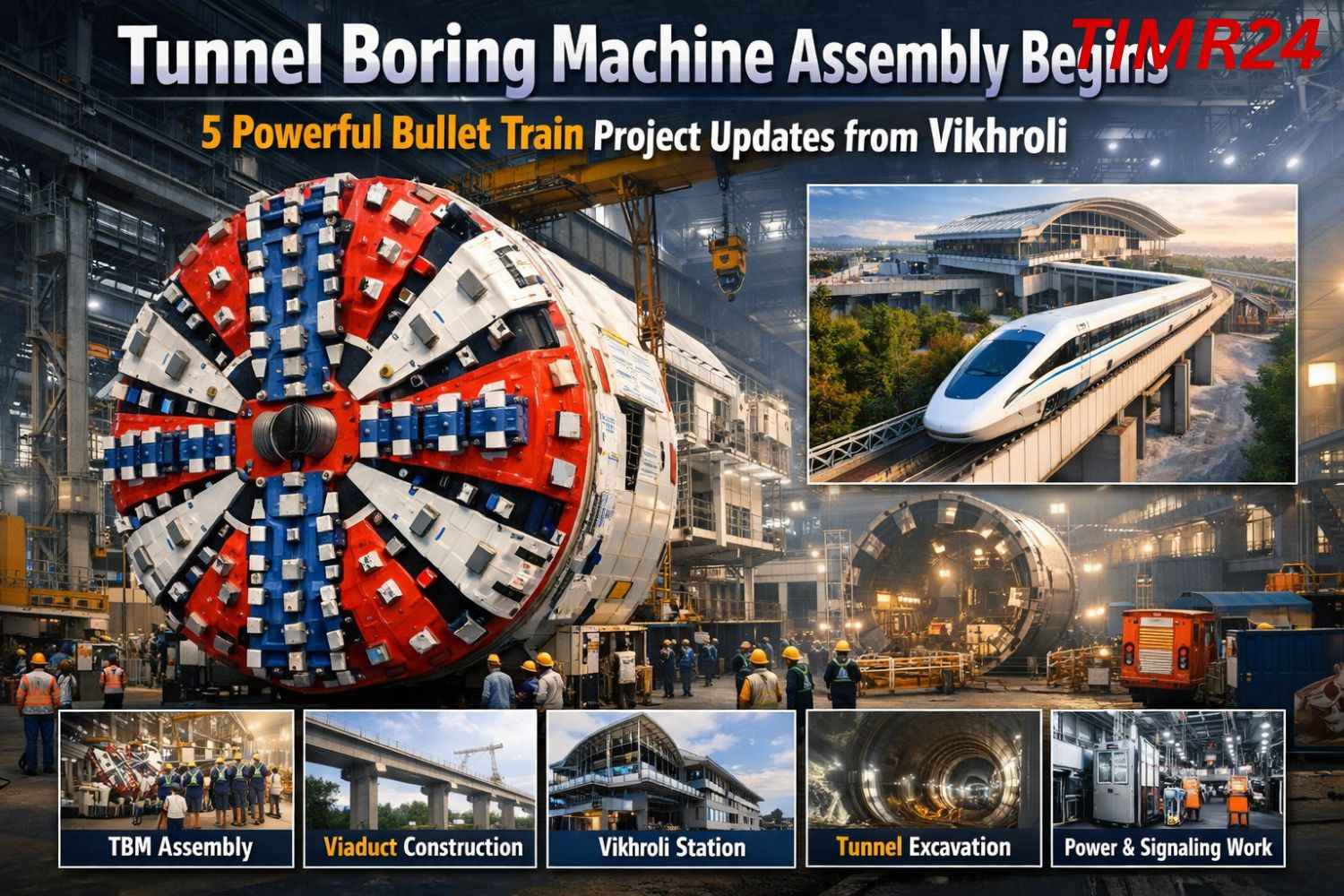













National High Speed Rail Corporation Limited has partnered with Larsen & Toubro Limited for the design, supply, and construction of track and track related works for a double line high-speed railway in Maharashtra. The project includes 157 route km alignment and includes four stations and a rolling stock depot. Indian companies have been awarded all three-track construction packages, increasing India’s expertise in high-speed rail track construction technology. The ballast-less slab track system is being used for India’s first high-speed railway project The ambitious Mumbai-Ahmedabad Bullet Train Project has achieved another milestone as the National High-Speed Rail.
Corporation Limited (NHSRCL) signed a landmark agreement with Larsen & Toubro (L&T) for executing track works. This project, often regarded as India’s first step into the era of high-speed rail, aims to connect two of the country’s most dynamic cities Mumbai and Ahmedabad through a modern rail corridor equipped with cutting-edge Japanese Shinkansen technology. Once operational, the bullet train is expected to run at speeds up to 320 km/h, reducing the travel time between the two cities from more than six hours to around two hours, redefining the future of transportation in India The Mumbai-Ahmedabad High-Speed Rail (MAHSR) corridor, often called the bullet train.
Project, is a flagship initiative under India’s infrastructure modernization mission. Managed by NHSRCL, this corridor spans around 508 kilometres and is designed to be constructed in phases. The project is being implemented with significant technological and financial collaboration from Japan, particularly using the Shinkansen system, which is globally recognized for its reliability and safety. According to the official (NHSRCL) the vision is to not only introduce speed but also set new benchmarks for comfort, sustainability, and efficiency in Indian rail travel. This high-speed train will pass through major cities such as Surat, Vadodara, Anand, and Sabarmati, providing seamless connectivity and fostering regional economic growth.
For readers interested in broader developments in India’s infrastructure, you can explore projects like (India’s Real Estate) that are similarly transforming the country’s urban and transport landscape The agreement signed between NHSRCL and Larsen & Toubro is a pivotal step in ensuring the timely execution of this mega project. L&T, one of India’s leading engineering and construction conglomerates, brings expertise in handling large-scale infrastructure projects, making it a natural choice for such a high-profile contract. Under this agreement, L&T will take responsibility for advanced track works, including the laying of ballastless slab tracks, precision engineering for alignment, and integration with signaling and safety systems.
This collaboration demonstrates India’s growing capacity to execute technically challenging projects while adhering to global standards For more insights into how Indian railways are evolving, check which showcases ongoing modernization programs across the nation The track system for the bullet train corridor is not conventional. Instead, it will use Japanese Shinkansen technology, which has a proven track record of safety and efficiency for decades. The ballastless slab track design, unlike traditional tracks with ballast stones, offers durability, precision alignment, and reduced maintenance. This is particularly critical for high-speed operations, where even minor misalignments.
Economic and Employment Impact
Can affect performance and safety. Moreover, the incorporation of earthquake-resistant features ensures that the corridor is prepared for natural challenges NHSRCL has emphasized that these technological advancements are not only about speed but also about reliability, longevity, and passenger comfort. The Japanese experience with Shinkansen is being blended with India’s local execution capacity through L&T, creating a model for future high-speed rail projects in India. The bullet train project is more than just a transportation initiative; it is a nation-building exercise. By connecting Mumbai, the financial capital of India, with Ahmedabad, a fast-emerging industrial.
Hub, the project will catalyze business activities and encourage investments in cities along the route. Regions such as Surat, known for its diamond and textile industries, will benefit from improved market access and faster logistics. Additionally, the project is generating thousands of direct and indirect jobs, from construction workers to engineers, and even opportunities for small-scale suppliers Parallel to this, India’s ongoing focus on sustainable urban development is evident in other initiatives like showcasing how innovation in infrastructure is shaping both transport and real estate sectors High-speed rail systems worldwide are celebrated for being eco-friendly alternatives to.
Road and air travel. The Mumbai-Ahmedabad corridor will significantly reduce greenhouse gas emissions by shifting a large number of travellers from planes and cars to rail. With lower per-passenger energy consumption, the bullet train supports India’s commitment to reducing its carbon footprint under the Paris Agreement. The track design itself is being aligned with minimal disruption to sensitive ecological zones, while compensatory afforestation and sustainability practices are being undertaken to balance development with environmental responsibility.
Boosting Connectivity and Smart City Growth
The bullet train project is expected to boost smart city development along the corridor. Cities like Surat, Vadodara, and Anand are poised to become new business hubs, benefitting from faster connectivity to Mumbai and Ahmedabad. These urban centers will experience increased investments in hospitality, retail, and housing, further propelling the Make in India vision. Moreover, as the project integrates with regional transport systems, it will also serve as a backbone for future connectivity expansions, linking with metro systems and expressways.
While the project has faced challenges such as land acquisition delays and pandemic-related slowdowns, the agreement with L&T ensures renewed momentum. According to official reports, partial operations are expected by 2028–2029, with full commissioning in the following years. Once operational, the corridor will not only symbolize India’s engineering capability but also position the country among the elite group of nations with functional high-speed rail systems. The future also holds the possibility of expanding similar corridors across India, linking Delhi, Chennai, Bengaluru, and Hyderabad in the long run.
The signing of the agreement between NHSRCL and L&T for track works is a defining chapter in India’s journey toward modern, high-speed transportation. Beyond the promise of reduced travel time, this project is a catalyst for economic growth, environmental sustainability, and regional development. With advanced track technology, global collaborations, and local expertise coming together, the Mumbai-Ahmedabad bullet train corridor represents not just speed but a vision of India’s future. As India continues to invest in projects of such scale, it is clear that the nation is steadily moving toward a new era of connectivity and infrastructure excellence, reshaping how people live, work, and travel.
Q1 What is the Mumbai Ahmedabad Bullet Train project?
It is India’s first high-speed rail corridor connecting Mumbai and Ahmedabad with trains running at 320 km/h.
Q2 Who signed the agreement for track works?
NHSRCL signed the agreement with Larsen & Toubro (L&T) for track works.
Q3: What technology is being used for track works?
Japanese Shinkansen technology with ballastless slab tracks will be used.
Q4: How will the project benefit India?
It will reduce travel time, create jobs, promote economic growth, and reduce carbon emissions.
Q5: When will the bullet train be operational?
The project is expected to be partially operational by 2028-2029 and fully operational in the next decade.