
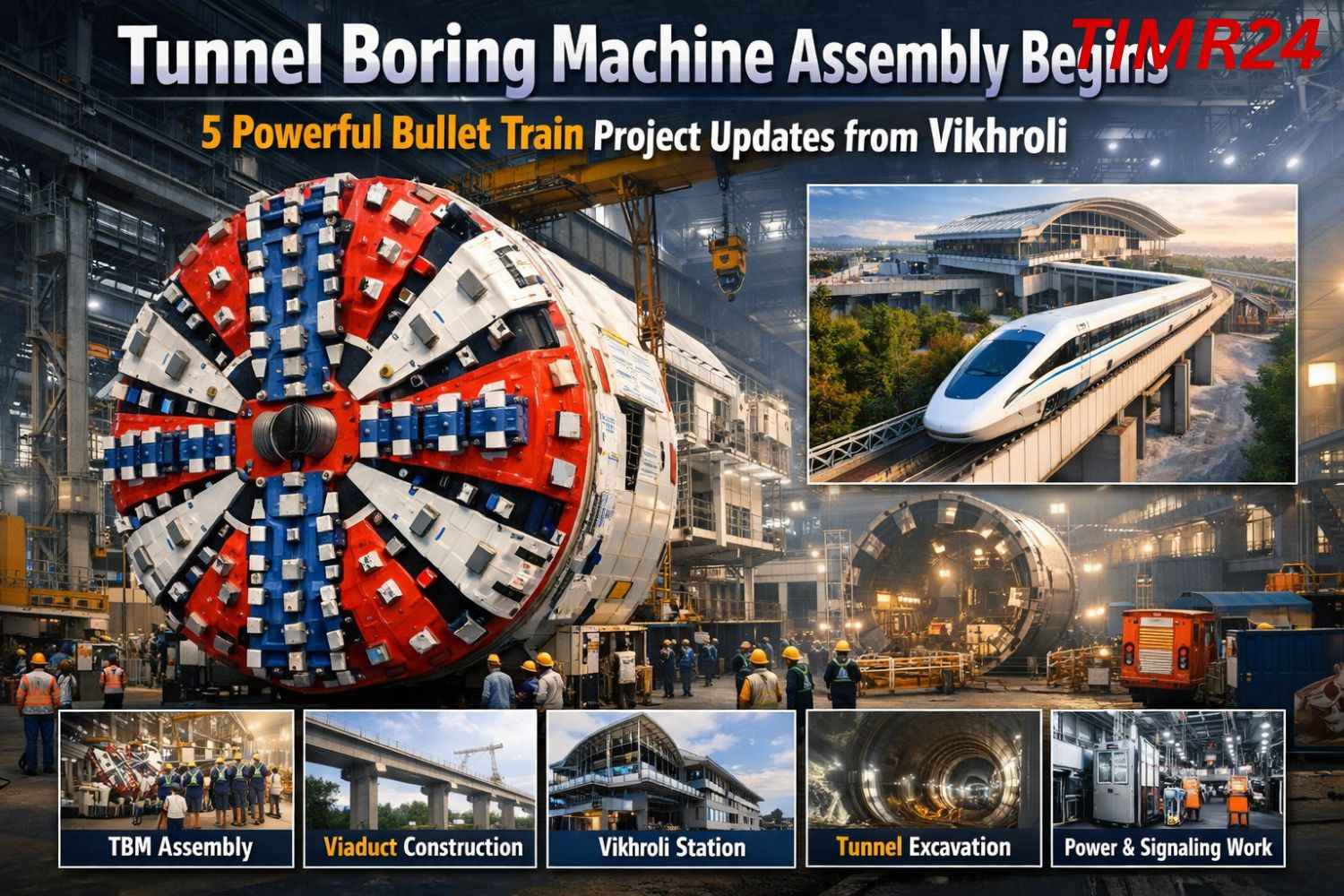














The National High-Speed Rail Corporation Limited (NHSRCL) has launched the first 40-metre Full Span Pre-Stressed Concrete (PSC) Box Girder for the Mumbai-Ahmedabad Bullet Train corridor in Maharashtra. The corridor spans 156 km and will use 2,575 full span girders, each 40 meters long, weighing around 970 metric tonnes. The girders are cast using 390 cubic meters of concrete and 42 metric tonnes of steel, enabling construction progress up to 10 times faster than segmental girders. The technology has already contributed to 319 km of completed viaduct in Gujarat. The Mumbai-Ahmedabad Bullet Train, India’s first high-speed rail project, has crossed a significant.
Engineering milestone with the successful launch of its first 40-meter full span pre-stressed concrete (PSC) box girder in Maharashtra. This achievement is not just a technical feat but a symbol of India’s entry into the elite group of nations that operate and build high-speed rail corridors. The moment holds historical importance because it marks the tangible progress of a project that has been envisioned to transform how people travel between Mumbai and Ahmedabad, shrinking distances, saving time, and boosting economic development along the corridor The launch of the 40m PSC box girder is one of the most challenging and innovative aspects of the project. Unlike conventional.
Bridge structures, a full span PSC box girder is designed to handle the dynamic load and speed requirements of bullet trains running at 320 km/h. Its strength, durability, and precision engineering ensure the stability of the elevated viaduct that will carry the train. The execution required specialized cranes, advanced technology, and coordinated efforts by teams of engineers and construction workers. This milestone shows that India is steadily adapting international standards of railway engineering. Similar to the developments seen in this project also showcases a blend of innovation and sustainability.
Impact on the Mumbai-Ahmedabad High-Speed Rail Corridor
The Mumbai-Ahmedabad corridor, spread across 508 kilometres, is designed to connect two of India’s most vibrant economic hubs. Once operational, the bullet train will cut the current travel time of about six hours to just around two hours, making daily business trips and intercity travel highly efficient. The corridor will have multiple stations including Thane, Vapi, Surat, Bharuch, Vadodara, Anand, and finally Ahmedabad, ensuring that smaller cities and industrial clusters along the route benefit equally from the connectivity. This progress is similar in spirit to the developments at (AURIC Smart City) where infrastructure planning is linked directly with regional growth.
Every milestone achieved in the bullet train project creates ripple effects in terms of regional development. In Maharashtra and Gujarat, new employment opportunities have opened across construction, supply chains, and allied industries. Real estate near upcoming stations is witnessing growth, and businesses are preparing for better logistics and faster connectivity. Tourism too is expected to receive a boost, as faster trains make weekend travel and city-to-city movement more practical. This model of development can be compared to the economic surge brought about by global-scale projects like where large investments stimulate local economies.
Technology Transfer and ‘Make in India’
One of the most significant outcomes of the project has been the partnership between India and Japan, with technical and financial assistance coming through the Japan International Cooperation Agency (JICA). While initial designs and technology inputs have been provided by Japan, there is a strong emphasis on transferring knowledge and expertise to Indian companies. Over time, domestic industries are expected to manufacture key components such as track systems, electrical equipment, and even parts of rolling stock. This aligns closely with the Make in India vision, ensuring that the bullet train is not just an imported model but a catalyst for local industrial growth.
Similar approaches were adopted by initiatives like the (CII Indian) where global standards were localized to Indian needs High-speed rail projects globally have proven to be more energy efficient and environmentally friendly compared to air or road travel. The Mumbai-Ahmedabad Bullet Train will run on electrified tracks, significantly reducing dependence on fossil fuels. With fewer vehicles on highways and a reduction in short-haul flights between Mumbai and Ahmedabad, the project will contribute to lower carbon emissions. Furthermore, efforts are being made to minimize land acquisition impacts and adopt greener construction practices.
Social Benefits and Better Connectivity
The sustainability aspect ties into India’s larger environmental goals and complements other green initiatives such as renewable energy adoption and Beyond speed and technology, the bullet train project promises to deliver a profound social impact. For people living along the corridor, it will mean faster access to education, healthcare, and job markets in major cities. Students will find it easier to pursue higher education across state borders, while professionals can consider job opportunities in cities without worrying about long commutes. Families will be able to stay more connected despite distances. In this way, the bullet train is not just a mode of transport but also a social bridge, narrowing gaps between regions and communities.
The success of the Mumbai-Ahmedabad Bullet Train project is expected to set the stage for more high-speed rail corridors across India. Potential future lines could connect Delhi with Varanasi, Mumbai with Nagpur, and Chennai with Bengaluru. Each of these routes will be designed to enhance connectivity and encourage balanced regional growth. Just as projects like the reflect industrial expansion (NMDC) bullet train corridors will become drivers of urbanization and modernization Large-scale infrastructure projects inevitably face challenges, whether it be land acquisition, funding issues, or public concerns. The bullet train project has also encountered delays and opposition in some.
A Symbol of Modern India
Regions However, the successful launch of the PSC box girder demonstrates that despite these challenges, progress is possible through planning, collaboration, and persistence. Each hurdle overcome is not just a step forward for the project but also a lesson for future infrastructure development in India Ultimately, the Mumbai-Ahmedabad Bullet Train is more than just a transportation project. It is a symbol of India’s ambition to match global standards in infrastructure, innovation, and sustainability. The successful launch of the 40m PSC box girder is proof that the vision is translating into reality. Once operational, the train will redefine travel between Mumbai and Ahmedabad.
Q1. What is the significance of the first 40m PSC box girder launch?
It marks a major construction milestone for the Mumbai-Ahmedabad Bullet Train project.
Q2. Where was the PSC box girder launched?
It was launched in Maharashtra, part of the high-speed rail corridor.
Q3. How long is the Mumbai-Ahmedabad Bullet Train corridor?
The corridor spans approximately 508 km connecting Mumbai and Ahmedabad.
Q4. What speed will the bullet train operate at?
The train will run at speeds of up to 320 km/h.
Q5. Who is executing the project?
The project is being implemented by the National High Speed Rail Corporation Limited (NHSRCL).