
















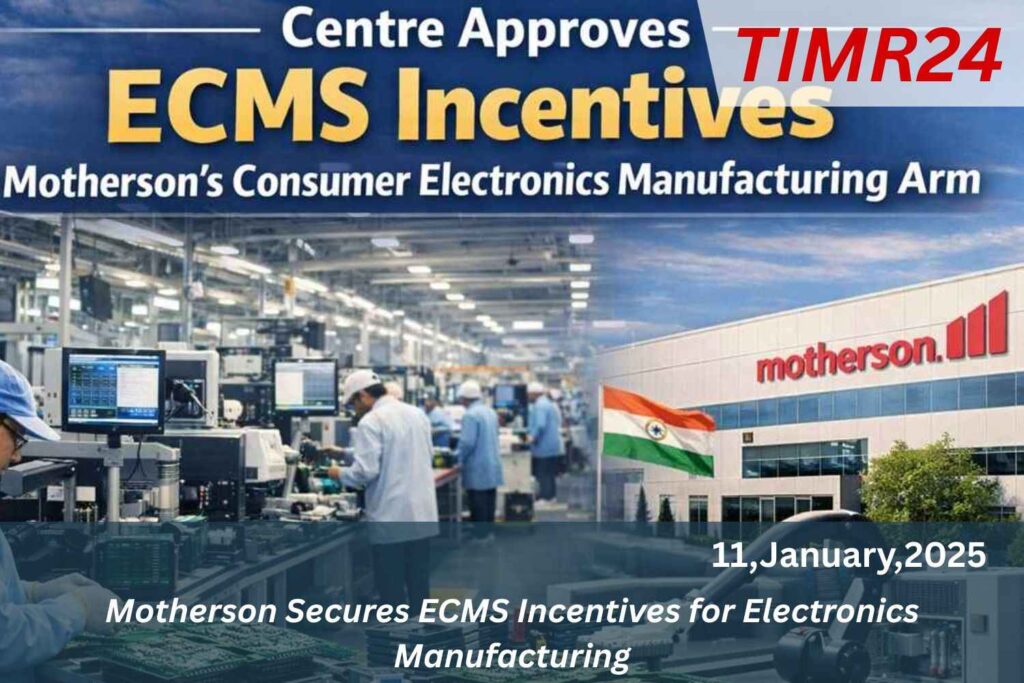
Motherson Electronic Components Private, a subsidiary of Samvardhana Motherson International, has received government incentives under the Electronics Components Manufacturing Scheme (ECMS) from the Ministry of Electronics and Information Technology, India. The approval, focusing on producing enclosures for consumer electronics, aligns with the Make in India initiative and supports a cumulative investment of Rs 19 billion from FY26 to FY31. This programme aims to create over 5,000 jobs at the Kanchipuram facility, highlighting Motherson’s operational strengths in high-value electronics manufacturing India’s manufacturing ecosystem received.
Global Electronics Manufacturing
A significant boost as Samvardhana Motherson International Limited (Motherson) secured incentives under the Electronics Component Manufacturing Scheme (ECMS), marking a decisive step in the country’s ambition to become a global electronics manufacturing hub. The ECMS scheme, rolled out by the Government of India, aims to reduce import dependency, strengthen domestic supply chains and support companies willing to invest in high-value electronics manufacturing. With this approval, Motherson is now positioned to expand its footprint beyond automotive components and into the fast-growing electronics value chain that supports electric vehicles, industrial automation, telecom, and consumer electronics.
The Electronics Component Manufacturing Scheme is part of India’s broader Make in India and Atmanirbhar Bharat strategy, which focuses on creating globally competitive manufacturing clusters. Under this scheme, companies receive financial incentives based on capital investments, production volumes, and localization targets. Motherson’s inclusion under ECMS confirms that the government sees the group as a strategic manufacturer capable of scaling advanced electronics production Motherson, which already operates across 44 countries and serves leading automotive OEMs, has been rapidly diversifying into electronics, mechatronics, sensors, wiring.
Electric Vehicles And Smart Mobility
Harnesses, and power modules. With the ECMS incentives in place, the group is expected to expand domestic production of printed circuit boards, electronic control units, battery management systems, and semiconductor-linked components. These products are vital for electric vehicles and smart mobility solutions, where electronics content now accounts for a major share of total vehicle cost The timing of Motherson’s ECMS approval is critical because India is witnessing explosive growth in EVs, renewable energy systems, telecom equipment, and industrial electronics. These sectors rely heavily on high-quality electronic components that have traditionally been imported from China, Taiwan, South Korea, and Japan.
By building domestic capabilities, Motherson will not only reduce import dependency but also improve supply chain resilience, a factor that became extremely important after COVID-19 disruptions From a business standpoint, ECMS incentives significantly improve the economics of electronics manufacturing. Electronics production typically requires heavy upfront capital investments in clean rooms, surface-mount technology lines, automated testing equipment, and R&D facilities. With government-backed incentives covering part of this cost, Motherson can accelerate its expansion without straining its balance sheet. The move is expected to enhance margins, diversify.
Plastic Molders, And Logistics Providers
Revenue streams, and reduce exposure to cyclical automotive markets The impact of this development extends well beyond one company. Motherson’s large supplier ecosystem, including PCB manufacturers, semiconductor packaging firms, plastic molders, and logistics providers, will benefit from increased domestic demand. This will likely lead to job creation, technology transfers, and skill development across India’s electronics manufacturing clusters in states like Tamil Nadu, Uttar Pradesh, Karnataka, and Telangana In the global context, electronics manufacturing is undergoing a geographic realignment as companies seek alternatives to China-centric supply chains.
India, supported by schemes like ECMS, PLI, and semiconductor incentives, is becoming a preferred destination for multinational firms looking to diversify. ability to integrate electronics with its existing automotive and mobility businesses gives it a competitive edge over pure-play electronics (Solar) manufacturers. This convergence of auto and electronics is especially important in electric and connected vehicles, where hardware and software are increasingly interdependent Another key dimension of Motherson’s ECMS approval is its contribution to sustainability. Electronics manufacturing under modern standards involves energy-efficient processes.
Financial Analysts Believe
Reduced material wastage, and compliance with global environmental norms. As India pushes toward net-zero targets, domestic electronics production will also reduce the carbon footprint associated with long-distance import Financial analysts believe that electronics could become one of Motherson’s fastest-growing verticals over the next decade. With EV penetration rising and digitalization accelerating across industries, demand for sensors, controllers, power electronics, and connectivity modules is set to soar. ECMS incentives will allow Motherson to price its products more competitively while maintaining profitability, making it a preferred supplier for both Indian and global OEMs.
Autonomy In Critical Technologies
This could translate into higher export revenues and stronger foreign exchange inflows for India The broader policy environment also supports this growth. Alongside ECMS, India has implemented the Production Linked Incentive (PLI) scheme for electronics, which rewards companies based on incremental sales. The synergy between ECMS and PLI creates a powerful framework that encourages both capacity building and output expansion. Companies like Motherson can leverage these schemes together to build world-class manufacturing facilities that meet international standards Motherson’s success under ECMS could encourage more Indian conglomerates to.
Invest in electronics manufacturing, accelerating the creation of a full-fledged domestic supply chain that includes semiconductors, displays, passive components, and embedded systems. This will strengthen India’s strategic autonomy in critical technologies while also boosting (India) its position in global trade. As electronics increasingly become the backbone of every modern industry, from healthcare to transportation, Motherson’s move signals a shift toward a more technology-driven manufacturing future for India.
Q1. What is the ECMS scheme and why did Motherson receive it?
ECMS is a government incentive program that supports domestic electronics component manufacturing, and Motherson qualified by committing investments and production targets aligned with India’s industrial policy.
Q2. How will ECMS benefit financially?
The incentives reduce capital costs and improve margins, enabling Motherson to scale electronics production faster and more competitively.
Q3. Which products will Motherson manufacture under ECMS?
The company is expected to focus on PCBs, electronic control units, battery management systems, and power electronics.
Q4. How does this impact India’s electronics sector?
It strengthens domestic supply chains, reduces imports, and creates jobs across the electronics ecosystem.
Q5. Will this help Motherson in the EV market?
Yes, electronics are core to EVs, and local manufacturing gives Motherson a strategic advantage in the fast-growing EV segment.