










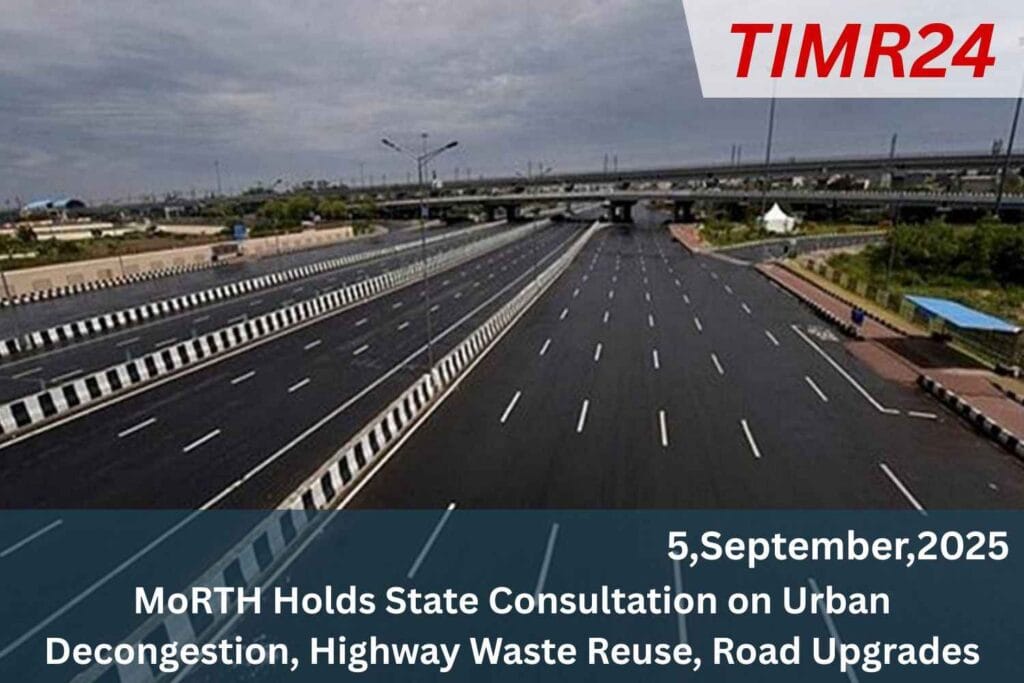
Union Minister Nitin Gadkari has held a State Consultation Conference to discuss key policy initiatives under finalization by the Central Government. The Urban Decongestion Policy aims to reduce traffic bottlenecks on National Highways passing through cities with a population of more than one lakh by developing access-controlled ring roads, bypasses, and elevated corridors. The policy emphasizes close integration with urban master plans and introduces flexible financing mechanisms. The Ministry is also promoting the reuse of inert waste from urban landfills in highway construction, reducing dependence on natural soil and addressing solid waste management.
The State Road Development Policy aims to provide central support for the upgradation of high-traffic State Highways, focusing on corridors with significant traffic volumes. The Ministry has proposed amendments to the National Highways Act, 1956 to simplify land acquisition procedures and enhance transparency. The Ministry of Road Transport and Highways (MoRTH) recently organized a comprehensive state consultation that focused on some of the most pressing aspects of India’s infrastructure development urban decongestion, highway waste reuse, road upgrades, and reforms in the National Highways Act The consultation served as a platform for central and state representatives to engage in dialogue, share regional challenges, and frame strategies.
Urban Decongestion and Smarter City Planning
that align with the country’s long-term mobility and sustainability goals. With rapid urbanization, increasing vehicular traffic, and growing concerns about environmental sustainability, this consultation marked a timely intervention by MoRTH to reimagine India’s infrastructure through integrated planning and reform-oriented action. One of the most urgent challenges highlighted during the consultation was urban decongestion. India’s metropolitan cities and tier-2 urban centers are experiencing rising traffic congestion due to rapid population growth, increased private vehicle ownership, and limited public transport integration. MoRTH emphasized the need for smarter road designs.
Improved traffic management systems, and greater reliance on multimodal transport to reduce pressure on highways that cut through city areas. Proposals such as dedicated freight corridors, expansion of ring roads, and better synchronization between highways and urban arterial roads were discussed. These strategies are expected to not only reduce travel time but also cut down on fuel wastage and vehicular emissions. The consultation linked these initiatives to the broader goals of the (GatiShakti) which focuses on integrated and holistic infrastructure development by combining roads, railways, ports, and urban transport under one framework.
Highway Waste Reuse and Sustainable Construction
Another important theme was the reuse of highway construction waste and the shift toward sustainable construction practices. India’s massive road-building programs, including Bharatmala Pariyojana, generate large quantities of construction and demolition waste, ranging from bitumen and asphalt to cement and rubble. Traditionally, much of this waste has been dumped or landfilled, creating environmental hazards. During the consultation, MoRTH encouraged states to adopt modern technologies that allow for recycling and reuse of waste materials in road construction and maintenance. This approach aligns with India’s transition to a circular economy, where waste is treated as a resource.
For example, reclaimed asphalt pavement (RAP) and recycled aggregates can be used to strengthen new road layers, reducing reliance on fresh raw materials. Experts also pointed to global best practices, such as Japan’s near 100% recycling of asphalt waste, as benchmarks India can replicate. By incorporating waste reuse into highway projects, MoRTH aims to lower construction costs, reduce carbon emissions, and extend the life cycle of road assets.
Road Upgrades for Efficiency and Connectivity
India’s economic growth is tightly linked to its road network, which handles more than 60% of freight and 85% of passenger traffic. The consultation stressed the importance of timely road upgrades to keep pace with increasing demand. Upgrades discussed included expansion of national highways to six or eight lanes, improved junction designs, deployment of Intelligent Transport Systems (ITS) for traffic monitoring, and strengthening of bridges and culverts to handle heavy freight loads. MoRTH also highlighted the need for EV-ready infrastructure, including charging points along national highways, which ties into the government’s clean mobility agenda. These upgrades are expected to ease logistics bottlenecks.
Improve road safety, and reduce logistic costs key goals under The integration of digital technologies, like real-time traffic management and electronic tolling, was also emphasized as critical for enhancing road efficiency. Policy reform formed the backbone of the consultation, with particular attention on the National Highways Act. Delays in land acquisition and legal disputes have historically slowed down highway projects, often leading to cost overruns. MoRTH discussed introducing streamlined procedures to make land acquisition faster and more transparent, while also ensuring fair compensation for affected stakeholders. Reforms will also aim to simplify project approvals and reduce bureaucratic hurdles.
Making India’s highway sector more attractive for private investment. By giving states a larger role in the process, MoRTH hopes to strike a balance between (NHAI) national development goals and regional priorities. These reforms are not only expected to accelerate project execution but also create a more investor-friendly ecosystem that will drive long-term infrastructure growth. What stood out in the consultation was MoRTH’s emphasis on integrating all these aspects into a single, holistic vision. Urban decongestion strategies will not be effective unless supported by road upgrades, while sustainability.
Holistic Infrastructure Vision
Goals cannot be achieved without embedding waste reuse practices into construction. Similarly, legal reforms under the NH Act will provide the necessary framework for these initiatives to move forward without delays. The consultation demonstrated how infrastructure development today cannot be approached in silos; it requires a blend of engineering innovation, environmental consciousness, and legal reforms By engaging state governments as equal partners, MoRTH underscored its commitment to cooperative federalism in infrastructure planning. States were encouraged to share their challenges and innovations, creating a platform for knowledge exchange. This bottom-up approach ensures that national programs like Bharatmala and PM GatiShakti are grounded in the realities of local governance and geography.
The consultation signalled MoRTH’s determination to balance rapid infrastructure expansion with sustainability and efficiency. As India pushes toward its 2047 vision of becoming a developed economy, roads will remain the backbone of its logistics and mobility systems. Through urban decongestion measures, sustainable waste reuse, strategic road upgrades, and progressive legal reforms, the ministry is setting the stage for an infrastructure ecosystem that supports economic growth while minimizing environmental impact. The outcomes of this consultation will likely influence state-level policies and project execution strategies in the years ahead, creating a ripple effect across the country’s transport and urban planning landscape.
Q1. What was the main focus of MoRTH’s state consultation?
The meeting centered on urban decongestion, highway waste reuse, road upgrades, and reforms in the NH Act.
Q2. How will urban decongestion benefit commuters?
It will reduce traffic delays, cut fuel wastage, and improve air quality in major Indian cities.
Q3. Why is highway waste reuse important?
It promotes sustainability by recycling construction waste into road-building material, reducing environmental damage.
Q4. What kind of road upgrades were discussed?
MoRTH emphasized smarter road designs, integration with multimodal transport, and digital infrastructure under PM GatiShakti.
Q5. What reforms in the National Highways Act are planned?
The reforms aim to simplify land acquisition, fast-track approvals, and ensure smoother project execution.