



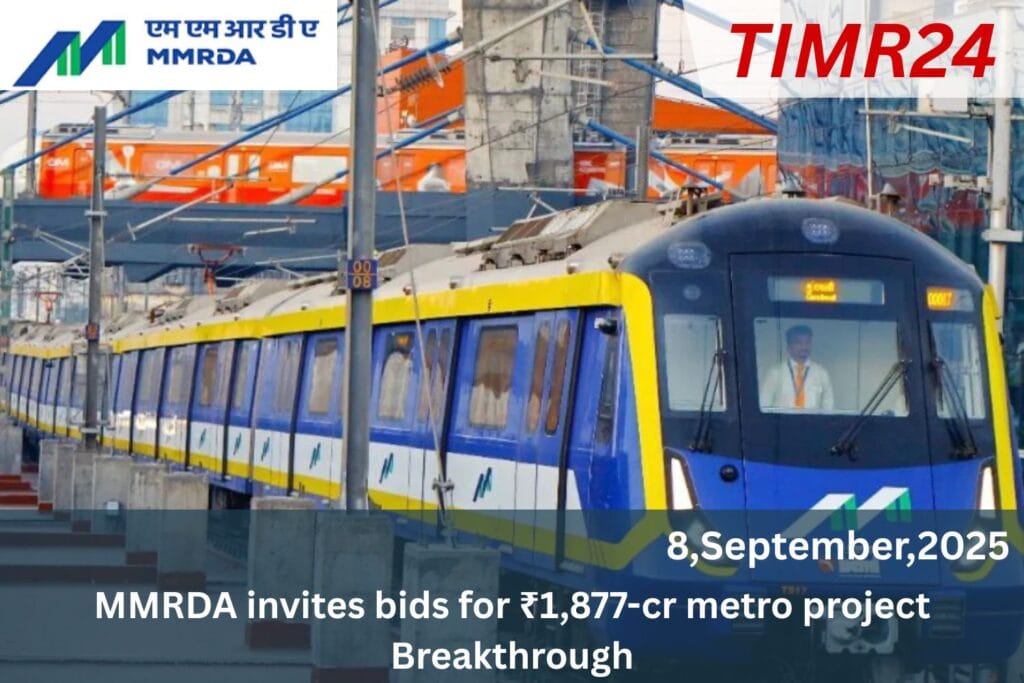
The Mumbai Metropolitan Region Development Authority (MMRDA) has invited bids for the civil construction of the Mumbai Metro’s Orange Line, costing ₹1877.88-crores. The contract includes part design and construction of an elevated viaduct and 19 stations, with a completion period of 30 months and an investment of ₹4,132 crore. The Mumbai Metropolitan Region Development Authority (MMRDA) has taken another decisive step towards reshaping the city’s urban transport ecosystem by inviting bids for its much-anticipated ₹1,877-crore metro project, a development that not only reflects the growing urgency to address traffic congestion and pollution but also highlights.
The city’s long-term vision for sustainable mobility. As the financial capital of India, Mumbai has always been a hub of commerce, culture, and rapid population growth, which has consistently put pressure on its existing transport infrastructure, and this project is designed to ease that burden by offering efficient, affordable, and eco-friendly transit solutions. According to the (MMRDA) the bidding will cover construction, civil works, system integration, and modern passenger amenities, ensuring that the project will meet global standards in metro operations. What makes this initiative especially significant is the way it complements the city’s broader expansion plans, much like how.
The spearheading parallel projects, reflecting a coordinated effort to improve urban connectivity. The need for such an ambitious investment becomes evident when considering that Mumbai, with its 20 million residents, witnesses some of the heaviest road congestion in India, where average commuters spend hours each day stuck in traffic, leading not only to frustration but also to severe economic losses and rising environmental concerns. In this context, the new metro expansion mirrors successful examples seen in other parts of the country such as the which also aimed to connect rapidly urbanizing regions to established city centers, and like Mumbai initiative is designed to bring.
Not just improved transportation but also regional economic growth by boosting real estate values, encouraging business development, and creating thousands of direct and indirect jobs The scope of the ₹1,877-crore project extends beyond just laying down tracks or building stations; it represents a holistic approach to modern infrastructure where stations will be equipped with digital ticketing systems, energy-efficient escalators, and improved last-mile connectivity options such as feeder buses and electric rickshaws, which align with India’s broader Smart City Mission. At the same time, this metro corridor will be strategically designed to integrate with existing and under-construction lines, making it part of a seamless web of mobility that reduces dependency on overcrowded roads and suburban railways.
This approach is reminiscent of developments like where authorities worked on ensuring multimodal connectivity to maximize commuter convenience. The MMRDA’s move also reflects the state government’s consistent push for green mobility solutions, a priority that has been underscored repeatedly in official communications and echoed in national infrastructure goals presented by the For the city’s commuters, the implications are far-reaching, as the project is expected to drastically reduce travel time, making cross-city movement not just quicker but also more predictable, something that is crucial in a metropolis where time is often as valuable as money.
From an economic perspective, metro expansions of this scale act as catalysts for local development. In neighbourhoods that were previously underserved, the arrival of metro connectivity has historically triggered real estate booms, increased retail activity, and improved accessibility to educational institutions and healthcare facilities. This pattern can already be observed in regions influenced by projects like the (Indian Railways) and similar transformations are anticipated in Mumbai once the new line becomes operational. Moreover, the project’s emphasis on eco-friendly infrastructure ties directly into the city’s larger fight against climate change.
As it will reduce reliance on private vehicles, lower fuel consumption, and cut vehicular emissions, reinforcing Mumbai’s role in India’s journey towards achieving its sustainable development targets. Much like which showcased the central government’s intent to modernize rolling stock with cutting-edge technology, the MMRDA’s metro project showcases regional authorities’ commitment to adopting innovative approaches in urban transport Socially, the project promises to democratize access to quality transport, bridging gaps between different socio-economic groups. For instance, students and office workers in peripheral areas who currently depend on long bus journeys will gain.
Faster access to city centers, while business professionals will benefit from time savings that translate into productivity gains. In the long run, such projects reduce the disparity between core urban zones and outer settlements, strengthening the idea of Mumbai as an inclusive and connected metropolis. Another layer of impact lies in job creation, as the construction phase alone will generate employment across multiple sectors, from skilled engineers to daily wage laborers, while the operational phase will offer permanent positions in maintenance, administration, and customer service. If we look at case studies such as it becomes clear that infrastructure projects of this magnitude.
Carry ripple effects that influence not just transportation but the entire urban economy The government’s emphasis on tenders and transparent bidding is also critical to ensure timely completion and quality outcomes, as delays and cost overruns have historically plagued Indian infrastructure projects. By opening up bidding at a value of ₹1,877 crore, MMRDA signals both confidence and accountability, setting a framework where private contractors are encouraged to bring innovative construction techniques, better project management, and cost-efficiency. This is in line with national goals to accelerate infrastructure development under public-private partnerships, similar to.
Agreements struck in the logistics sector, such as What makes Mumbai’s project stand out, however, is its immediate impact on daily life, as millions of commuters are eagerly awaiting tangible relief from the city’s notorious traffic snarls the MMRDA’s announcement to invite bids for a ₹1,877-crore metro project is not merely a bureaucratic update but a decisive moment in Mumbai’s transformation towards a world-class urban center with efficient, sustainable, and inclusive public transport. The integration of eco-friendly practices, job creation, real estate growth, and commuter benefits creates a multi-layered impact that goes far beyond transportation, shaping the very fabric of the city’s.
Future When viewed alongside other ambitious initiatives like it is clear that India’s cities are undergoing a transport revolution that will redefine urban living for decades to come, and Mumbai, with its latest metro push, is at the forefront of this transformation, paving the way for a faster, greener, and more connected tomorrow.
Q1. What is the value of the MMRDA metro project?
The project is valued at ₹1,877 crore.
Q2. Who will oversee the bidding process?
The Mumbai Metropolitan Region Development Authority (MMRDA) will manage it.
Q3. What is the main objective of this metro project?
It aims to improve connectivity and reduce traffic congestion in Mumbai.
Q4. When is the bid submission deadline?
The timeline will be announced by MMRDA in the tender document.
Q5. How will the project impact Mumbai commuters?
It will reduce travel time, ease road traffic, and improve public transport efficiency.