











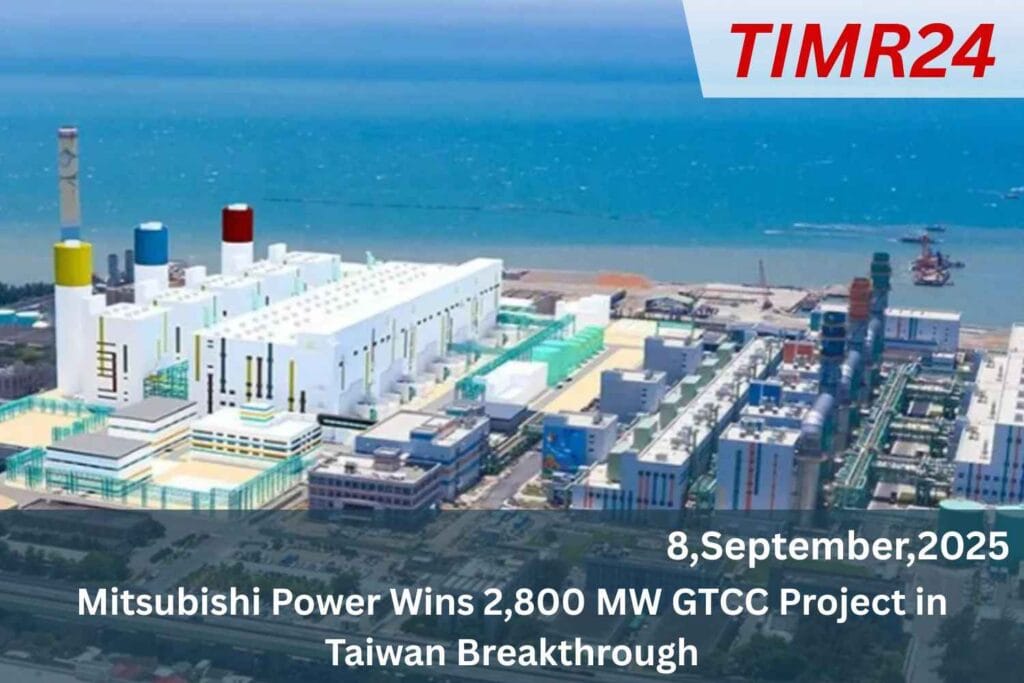
Mitsubishi Power has secured a contract for a 2,800 MW gas turbine combined cycle project at Taiwan Power Company’s Tung Hsiao Power Plant. The contract, awarded jointly with Taiwan’s CTCI Corporation, covers five units using M501JAC gas turbines. The project is part of Taiwan’s long-term power supply plan, aiming to expand capacity and reduce environmental impact. Mitsubishi Power will supply the gas turbines, steam turbines, and auxiliary equipment, while CTCI will oversee construction and balance of plant Mitsubishi Power’s victory in securing a 2,800 MW Gas Turbine Combined Cycle (GTCC) project in Taiwan marks one of the most significant milestones in Asia’s.
Clean energy transition. This project is more than just an infrastructure contract it is a vision of how nations can align economic growth with sustainable energy practices while strengthening energy security. The initiative also reflects Taiwan’s ambition to reduce coal dependency and embrace advanced natural gas and renewable energy solutions that contribute to a lower carbon footprint Taiwan has been pushing forward with its energy diversification agenda, focusing heavily on natural gas and renewable energy as cornerstones of its 2030 energy strategy. The government aims to phase down coal power plants and replace them with cleaner and more efficient alternatives. In this context.
GTCC Technology A Game-Changer in Power Generation
Mitsubishi Power’s project aligns perfectly with Taiwan’s ambitions. The scale of 2,800 MW capacity ensures that the country can handle rising electricity demand without compromising its environmental commitments. For readers interested in Taiwan’s policy framework offers deeper insights into the island nation’s energy transformation Gas Turbine Combined Cycle technology is widely recognized for its efficiency and ability to reduce emissions compared to conventional coal-fired plants. The working principle involves using a gas turbine to generate electricity while capturing excess heat to power a steam turbine, thereby maximizing energy efficiency. Mitsubishi Power will deploy.
Its state-of-the-art J-series GTCC turbines, known for achieving efficiency levels of over 60 percent while offering the flexibility needed for grid balancing. This makes GTCC not only a clean choice but also a reliable bridge for integrating variable renewable energy sources like wind and solar. To understand the global role of GTCC, the U.S. (Energy’s Resource) provides an excellent reference This project strengthens Mitsubishi Power’s leadership in the Asian energy sector. Having executed several large-scale projects in India, Japan, and Vietnam, the company is now solidifying its presence in Taiwan with one of its largest-ever contracts. By combining advanced turbine technology.
With digital monitoring systems, Mitsubishi Power is positioning itself as a key partner for nations that seek both efficiency and sustainability. In India, for example, the modernization of power infrastructure has been a recurring theme, as seen in our recent coverage Such parallels highlight how Asian countries are converging toward innovative solutions that guarantee reliability and green outcomes.
Environmental Benefits and Carbon Reduction
One of the strongest arguments in favour of GTCC technology is its ability to deliver immediate emission reductions compared to coal. In Taiwan, where industrial activity continues to rise, the shift to natural gas will significantly cut carbon dioxide, sulfur dioxide, and nitrogen oxide levels. Additionally, Mitsubishi Power’s turbines are designed with a pathway to hydrogen co-firing, which means they can gradually transition toward zero-carbon operations in the future. This long-term compatibility ensures the project will remain relevant as global climate policies evolve. Readers can explore the global context of emission reduction strategies at.
The 2,800 MW GTCC project is expected to bring substantial economic benefits to Taiwan beyond clean energy production. Large-scale energy projects like this one stimulate local employment, provide technology transfer opportunities, and enhance the capabilities of domestic contractors and engineers. For Taiwan, this is a chance to integrate world-class technologies into its power infrastructure while also uplifting its workforce. This aspect of inclusive growth is not limited to the power sector; we have also seen similar benefits in infrastructure initiatives like (NHAI’s) where development projects contribute to skills and community empowerment.
Supporting Renewable Integration and Grid Stability
Taiwan has made bold moves in the renewable sector, especially in offshore wind and solar power. However, renewable energy comes with challenges of intermittency. GTCC plants are flexible and can ramp output up or down quickly, providing much-needed stability to the grid. By acting as a complementary partner to renewables, GTCC ensures that the nation can pursue aggressive renewable targets without compromising energy security. The has often emphasized the importance of balancing clean energy with grid stability, and Taiwan’s model may well become a reference for other nations in the Asia-Pacific region.
At the heart of this breakthrough lies advanced engineering. Mitsubishi Power’s J-series turbines not only deliver high efficiency but are also backed by digital platforms that enable predictive maintenance and performance optimization. These innovations ensure minimal downtime and enhanced reliability, which is essential in a country like Taiwan that relies on consistent electricity supply for its industrial economy. Internally, this resonates with other technological stories we’ve covered, such as showing how technology is the real driver of energy transformation across multiple segments.
Geopolitical and Strategic Relevance
Energy projects of this magnitude also carry geopolitical significance. Taiwan is strategically located in Asia-Pacific, and strengthening its energy independence is crucial not only for domestic growth but also for regional stability. Partnerships with global players like Mitsubishi Power underscore Taiwan’s commitment to aligning with international best practices in energy management. At a time when global energy security is under constant discussion, such projects highlight how bilateral cooperation can pave the way for stable, long-term solutions.
Although the current focus is on natural gas, the long-term vision is clear transitioning toward hydrogen-based systems. Mitsubishi Power’s turbines are designed with hydrogen readiness, meaning that as hydrogen infrastructure develops, these plants can shift from natural gas to hydrogen or blended fuel. This adaptability ensures that the investment remains future-proof and that Taiwan continues to align with global decarbonization trends. The hydrogen economy is still in its early stages, but major institutions like the provide insights into how quickly it is developing worldwide.
Conclusion: A Defining Chapter in Taiwan’s Energy Future
The Mitsubishi Power 2,800 MW GTCC project in Taiwan is more than an infrastructure win it is a comprehensive vision of sustainable progress. It brings together technology, policy, environmental responsibility, and economic development in a single initiative. By delivering cleaner, more efficient power, the project strengthens Taiwan’s ability to meet its climate commitments while ensuring stable growth. It also reinforces Mitsubishi Power’s position as a global leader in energy innovation, capable of shaping the future of power generation across Asia and beyond. Just as other infrastructure efforts like demonstrate the interconnectedness of sustainable development, Taiwan’s GTCC breakthrough sets a benchmark for balancing energy, economy, and environment.
Q1. What is Mitsubishi Power’s 2,800 MW GTCC project in Taiwan?
It is a large-scale gas turbine combined cycle power project designed to provide reliable, low-emission electricity to Taiwan.
Q2. Why is this project important for Taiwan?
It supports Taiwan’s energy transition by replacing coal dependency with efficient, cleaner natural gas-based power.
Q3. What technology will Mitsubishi Power use?
Advanced J-series GTCC turbines, known for high efficiency, flexibility, and reduced carbon footprint.
Q4. How does GTCC benefit the environment?
It lowers emissions, increases fuel efficiency, and provides stable backup for renewable energy integration.
Q5. When will the project be operational?
The project is expected to be completed in phases over the next few years, supporting Taiwan’s 2030 clean energy goals.