

















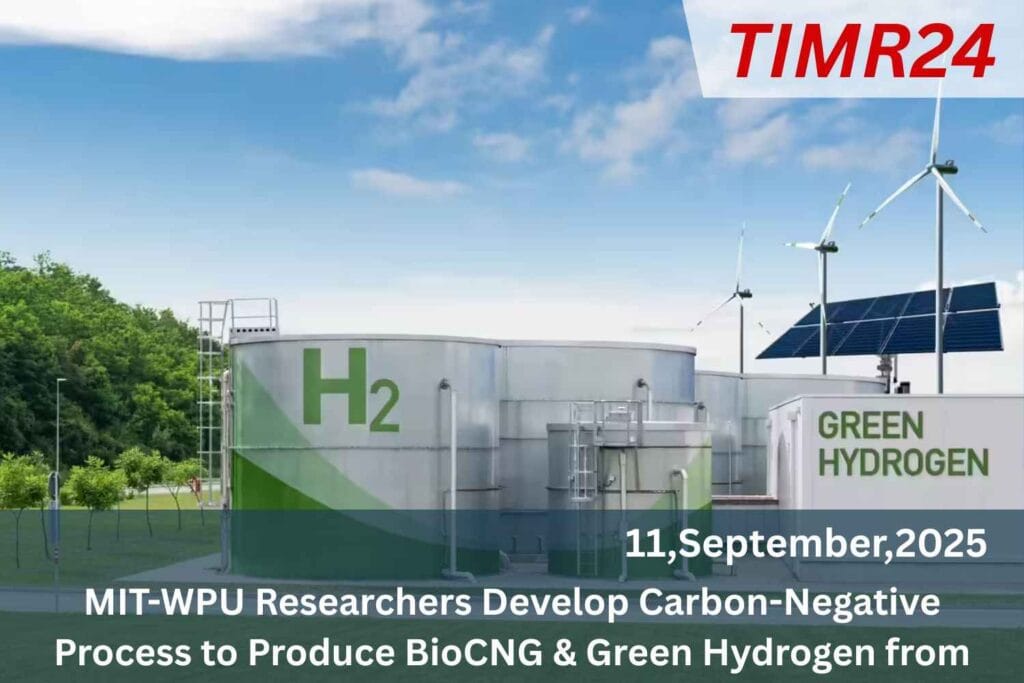
Researchers at MIT World Peace University (MIT-WPU) have developed a carbon-negative process that generates BioCNG and Green Hydrogen from mixed agricultural waste. This innovative approach offers a cleaner and more cost-effective path to India’s energy independence, supporting the Atmanirbhar Bharat mission and the philosophy of Life (Lifestyle for Environment). The process is based on the growing impact of climate change, frequent cyclones, erratic heavy rains, and prolonged droughts, as well as discussions with farmers struggling to manage large volumes of crop residue. The process delivers significantly higher efficiency while ensuring carbon-negative output.
Positioning MIT-WPU as a key contributor to India’s renewable energy transition. The bio-culture developed achieved a biomass-to-gas conversion efficiency of 12%, and a fully scalable 500 kg/day pilot plant is now established on the MIT-WPU campus. The process also produces Biochar, a valuable by-product used in industries such as pharmaceuticals, cosmetics, fertilizers, and construction. The process also generates biofertilizers as a by-product, which can replace urea usage in farming. The global shift towards renewable energy has entered a new phase as researchers at MIT World Peace University (MIT-WPU) in Pune have unveiled a cutting-edge carbon-negative.
Process that can convert agricultural waste into BioCNG and green hydrogen. This innovation is not just another addition to India’s green energy ecosystem it represents a turning point in the way we look at waste, fuel, and climate responsibility. The project demonstrates how academic research can drive industrial application while addressing two of the nation’s biggest challenges: sustainable energy production and crop residue management India generates nearly 500 million tonnes of agricultural waste annually, and a significant portion of this biomass is burned in fields, especially in states like Punjab, Haryana, and Uttar Pradesh. The practice, though convenient for farmers.
BioCNG A Rural-Friendly Fuel
Contributes to toxic smog, deteriorating air quality, and rising greenhouse gas emissions. The MIT-WPU research team has developed a process that transforms this waste into valuable clean fuels, creating an alternative to stubble burning while also generating income opportunities for rural communities. This innovation not only improves environmental health but also empowers farmers to be part of India’s clean energy transition BioCNG produced from crop residues holds promise as a direct replacement for conventional CNG, which is widely used in transport, households, and industries. Unlike fossil-based natural gas, BioCNG is renewable, low-emission, and locally.
Producible. MIT-WPU’s carbon-negative technology ensures that the lifecycle of this fuel captures more carbon than it releases, setting it apart from other bioenergy methods. Imagine a future where rural India becomes a hub of BioCNG production, with farmers supplying crop residues to decentralized plants and transport companies using the fuel to cut costs and emissions. This possibility could redefine both rural economies and urban sustainability goals. While BioCNG meets current energy needs, green hydrogen is the cornerstone of India’s long-term climate strategy.
Produced through renewable processes, hydrogen is versatile, powering fuel cells, industries, and heavy transport. MIT-WPU’s approach of generating hydrogen from agricultural waste is unique because it merges two critical agendas clean energy innovation and waste management. This fits seamlessly with the National Green Hydrogen Mission, which aims to make India a global leader in hydrogen production. By decentralizing hydrogen production and connecting it to agriculture, this technology can pave the way for an inclusive green economy.
Carbon-Negative: Beyond Neutrality
Most renewable processes are celebrated for being carbon-neutral, meaning they balance the carbon they emit with what they capture. MIT-WPU’s breakthrough is described as carbon-negative, a step further that ensures more carbon is removed from the atmosphere than released. This distinction makes the innovation globally significant, especially at a time when nations are searching for strategies to limit warming to 1.5°C as outlined in the Paris Agreement. The technology does not merely slow down emissions it actively reverses them, aligning with India’s commitment to reach net-zero by 2070.
The impact of this research goes beyond energy production. For farmers, this technology provides an alternative to burning crop residues, which has long been criticized but rarely replaced with a practical solution. By selling residues for BioCNG and hydrogen production, farmers gain a new revenue stream, (Water Project) reduce pollution in their communities, and contribute directly to the fight against climate change. This could mark the beginning of a farm-to-fuel economy, where rural areas become central to India’s clean energy infrastructure.
Global and National Context
Globally, countries are searching for scalable solutions to meet their climate goals. Europe is investing heavily in hydrogen, while nations like Japan and South Korea are building hydrogen-based transport systems. India, with its vast agricultural base, has the unique advantage of converting waste into wealth. The MIT-WPU process stands out as a model that could be replicated in other agricultural economies. Nationally, it complements initiatives like the National Bio-Energy Mission and the Green Hydrogen Policy, bridging policy intent with technological execution MIT-WPU’s role in this development underscores the importance of universities in driving real-world change.
Academic institutions, when empowered with research funding and industry partnerships, can produce breakthroughs that are not limited to journals but actively reshape industries. This project shows how academia can bridge the gap between lab-scale research and field-level implementation, ensuring that innovation does not remain confined to classrooms but contributes directly to national development This research aligns closely with global climate and energy resources. The Ministry of New and Renewable Energy (MNRE) provides insights into India’s hydrogen initiatives Internationally, updates from the United Nations Framework Convention.
On Climate Change (UNFCCC) highlight how carbon-negative solutions can accelerate climate action (UNFCCC). Technical studies on BioCNG can also be explored at ET Energy World These external resources provide context and validation to the MIT-WPU innovation The road to a carbon-neutral and eventually carbon-negative future will not be simple. Scaling technologies from university labs to nationwide deployment requires supportive policies, investments, and community engagement. MIT-WPU’s breakthrough has laid the foundation, but for it to succeed at scale, collaborations with governments, startups, and industries will be critical.
Imagine clusters of BioCNG and hydrogen plants across India, powered by stubble that once choked the air, now fuelling clean vehicles, industries, and homes. That vision is not far away if this innovation is nurtured and scaled The MIT-WPU carbon-negative process is more than a technological milestone it is a statement of possibility. By addressing waste management, clean fuel production, and carbon reduction simultaneously, it creates a holistic model of sustainability. For India, it could mean reduced dependence on fossil fuel imports, healthier air, and stronger rural economies. For the world, it signals that carbon-negative solutions are achievable and scalable.
Q1. What is the carbon-negative process developed by MIT-WPU?
It is a method to produce BioCNG and green hydrogen from agricultural waste while reducing carbon emissions.
Q2. How does this benefit farmers?
Farmers can monetize crop residues instead of burning them, creating income opportunities.
Q3. Why is this process considered carbon-negative?
It absorbs or offsets more carbon than it emits, reducing greenhouse gases.
Q4. What fuels are produced from agricultural waste in this method?
BioCNG and green hydrogen, both clean alternatives to fossil fuels.
Q5. How does this align with India’s green energy goals?
It supports the National Green Hydrogen Mission and India’s net-zero 2070 target.