








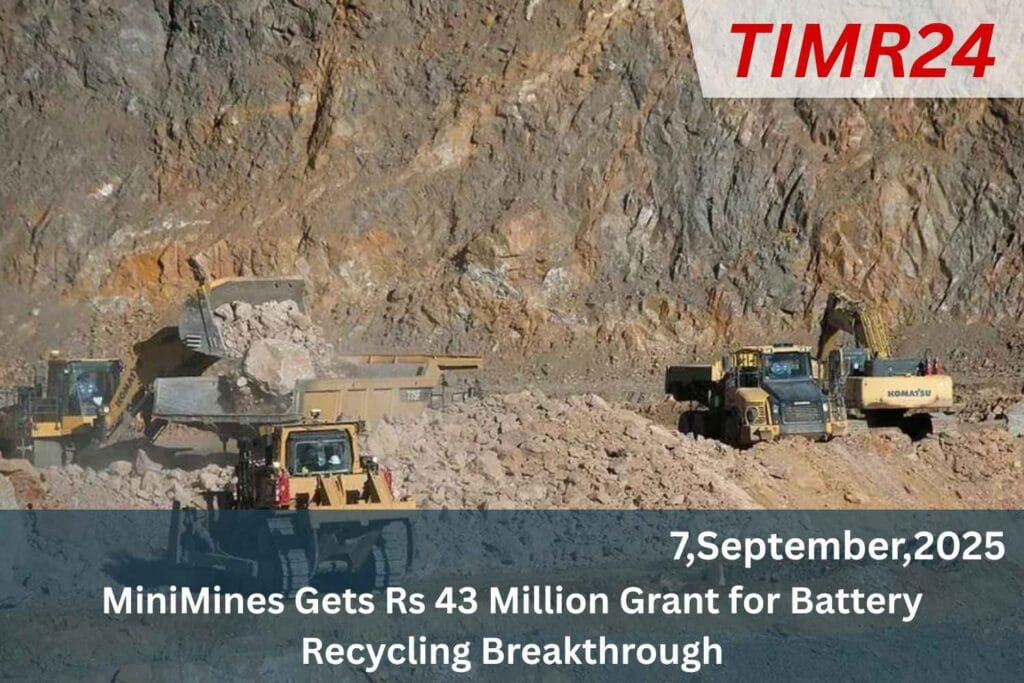
MiniMines Cleantech Solutions, a battery recycling start-up, has received Rs 43 million in grants from Oil India Ltd, ACT, and the United Nations Industrial Development Organisation (UNIDO) to support its refining and recycling of critical minerals in India. The funding will be used for process engineering, plant commissioning, and commercial validation of recycled battery-grade materials. MiniMines aims to reduce India’s dependence on imported raw materials and create a resilient and circular supply chain for India’s green industrial future. India’s clean energy sector has been evolving rapidly over the past decade, and one of the most exciting developments is the news that.
MiniMines has secured a Rs 43 million grant for its pioneering battery recycling technology, a milestone that reflects the growing importance of sustainable practices in the electric mobility and renewable energy ecosystem. The timing of this funding could not be more crucial, as the demand for electric vehicles (EVs), energy storage systems, and portable electronics continues to surge, putting immense pressure on the supply of raw materials like lithium, cobalt, and nickel. Unlike conventional recycling methods that often generate significant emissions, MiniMines has focused on developing eco-friendly technologies that recover these valuable metals while minimizing .
Environmental harm, thereby positioning itself at the heart of India’s transition to a circular economy The significance of this grant lies not just in the financial support, but in what it symbolizes: a national and global acknowledgment that battery recycling is a cornerstone of future sustainability. India, much like other emerging economies, has been grappling with the challenge of managing electronic and battery waste, which if left unchecked, could have serious environmental and health impacts. By securing funding, MiniMines has demonstrated that innovative startups can bridge the gap between technological advancement and environmental responsibility. This is very much in line with.
The government’s broader push for clean mobility under programs like FAME II, which incentivizes EV adoption, and policies that encourage local manufacturing of batteries under the Production Linked Incentive (PLI) scheme. Readers interested in government policies supporting EV adoption can refer to When examining the impact of MiniMines’ work on the electric vehicle industry, one must consider the sheer scale of battery requirements in the coming decade. India is projected to become one of the largest EV markets globally, with millions of vehicles expected to hit the roads. This massive expansion naturally requires a consistent supply of batteries, but importing.
Raw materials from countries like Chile, Australia, and the Democratic Republic of Congo not only raises costs but also creates geopolitical vulnerabilities. MiniMines’ battery recycling technology reduces dependency on imports by recovering essential metals domestically, creating a self-reliant ecosystem. This also ties into India’s Atmanirbhar Bharat mission, which emphasizes reducing foreign dependency in critical sectors. To understand global recycling practices and their potential for India, the (Energy Agency’s) provide valuable context.
From a technological standpoint, MiniMines has set itself apart by emphasizing processes that maximize recovery rates while reducing energy consumption. Traditional methods of recycling batteries often involve smelting, which is energy-intensive and environmentally damaging. Instead, MiniMines is believed to employ cleaner chemical and mechanical processes, making its approach both cost-effective and eco-friendly. Such breakthroughs not only benefit the domestic market but also make India a potential hub for battery recycling solutions that can be exported to other countries struggling with the same challenges. Initiatives like are already working to position India as a leader in energy storage and recycling technologies, and MiniMines’ success fits neatly into this larger vision.
The financial benefits of this Rs 43 million grant also deserve attention. Battery costs remain one of the largest components in the price of an electric vehicle, and lowering these costs through efficient recycling could make EVs far more affordable for the average consumer. This would create a ripple effect: increased EV adoption leads to reduced fossil fuel dependency, cleaner air, and progress toward India’s climate commitments. On the industrial side, recycled materials provide manufacturers with a more predictable and less volatile supply chain, reducing risks associated with global price fluctuations of raw materials. From an environmental perspective, effective recycling.
Prevents toxic materials from entering landfills and water bodies, addressing concerns of pollution and ecological damage This development also resonates strongly with India’s renewable energy and clean-tech narrative, where both government and private players are pushing toward aggressive sustainability goals. MiniMines’ achievement reflects the growing collaboration between policymakers, investors, and startups, all working toward building a robust green economy. The Ministry of New and Renewable Energy (MNRE) has laid out ambitious renewable energy targets, and while solar and wind projects often steal the spotlight, efficient battery management is equally critical for.
Storing and distributing renewable energy effectively. For official updates on India’s renewable policies, you can check (MNRE’s) From a broader lens, MiniMines’ breakthrough should be seen not just as a domestic achievement but as part of a global movement toward sustainable innovation. Around the world, countries are racing to secure their positions in the green economy, and India’s contribution through startups like MiniMines sends a strong signal that it is not just a participant but a leader in this transformation. Global investors are increasingly attracted to Indian cleantech ventures, and grants like this one add credibility to the ecosystem, paving the way for more funding and collaborations.
What makes this story compelling is how seamlessly it connects policy, industry, innovation, and society. On one end, you have government schemes like FAME II and PLI that create demand and supply incentives. On the other, you have private players like MiniMines introducing cutting-edge solutions. This combination directly benefits industries such as automotive manufacturing, renewable energy, and waste management, while also positively impacting ordinary citizens by promoting cleaner cities and affordable mobility. The interlinking of these elements shows that battery recycling is not an isolated niche, but rather a central pillar in the broader mission of achieving a sustainable future.
For those following India’s clean energy news, it’s worth connecting this development with related breakthroughs. For instance, projects like the NTPC Green 25 MW Bhuj Solar Project highlight how renewable power generation is advancing, while initiatives such as Concord’s Zero Emission Rail Propulsion demonstrate clean innovation in transportation. Together, they paint a holistic picture of India’s journey toward sustainability, where renewable generation, clean transport, and circular recycling systems are all part of the same ecosystem Looking ahead, the grant received by MiniMines could act as a catalyst for other startups to innovate in areas like e-waste recycling.
Hydrogen storage, and alternative battery chemistries. The clean energy sector thrives on cross-pollination of ideas, and MiniMines’ success story might inspire the next wave of entrepreneurs who see both the financial viability and social necessity of green innovations the Rs 43 million grant awarded to MiniMines for its battery recycling breakthrough is more than just financial aid it is a validation of India’s clean energy vision, a reinforcement of the global shift toward sustainability, and a roadmap for how technology and innovation can align with environmental responsibility. As India strengthens its position in the global green economy, initiatives like this will define the path forward, demonstrating that sustainability and profitability can indeed go hand in hand.
Q1. What is MiniMines’ Rs 43 million grant for?
The grant will be used to enhance battery recycling technologies and sustainable waste management solutions.
Q2. Why is battery recycling important for India?
Battery recycling reduces e-waste, recovers valuable metals, and supports India’s electric mobility mission.
Q3. How will this grant impact the EV industry?
It will strengthen the supply of recycled materials, reduce dependency on imports, and lower EV battery costs.
Q4. Who provided the Rs 43 million grant to MiniMines?
The grant was awarded under a government-supported clean-tech and sustainability initiative.
Q5. What innovations does MiniMines bring to recycling?
They focus on eco-friendly processes that maximize metal recovery and reduce carbon emissions.