











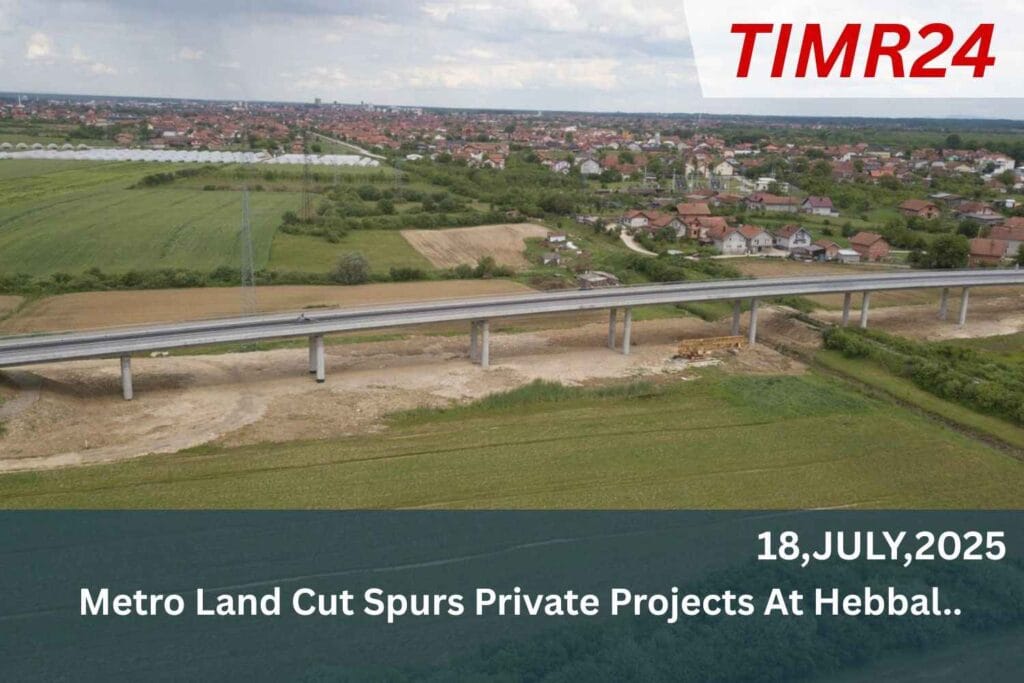
The Karnataka government has reduced the land allocated for the Nama Metro project in Hebbal from 45 acres to just 9 acres, allowing private developers to build high-end hotels, commercial towers, and luxury housing. The decision follows a high-level meeting where Bengaluru Metro Rail Corporation Ltd (BMRCL) officials confirmed they had scaled down their land requirement. Former minister Suresh Kumar has criticized the move, arguing it compromises the city’s long-term transit needs for short-term private interests.
The decision to reduce land earmarked for Bengaluru’s metro expansion in the Hebbal area has led to a significant increase in interest from private real estate developers. As land parcels originally reserved for public infrastructure become available, Hebbal is witnessing a surge in proposals for mixed-use and commercial real estate projects, reshaping the region’s urban growth trajectory.
Background: Metro Land Allocation Shift
Bangalore Metro Rail Corporation Limited (BMRCL) had initially earmarked substantial land near Hebbal for metro construction and auxiliary facilities. However, following a realignment of routes and optimization of land use, some of these plots have now been released. This shift has opened up prime parcels for alternative development, sparking a wave of private sector enthusiasm. For more context on metro-related developments.
Rise of Private Projects in Hebbal
Developers have quickly responded to the opportunity. Several proposals for high-rise residential towers, commercial complexes, and business parks are under review or in early-stage execution. This trend aligns with the region’s increasing attractiveness due to its proximity to major road networks and existing infrastructure. The newfound availability of land has helped overcome previous barriers to large-scale construction. For instance, local firms are now proposing integrated township models that blend office, retail, and living spaces. This reflects a broader trend seen across Bengaluru’s growing satellite hubs, including.
- Knight Frank Report on Bengaluru Real Estate
https://www.knightfrank.co.in
Impact on Real Estate Demand
Hebbal has already established itself as a sought-after micro-market due to its connectivity through the Outer Ring Road, Bellary Road, and its proximity to Kempe Gowda International Airport. With the metro land reduction freeing up previously untouchable plots, demand for property in the region has intensified. According to market experts, land rates in Hebbal have surged over the past six months, with developers keen to secure strategic holdings.
Infrastructure Complementing Real Estate Growth
To support this influx of development, local authorities are fast-tracking road improvements, drainage upgrades, and utility provisioning in Hebbal. Plans are underway to ensure that basic infrastructure keeps pace with commercial demand. Additionally, with Hebbal now hosting IT parks, educational institutions, and healthcare facilities, the area is evolving into a self-sustaining urban cluster. Read more about infrastructure
Challenges and Future Outlook
While the development boom is encouraging, concerns around traffic congestion, environmental sustainability, and zoning compliance remain. Urban planners suggest that future projects must integrate smart urban design and environmental impact mitigation measures. Still, the overall outlook for Hebbal remains highly positive. With regulatory clarity, improved accessibility, and fresh land availability, it is poised to become one of Bengaluru’s most dynamic development zones.
Q1. What triggered the private real estate surge in Hebbal?
The BMRCL’s decision to reduce land acquisition for metro expansion freed up parcels, attracting private developers.
Q2. Which types of projects are coming up in Hebbal?
Primarily residential towers, mixed-use developments, and commercial spaces are being planned.
Q3. How does the metro development benefit Hebbal’s growth?
Improved connectivity from the metro boosts real estate value and investor interest in the area.
Q4. Are any major builders involved in the Hebbal projects?
Yes, several reputed developers are eyeing Hebbal for high-value investments and new launches.
Q5. Will the metro land cut affect transport infrastructure?
No, BMRCL has reworked the plan to ensure efficient connectivity without needing excessive land.