







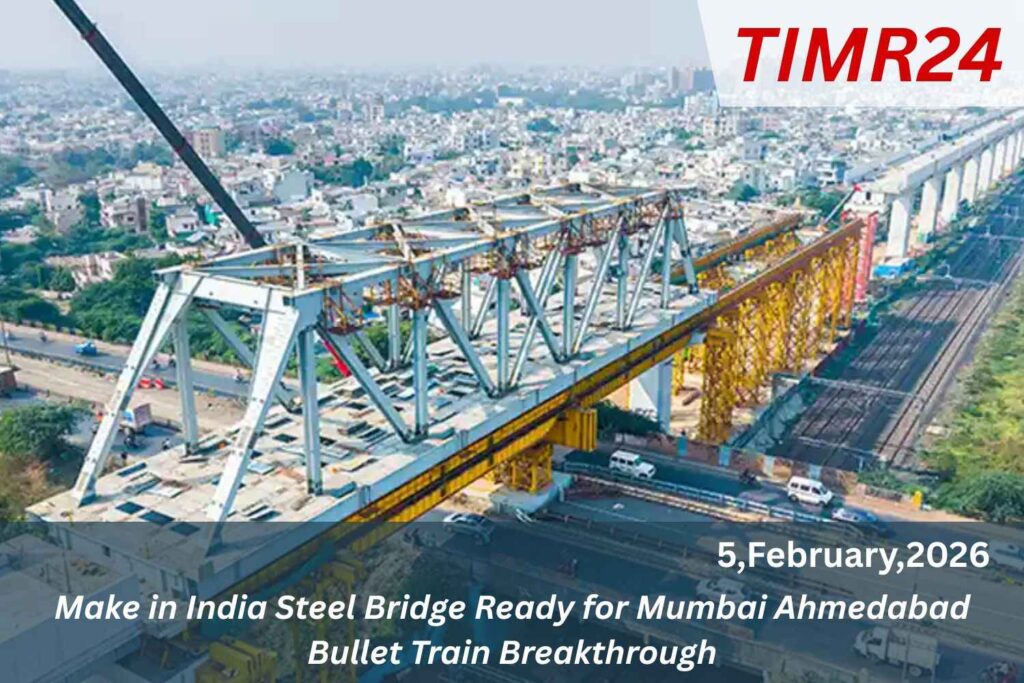
In a notable achievement for Indian Railways, a 100 m ‘Make in India’ steel bridge has been completed over an underground metro tunnel in Ahmedabad for the Mumbai Ahmedabad Bullet Train Project. This bridge is the 13th of 17 planned in Gujarat, enhancing rail connectivity while ensuring the safety of urban transport systems. It features a span of approximately 100 metres, redesigned from an SBS viaduct to a Steel Truss Bridge, to avoid load transfer to the metro tunnel. Weighing 1,098 metric tons, this bridge measures 14 metres in height and 15.5 metres in width, fabricated in Wardha, Maharashtra. It incorporates 45,186 TTHS bolts and is protected by C5.
India’s Flagship High Speed
System painting for durability, reflecting Indian Railways’ commitment to safe and modern infrastructure that integrates with existing transport networks India’s flagship high-speed rail project, the Mumbai–Ahmedabad Bullet Train, has reached a major engineering milestone with the successful readiness of a Make in India steel bridge. This achievement is more than just a construction update; it reflects the country’s growing capability to design, fabricate, and install world-class infrastructure using indigenous resources. The steel bridge, manufactured entirely within India, stands as a strong symbol of Atmanirbhar Bharat and highlights how domestic.
Industries are now playing a decisive role in globally benchmarked projects. As India accelerates its journey toward advanced transport systems, this bridge demonstrates the technical confidence required to deliver high-speed rail safely and efficiently The Mumbai–Ahmedabad High-Speed Rail (MAHSR) corridor is India’s first bullet train project and is being implemented by the National High-Speed Rail Corporation Limited (NHSRCL). The project aims to reduce travel time between Mumbai and Ahmedabad to nearly two hours while ensuring world-class safety, comfort, and speed. Infrastructure such as viaducts, tunnels, and bridges forms the backbone of this ambitious.
Conventional Concrete Structures
Corridor, and the inclusion of an indigenously built steel bridge marks a strategic shift toward domestic manufacturing excellence. This development directly aligns with India’s broader infrastructure roadmap Steel bridges play a crucial role in high-speed rail networks due to their strength, flexibility, and durability. Unlike conventional concrete structures, steel bridges are especially suitable for areas requiring long spans, river crossings, and locations with complex geological conditions. For the Mumbai Ahmedabad Bullet Train, the Make in India steel bridge has been designed to meet stringent Japanese Shinkansen standards, ensuring minimal.
Vibration, high load-bearing capacity, and exceptional safety margins. The fact that Indian manufacturers have successfully met these demanding specifications indicates a significant leap in the nation’s heavy engineering and fabrication capabilities The fabrication of this steel bridge within India has also delivered substantial economic benefits. By sourcing materials locally and engaging Indian steel manufacturers, fabricators, and logistics providers, the project has generated employment and strengthened domestic supply chains. This approach reduces dependence on imports and ensures better cost control, timely delivery, and long-term maintenance advantages.
Require Exacting Standards
From a technological perspective, the bridge incorporates advanced welding techniques, corrosion-resistant coatings, and precision-engineered components to ensure longevity and minimal maintenance. High-speed trains impose dynamic loads that require exacting standards in structural design, and Indian engineers have risen to the challenge by adopting international best practices while leveraging local expertise. This blend of global technology and Indian manufacturing reinforces India’s reputation as a reliable destination for complex infrastructure execution The environmental impact of using a steel bridge has also been carefully considered.
Populated And Ecologically Sensitive
Steel structures allow for faster erection at project sites, reducing construction time and minimizing disruption to surrounding ecosystems. Additionally, steel is recyclable, making it a more sustainable choice over the lifecycle of the project. For a densely populated and ecologically sensitive corridor like Mumbai Ahmedabad, these advantages are particularly significant. By adopting efficient construction methodologies, the project supports India’s commitment to sustainable infrastructure development while meeting future mobility demands Another important aspect of this milestone is the confidence it builds for upcoming high-speed rail and metro projects across India.
Successfully delivering a Make in India steel bridge for the country’s first bullet train sets a precedent for future corridors planned between major cities. It proves that Indian industries can handle complex fabrication, quality assurance, and logistics coordination at a scale comparable to global leaders. This confidence will likely encourage policymakers to prioritize domestic sourcing in future mega projects Institutional support has been a key driver behind this achievement. NHSRCL, in collaboration with Japanese technical partners, has ensured rigorous inspection and quality control throughout the manufacturing and installation process.
Global Infrastructure Hub
This collaborative model has enabled effective technology transfer while retaining core manufacturing activities within India The Make in India steel bridge also holds symbolic importance at a time when India is positioning itself as a global infrastructure hub. Large-scale (India) initiatives promoted under Make in India, accessible at emphasize the role of domestic manufacturing in driving economic growth and innovation. The bullet train project perfectly encapsulates this vision by combining international collaboration with strong local execution. It shows how India can absorb advanced technologies and adapt them within its own industrial ecosystem.
Beyond engineering and economics, this development has broader social implications. Improved connectivity between Mumbai and Ahmedabad will enhance regional integration, stimulate tourism, and support business growth across Maharashtra and Gujarat. High-speed rail reduces travel fatigue, increases productivity, and offers a reliable alternative to air and road transport. The readiness of key infrastructure components like the steel bridge brings the project closer to delivering these benefits to millions of passengers, reinforcing public confidence in India’s infrastructure ambitions As India continues to invest heavily in next-generation transport systems.
The success of the Make in India steel bridge for the Mumbai–Ahmedabad Bullet Train serves as a defining moment. It validates the country’s ability to deliver precision-driven, safety-critical infrastructure at an international level while nurturing domestic industries The (India) readiness of the Make in India steel bridge is not merely a construction milestone but a testament to India’s evolving engineering maturity. It underscores the effectiveness of domestic manufacturing when supported by clear policy direction, technical collaboration, and skilled manpower. As the Mumbai–Ahmedabad Bullet Train project progresses, this achievement will remain a benchmark.
Q1. What is special about the Make in India steel bridge for the bullet train?
It is fully manufactured in India and meets international high-speed rail safety and quality standards.
Q2. Which project uses this steel bridge?
The Mumbai Ahmedabad High-Speed Rail (Bullet Train) corridor.
Q3. Why are steel bridges important for bullet trains?
They provide high strength, flexibility, and durability for long spans and high-speed loads.
Q4. Who is implementing the Mumbai–Ahmedabad Bullet Train project?
National High-Speed Rail Corporation Limited (NHSRCL).
Q5. How does this bridge support Make in India?
It boosts domestic manufacturing, reduces imports, and strengthens Indian engineering capabilities.