


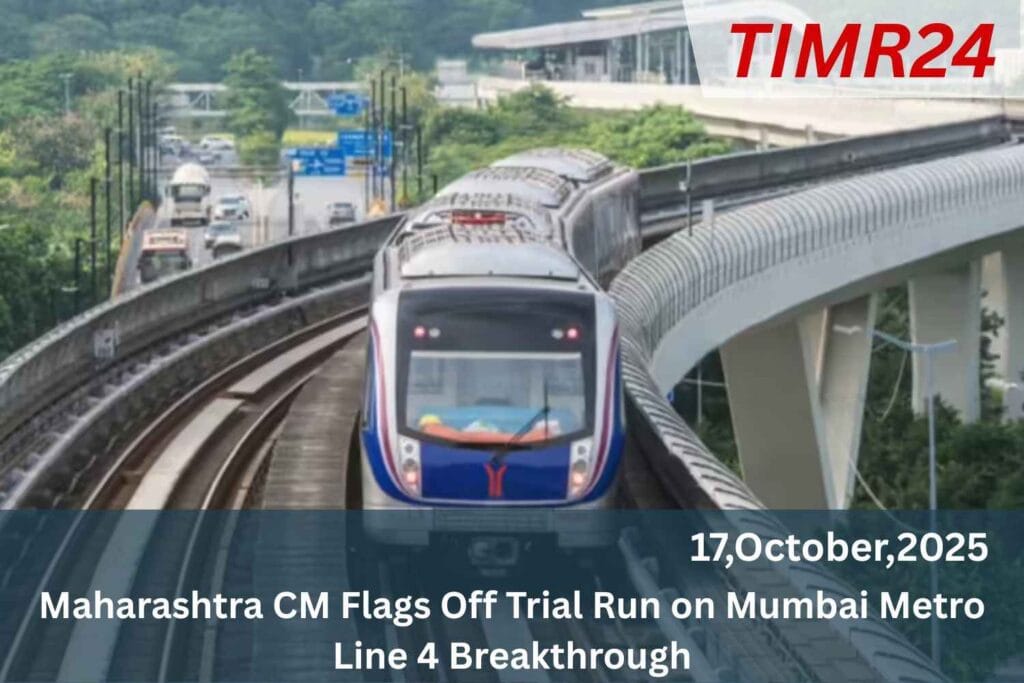
Maharashtra’s Maharashtra chief minister, Devendra Fadnavis, has launched the first trial run of Mumbai Metro Line 4, marking a significant milestone in the city’s expanding metro network. The corridor, spanning 32.3 km from Wadala to Kasarvadavali, will extend further under Line 4A up to Gaimukh, bringing the total length to 35.1 km with 32 stations. The project, implemented by the Mumbai Metropolitan Region Development Authority, aims to provide sustainable, eco-friendly, and efficient transport solutions while reducing road congestion and improving daily commute times for millions of passengers. The Maharashtra Chief Minister recently inaugurated.
The trial run of Mumbai Metro Line 4, a momentous step in the city’s urban transport development. Stretching approximately 32 kilometres, Metro Line 4 connects Wadala to Kasarvadavali, passing through key areas like Ghatkopar, Mulund, Thane, and Bhandup. This new corridor is expected to transform commuting patterns, significantly reduce traffic congestion, and improve connectivity between Mumbai’s eastern suburbs and central business districts. The trial run is a critical phase, allowing engineers and operational teams to assess train performance, signaling systems, station functionality, and safety measures before commencing commercial.
Operations. This development is part of Mumbai Metro’s Phase II expansion, aimed at easing the daily commute for millions and integrating various parts of the city through efficient rapid transit Metro Line 4’s inauguration demonstrates the Maharashtra government’s commitment to modernizing the city’s public transport infrastructure. With Mumbai facing chronic traffic congestion, rapid urbanization, and increasing population density, metro projects like Line 4 provide a sustainable solution. The Chief Minister highlighted that the line will not only benefit daily commuters but also facilitate economic growth by improving access to commercial centers, educational institutions.
Hospitals, and residential areas along the route. Metro Line 4 also forms a vital link in Mumbai’s growing metro network, connecting seamlessly with Metro Line 1 at Wadala and planned interchanges with Lines 2, 5, and 6. This multi-line integration ensures smooth passenger transfers and encourages greater adoption of public transport over private vehicles. Internal references to other Mumbai Metro projects such as (Metro Line) provide readers with a broader understanding of the city’s transit development One of the most significant aspects of Metro Line 4 is its state-of-the-art infrastructure. The trains are equipped with modern signaling and communication systems.
Energy-efficient electric coaches, and automated safety features. During trial runs, technical teams monitor speed, braking systems, and platform alignment to ensure seamless operations once the metro becomes operational. These trial runs are essential to detect and correct any operational glitches, test emergency response protocols, and fine-tune station operations. Additionally, staff training is conducted simultaneously to familiarize operators, conductors, and station personnel with real-time operational scenarios. For a detailed look at metro safety and testing procedures, readers can refer Metro Line 4 is not just a transport project but a comprehensive urban mobility.
Solution The stations are designed to be accessible, eco-friendly, and equipped with modern amenities. Several stations include facilities for differently-abled passengers, digital information systems, automated ticketing, and security surveillance. Sustainability has been a key consideration, with rainwater harvesting, energy-efficient lighting, and green building norms implemented at stations and depots. The metro also aims to reduce Mumbai’s carbon footprint by encouraging public transport usage, thereby reducing the number of private vehicles on the road. Internal linkages to can provide readers with insights into India’s growing focus on eco-friendly infrastructure.
Integration with existing transport networks is another critical feature of Metro Line 4. The line connects with suburban railway stations, bus terminals, and other metro corridors, creating a multi-modal transport hub. This integration facilitates last-mile connectivity, making it easier for passengers to travel between different modes of transport without inconvenience. Areas along the metro route, including Wadala, Ghatkopar, and Mulund, are expected to experience improved property value and commercial activity due to enhanced accessibility. For more details on multi-modal urban transport, readers can explore Economic and social benefits of Metro Line.
4 are manifold. By reducing travel time, commuters save precious hours daily, which can be redirected toward productive activities. Local businesses benefit from increased footfall near stations, while employment opportunities arise during both construction and operational phases. Metro projects also generate ancillary benefits in terms of improved urban planning, reduced pollution, and more efficient land use. The government has emphasized that Mumbai Metro’s expansion, including Line 4, aligns with broader initiatives to develop smart city infrastructure across Maharashtra. For updates on smart city projects, internal links to (Smart City) can provide a detailed perspective.
The trial run also serves as a platform to introduce citizens to the metro experience. Public awareness campaigns, safety drills, and educational initiatives ensure that commuters are prepared for the operational launch. Residents along the route, students, office-goers, and tourists are expected to be the primary beneficiaries. By fostering a culture of public transport usage, Metro Line 4 helps Mumbai move toward a more sustainable, efficient, and commuter-friendly urban environment. Moreover, improved connectivity is expected to reduce congestion on arterial roads such as Eastern Express Highway, benefiting daily road users.
Metro Line 4 is expected to integrate advanced digital systems for operations management, including centralized traffic control, automated ticketing, and real-time passenger information services. These systems enhance operational efficiency, improve commuter experience, and ensure safety standards are met consistently. Technical experts continue to monitor these systems during the trial phase, making adjustments as needed to achieve optimal performance. Internal links to provide detailed insight into these advanced systems Looking ahead, the Maharashtra government plans to expand Mumbai’s metro network further, with multiple new corridors under construction.
Metro Line 4 serves as a blueprint for future projects, combining technology, sustainability, commuter convenience, and safety standards. It also reflects the city’s readiness to embrace modern infrastructure solutions, catering to a growing population that increasingly relies on public transportation. For readers interested in broader metro network expansion,(Mumbai Metro) can offer comprehensive coverage The inauguration of the trial run signifies more than just a transportation milestone. It represents a step toward transforming Mumbai into a city with efficient, sustainable, and integrated urban mobility. Metro Line 4 is expected to catalyze economic growth, improve quality of life, and set.
A precedent for future transport infrastructure in Maharashtra and beyond. The focus on technology, integration, sustainability, and commuter convenience ensures that Mumbai remains at the forefront of modern urban transit solutions. For continuous updates on Metro Line 4 and related projects, readers can refer to which provides detailed information on operations, stations, and upcoming developments the trial run of Mumbai Metro Line 4 represents a critical achievement in Maharashtra’s urban transportation journey. It exemplifies a holistic approach to urban mobility, combining modern technology, sustainability, commuter-focused infrastructure, and strategic planning.
Q1 When did the trial run of Mumbai Metro Line 4 start?
The trial run of Mumbai Metro Line 4 was flagged off by Maharashtra CM on August 24, 2025.
Q2 Which areas will Metro Line 4 connect?
Metro Line 4 connects Wadala to Kasarvadavali, covering major suburbs in Mumbai and easing city commute.
Q3 What is the expected benefit of Metro Line 4?
The new line will reduce traffic congestion, provide faster travel, and enhance connectivity for daily commuters.
Q4 How many stations are there on Line 4?
Mumbai Metro Line 4 consists of 32 stations, covering a distance of approximately 32 km.
Q5 When is the commercial operation expected to begin?
Following successful trial runs, commercial operations are expected to commence by early 2026, subject to safety approvals.