


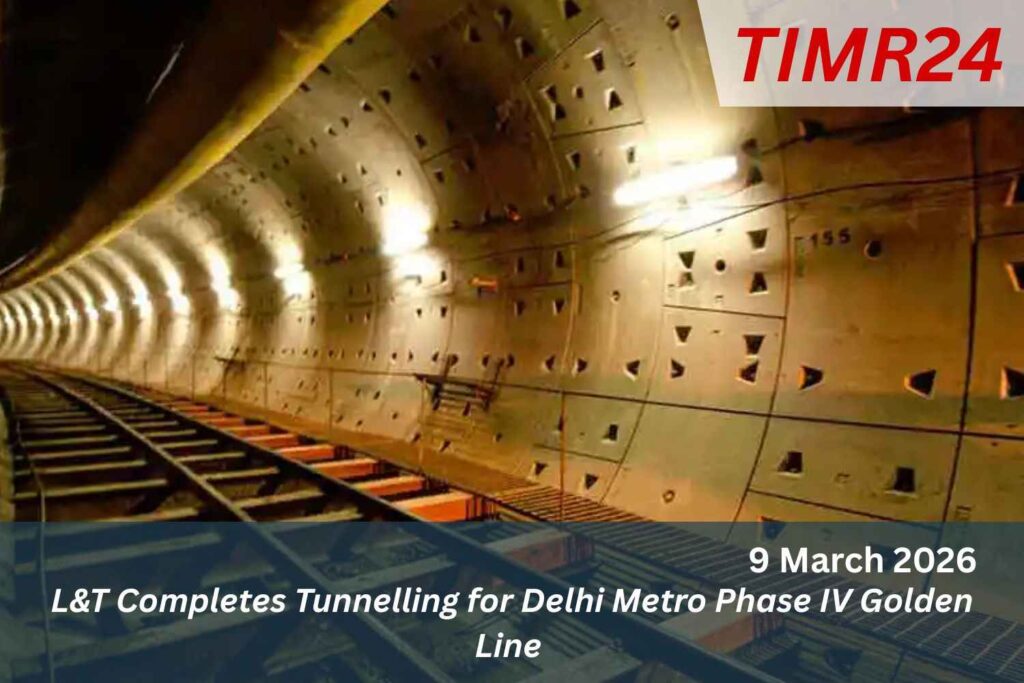
Larsen & Toubro (L&T) has successfully completed the tunnelling for the Phase IV Golden Line of the Delhi Metro, marked by significant breakthroughs of tunnel boring machines (TBMs) near IGNOU Station. This project featured innovative stacked tunnelling, necessitated by limited surface space at the Neb Sarai site, resulting in vertically aligned twin tunnels. The project faced urban challenges, including tunnelling beneath over 650 multi-storey buildings and adhering to construction restrictions under the Graded Response Action Plan (GRAP). L&T achieved eight tunnel drives totaling approximately 10,650 metres while upholding rigorous safety and quality standards.
Delhi’s Mass Rapid Transit Network Engineering
The completion of tunnelling work for the Delhi Metro Phase IV Golden Line corridor marks a major milestone in the expansion of Delhi’s mass rapid transit network. Engineering giant Larsen & Toubro has successfully finished the underground tunnelling section of this ambitious metro corridor, bringing the project closer to its operational phase. The Golden Line is one of the most important corridors under the fourth phase of expansion led by Delhi Metro Rail Corporation, which continues to transform urban mobility in India’s capital city. With Delhi facing growing traffic congestion and increasing demand for sustainable transportation, this new metro corridor is expected to significantly.
Enhance connectivity between key residential, commercial, and transit hubs The Golden Line corridor stretches between Aerocity and Tughlakabad, covering a large portion of South Delhi and providing seamless integration with existing metro lines. Aerocity is an important commercial and hospitality hub near the airport, while Tughlakabad serves as a key transport junction for southern parts of the city. Once operational, the corridor will allow passengers to travel quickly between these locations without relying on road transport, which often suffers from heavy traffic congestion. The completion of tunnelling represents one of the most complex stages of metro construction.
Specifically Designed For Large-Scale Underground
As underground infrastructure requires high precision engineering, advanced machinery, and strict safety measures Tunnelling operations for the Golden Line were carried out using advanced Tunnel Boring Machines (TBMs), which are specifically designed for large-scale underground infrastructure projects. These machines excavate soil while simultaneously installing concrete segments that form the tunnel lining. The technology ensures structural stability and minimizes disruption on the surface above. The successful completion of the tunnelling phase demonstrates the engineering capabilities of Larsen & Toubro, a company widely recognized.
For executing complex infrastructure projects across India and internationally The Delhi Metro Phase IV program itself is a massive urban infrastructure initiative aimed at expanding the existing metro network by adding several new corridors and extensions. Since its inception, the Delhi Metro has become one of the most successful public transport systems in the world, providing fast, reliable, and environmentally friendly travel for millions of passengers every day. The expansion under Phase IV will further strengthen the network and support the growing population of the National Capital Region. According to the Delhi Metro Rail Corporation, the new corridors are designed to improve.
South Delhi And Other Parts
Connectivity in areas that currently lack direct metro access, thereby encouraging more people to shift from private vehicles to public transport The Golden Line corridor plays a strategic role in improving connectivity between South Delhi and other parts of the city. Areas along this route include several residential neighborhoods, educational institutions, commercial complexes, and transport hubs. The new metro line will reduce travel time significantly, allowing commuters to move efficiently across the city. It will also provide better integration with existing metro corridors, creating a more interconnected transport system. This connectivity is essential for supporting economic.
Activity and urban development in the region Another important benefit of the Golden Line project is its contribution to environmental sustainability. Urban transportation is a major source of pollution in large cities like Delhi, where traffic congestion often leads to high emissions. By expanding the metro network and encouraging more people to use public transport, the Delhi Metro Phase IV expansion will help reduce carbon emissions and improve air quality. The use of energy-efficient trains and modern infrastructure further supports the goal of creating a sustainable transportation system The construction of underground metro tunnels is a technically.
Conditions, Groundwater Levels, And Surrounding
Challenging process that requires detailed planning and coordination. Engineers must carefully analyze soil conditions, groundwater levels, and surrounding structures before beginning excavation. In densely populated urban areas, these challenges become even more significant. The successful tunnelling for the Golden Line highlights the advanced engineering practices used in modern metro construction projects. Safety measures, continuous monitoring, and specialized equipment ensure that tunnelling operations are carried out without affecting nearby buildings or public utilities The role of Larsen & Toubro in this project reflects the company’s long-standing.
Expertise in infrastructure development. Over the years, the company has been involved in numerous metro rail projects across India, including projects in cities like Mumbai, Chennai, and Hyderabad. Its participation in the Delhi Metro Phase IV expansion further reinforces its position as a leading engineering and construction company. The successful completion of tunnelling work demonstrates the company’s ability to deliver complex projects within strict timelines and technical requirements The Delhi Metro Rail Corporation has consistently emphasized the importance of expanding the metro network to meet the transportation needs of a rapidly growing urban population.
L&T Stimulate Economic Growth In Areas
As Delhi continues to expand, efficient public transport systems become essential for maintaining mobility and reducing traffic congestion. The Golden Line corridor will play a crucial role in addressing these challenges by providing a reliable alternative to road transport In (India) addition to improving connectivity, the metro expansion is also expected to stimulate economic growth in areas along the corridor. Improved transport infrastructure often leads to increased real estate development, commercial activity, and employment opportunities. Businesses benefit from easier access to customers and employees, while residents gain better connectivity to workplaces, schools, and healthcare facilities.
This broader economic impact highlights the significance of large-scale infrastructure projects such as the Delhi Metro Phase IV expansion The completion of tunnelling work represents an important step forward, but several stages remain before the Golden Line becomes fully operational. These include track installation, signaling systems, electrification, station construction, and trial runs. Each stage must be completed according to strict safety and quality standards before passenger services can begin. Once operational, the corridor will become an integral part of Delhi’s metro network and will serve thousands of commuters daily.
Network Becomes More Extensive
The Delhi Metro continues to set benchmarks for urban transportation in India and around the world. With every new expansion phase, the network becomes more extensive and efficient, supporting the city’s long-term development goals. The successful tunnelling of the (India) Golden Line corridor by Larsen & Toubro is a testament to the progress being made in infrastructure development and engineering innovation. As construction progresses toward completion, the Golden Line is expected to become a vital component of Delhi’s public transport system, providing faster, cleaner, and more reliable mobility for millions of residents.
Q1. What is the Delhi Metro Phase IV Golden Line project?
The Golden Line is a major corridor under Delhi Metro Phase IV connecting Aerocity to Tughlakabad, improving connectivity across South Delhi.
Q2. Which company completed the tunnelling work?
The tunnelling work was completed by Larsen & Toubro, one of India’s leading infrastructure and engineering companies.
Q3. Who is responsible for the Delhi Metro project?
The project is being developed by Delhi Metro Rail Corporation (DMRC), which manages metro development and operations in Delhi.
Q4. What is the importance of the Golden Line corridor?
It will reduce travel time, improve metro connectivity, and support sustainable urban mobility in Delhi.
Q5. When will the Golden Line become operational?
The corridor is expected to open in phases after completion of civil work, track laying, and system installations over the next few years.