

















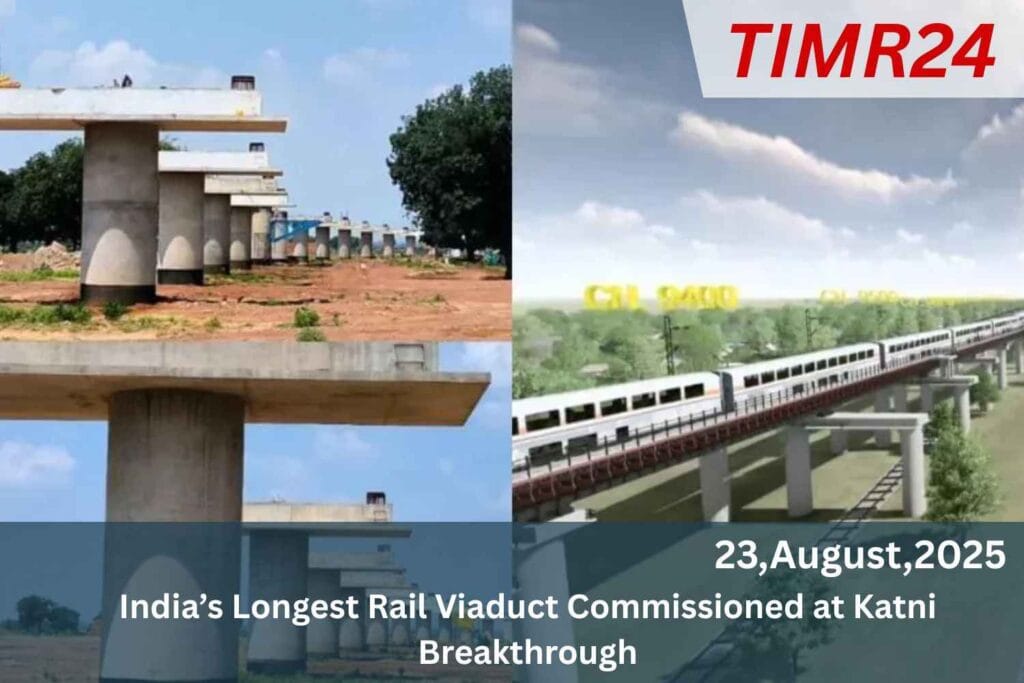
India’s Katni Grade Separator, India’s longest railway viaduct, has been commissioned, spanning 33.40 kilometres. The 33.40-kilometer structure aims to improve passenger and freight movement across central India. The viaduct consists of two corridors: a down-grade separator still under construction and a 15.85 km up-grade separator. Once fully completed, it will provide seamless connectivity between Bina and New Katni Junction, reducing travel time, delays, and freight competitiveness. The project is expected to benefit industries and the economy.
The Indian Railways has added yet another landmark achievement with the commissioning of the country’s longest rail viaduct at Katni in Madhya Pradesh. This engineering marvel not only sets a new benchmark in railway infrastructure but also highlights India’s growing capability in executing large-scale projects that improve connectivity and boost the economy. Katni, already known as an important railway junction in central India, will now serve as a strategic hub for freight and passenger movement, further strengthening the national transport network.
Located in Madhya Pradesh, Katni has long been considered a key link for coal, minerals, and industrial goods transportation. The new rail viaduct significantly eases the flow of traffic across this region by providing a smoother, congestion-free pathway. For a region that connects North, East, and Central India, this viaduct reduces travel bottlenecks and enhances efficiency. Much like the (Ganga Bridge) that recently became the widest extradosed cable-stayed bridge, the Katni viaduct reflects India’s commitment to upgrading its transport corridors with world-class infrastructure.
Engineering Excellence and Construction Details
Stretching over an impressive length of nearly 7 km, the Katni rail viaduct has been constructed using advanced engineering techniques, including pre-stressed concrete structures, seismic-resistant designs, and environmentally sustainable practices. Indian Railways has ensured that the design complies with global safety standards, making it durable for heavy freight as well as high-speed passenger trains. The project has drawn comparisons with international benchmarks, placing India in the league of countries capable of building massive transport infrastructure.
One of the major advantages of the Katni viaduct is the reduction in travel time for both freight and passenger trains. The viaduct bypasses congested sections, enabling smoother train operations, especially for long-haul freight services carrying coal, cement, food grains, and industrial products. For passengers, it means fewer delays, better connectivity, and an overall improved travel experience. This development mirrors the objective of projects like the which focus on regional connectivity and resource efficiency, highlighting how large infrastructure projects can directly uplift regional economies. The commissioning of this viaduct is not merely a achievement but also a catalyst for regional economic growth.
Katni and nearby districts are home to several industries, and efficient railway connectivity will directly benefit manufacturing and mining operations. With reduced transportation costs, industries in Madhya Pradesh and neighbouring states will be more competitive, driving employment and growth opportunities. In this way, the viaduct plays a role similar to that of initiatives like which reduce costs and increase efficiency for road transport. Together, road and rail reforms are reshaping India’s logistics ecosystem. While infrastructure projects often raise concerns about environmental impact, the Katni viaduct has been designed to minimize land acquisition and displacement.
Elevated structures reduce ground-level disturbance, thereby conserving farmland and ecosystems in the region. The reduced train idling and congestion also mean less fuel consumption and lower emissions, making this project a step toward greener railways. This aligns with India’s broader vision of sustainable infrastructure, much like that emphasizes long-term ecological balance in development projects. India’s railway system is the lifeline of its economy, and projects like the Katni viaduct strengthen the vision of seamless connectivity across states. With the growing demand for high-speed and heavy-load trains, infrastructure must evolve to keep pace.
The viaduct ensures that Indian Railways can handle increased traffic while reducing operational strain on existing routes. It also integrates well with the government’s mission of creating a modern transport ecosystem that balances road, rail, and waterways, providing citizens with reliable mobility options. The successful commissioning of India’s longest rail viaduct at Katni is more than just an infrastructure (Projects in Gaya) milestone it is a statement of intent. It signals that Indian Railways is ready to embrace world-class technologies, sustainable practices, and faster execution timelines to meet the nation’s growing transport needs. As the government continues to push forward with large-scale.
Q1. Where is India’s longest viaduct located?
It is located at Katni, Madhya Pradesh.
Q2. What is the length of the Katni rail viaduct?
The viaduct spans approximately 7 km, making it the longest in India.
Q3. What is the purpose of the Katni rail viaduct?
It improves rail connectivity, reduces congestion, and supports freight movement.
Q4. Which organization built the Katni viaduct?
It was constructed by Indian Railways with modern engineering techniques.
Q5. How will the viaduct benefit passengers?
It will ensure faster travel, smoother operations, and better connectivity across regions.