


















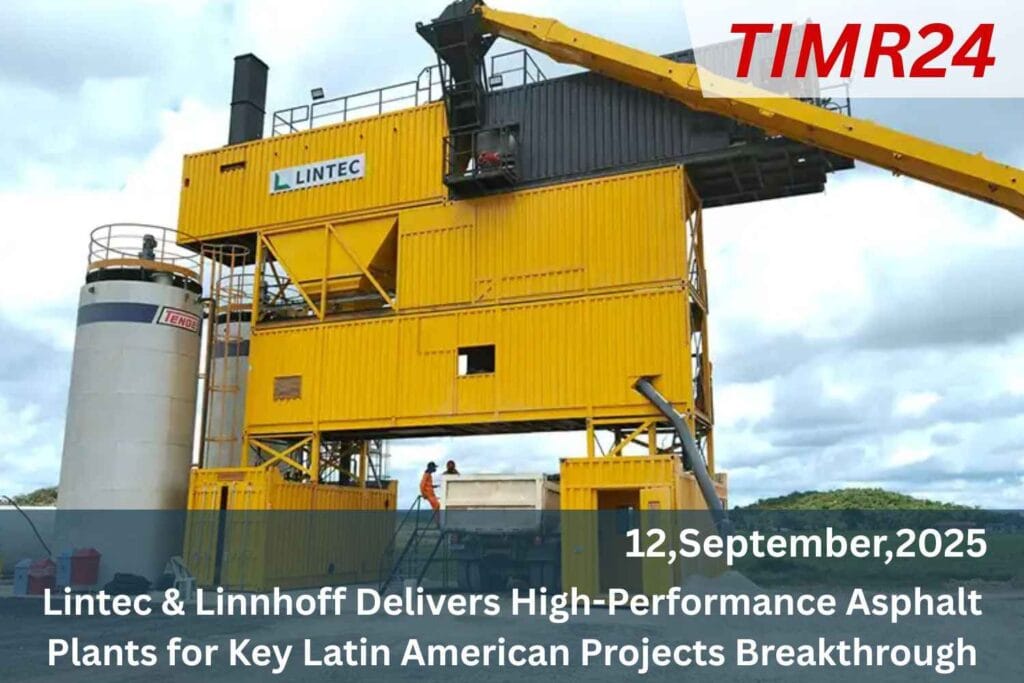
Lintec & Linnhoff’s is collaborating with two Lintec Containerised Asphalt Mixing Plants and a Continuous Asphalt Mixing Plant on key road projects in Brazil and Mexico. The CSD1500 containers are being deployed to support Brazil’s agricultural supply chain, the BR-163 Highway, by providing high-quality asphalt mix. The plants offer rapid installation, fuel and transport cost savings, and robust performance in remote areas. In Mexico, the Lintec CDP14000M Asphalt Mixing Plant is leading the National Road Infrastructure Program, integrating up to 15% Reclaimed Asphalt Pavement (RAP) to lower material costs, conserve resources, and reduce environmental impact.
The plants are designed to minimize environmental impact and align with growing demand for greener construction practices. Lintec & Linnhoff’s is committed to supporting the region’s infrastructure investments with smart, reliable, and sustainable technologies, ensuring their solutions remain aligned with the region’s long-term development goals. Lintec & Linnhoff, a globally recognized leader in asphalt and concrete batching technology, has recently expanded its footprint across Latin America by delivering high-performance asphalt plants for several critical infrastructure projects. These deliveries represent a milestone not only for the company but also for the region.
Which is experiencing a surge in demand for high-quality road construction, airport development, and urban connectivity initiatives. The Latin American market, encompassing countries like Brazil, Colombia, Chile, and Peru, has increasingly prioritized sustainable and technologically advanced solutions to meet infrastructure needs. Lintec & Linnhoff’s asphalt plants, designed with cutting-edge modular and containerized technology, cater precisely to these requirements. Unlike conventional stationary plants, these units offer enhanced mobility and rapid deployment, allowing construction companies to initiate projects in remote or challenging locations with minimal downtime.
The modular design ensures that each plant can be configured according to the scale of the project, whether it is a highway expansion in São Paulo or an airport upgrade in Bogotá, while maintaining consistent production quality and compliance with local environmental standards In Latin America, infrastructure projects often face logistical challenges due to diverse terrains and regulatory complexities. Lintec & Linnhoff’s containerized asphalt plants address these issues by providing pre-assembled units that can be transported easily by road or rail and installed swiftly on-site. This efficiency reduces construction delays and overall project costs, which is especially critical in fast.
Paced urban development projects. Similar technological advancements have been adopted in India for major highway expansions under the National Highways Authority, where companies like Eicher have also introduced energy-efficient vehicles and equipment to enhance construction efficiency The Latin American projects leverage this same principle, integrating automation and precision mixing technology to produce consistent asphalt batches with minimal human intervention. Automated control systems monitor temperature, aggregate composition, and mixing time to ensure every batch meets rigorous quality standards Another significant aspect of these high-performance.
Asphalt plants is their alignment with sustainability goals. Environmental compliance is becoming a critical factor for infrastructure projects worldwide, and Latin America is no exception. Lintec & Linnhoff’s plants are designed to minimize dust emissions, reduce noise levels, and optimize fuel consumption. The integration of energy-efficient burners and recycled material processing further enhances sustainability, reflecting a global trend toward green construction practices. For contractors and government agencies aiming to achieve carbon-neutral infrastructure, these plants provide a reliable solution that meets both productivity and ecological objectives. Insights from international standards.
Such as the United Nations Sustainable Development Goals (NHAI) reinforce the importance of adopting eco-friendly technologies in infrastructure development, and the company’s efforts in Latin America exemplify this approach The deployment of Lintec & Linnhoff’s asphalt plants is not limited to highways alone; urban mobility projects, logistics corridors, and airport construction are also key beneficiaries. Rapid urbanization in cities like São Paulo, Santiago, and Lima has created a demand for modern road networks capable of handling increased traffic while ensuring safety and durability. Asphalt quality and consistency are paramount for projects involving heavy-duty usage, and Lintec & Linnhoff’s advanced mixing.
Technology ensures that the roads can withstand extreme temperatures, heavy loads, and frequent use. Additionally, airport infrastructure projects benefit from these high-performance plants, as they provide the reliable asphalt quality required for runways, taxiways, and aprons, ensuring operational safety and longevity. Comparable projects in India, such as the development of airport tarmac facilities for airlines like IndiGo (Airport), highlight the global relevance of such technologies in modern transportation infrastructure. The integration of digital monitoring and remote management capabilities further enhances the operational efficiency of these asphalt plants. Contractors can monitor production in real time.
Identify potential bottlenecks, and adjust operations remotely to maintain continuous workflow. This capability reduces downtime, optimizes resource utilization, and ensures timely delivery of construction milestones. In regions where labor shortages or skill gaps exist, such automation becomes a game-changer, allowing infrastructure projects to progress without compromise. Furthermore, predictive maintenance features embedded in the plants minimize unplanned interruptions, enhancing the overall lifespan of the equipment and ensuring that project budgets remain under control Latin American governments are also recognizing the economic impact of deploying modern asphalt.
Plants. Investment in high-performance construction equipment not only accelerates project completion but also stimulates local employment, logistics, and supply chain networks. By improving connectivity between urban centers, ports, and industrial hubs, these projects contribute to regional economic growth and trade facilitation The availability of modular and transportable plants makes it feasible for multiple projects to be executed simultaneously across different geographies, increasing productivity and reducing the overall time to completion. The experience of other regions, such as Europe’s green infrastructure initiatives demonstrates that integrating advanced technology into.
Construction projects creates long-term benefits for society, the environment, and the economy alike The future outlook for Lintec & Linnhoff in Latin America appears promising. With governments emphasizing smart cities, urban mobility, and resilient transport networks, the demand for technologically advanced asphalt plants is expected to grow steadily. Lintec & Linnhoff’s ability to adapt equipment for local conditions, provide rapid deployment, and maintain high production standards positions the company as a trusted partner for public and private infrastructure developers. Beyond the immediate benefits of improved asphalt quality and construction efficiency, these plants set.
A benchmark for future projects, encouraging other manufacturers and contractors to adopt innovative, sustainable, and cost-effective solutions. As Latin American countries continue to invest in large-scale infrastructure development, including expressways, logistics hubs, and airports, Lintec & Linnhoff’s technology will play an integral role in shaping the region’s transportation landscape the delivery of high-performance asphalt plants by Lintec & Linnhoff to key Latin American projects represents a pivotal moment in modern infrastructure development. Combining modular design, automation, sustainability, and superior performance, these plants address the challenges of rapid.
Urbanization, environmental compliance, and logistical complexity. By facilitating faster project execution and higher-quality construction, Lintec & Linnhoff is not only contributing to improved roadways, airports, and urban transport networks but also supporting broader economic growth in the region. For readers interested in similar infrastructure advancements, India’s NHAI projects and modern airport developments provide a parallel understanding of how technology and sustainability converge in construction. This breakthrough delivery underscores the transformative impact of advanced equipment in shaping resilient and future-ready infrastructure across Latin America and beyond.
Q1. Why are Lintec & Linnhoff asphalt plants preferred in Latin America?
They offer modular, containerized designs that are easy to transport and install while ensuring high-quality asphalt production.
Q2. How do these plants support sustainability?
They reduce emissions, optimize fuel use, and comply with environmental regulations.
Q3. Which countries in Latin America are using these asphalt plants?
Brazil, Colombia, Peru, and Chile are among the key markets.
Q4. What makes containerized asphalt plants unique?
They allow faster installation, mobility, and reduced logistical costs compared to conventional plants.
Q5. How does this breakthrough impact infrastructure growth?
It accelerates road, airport, and urban development projects, boosting regional connectivity.