















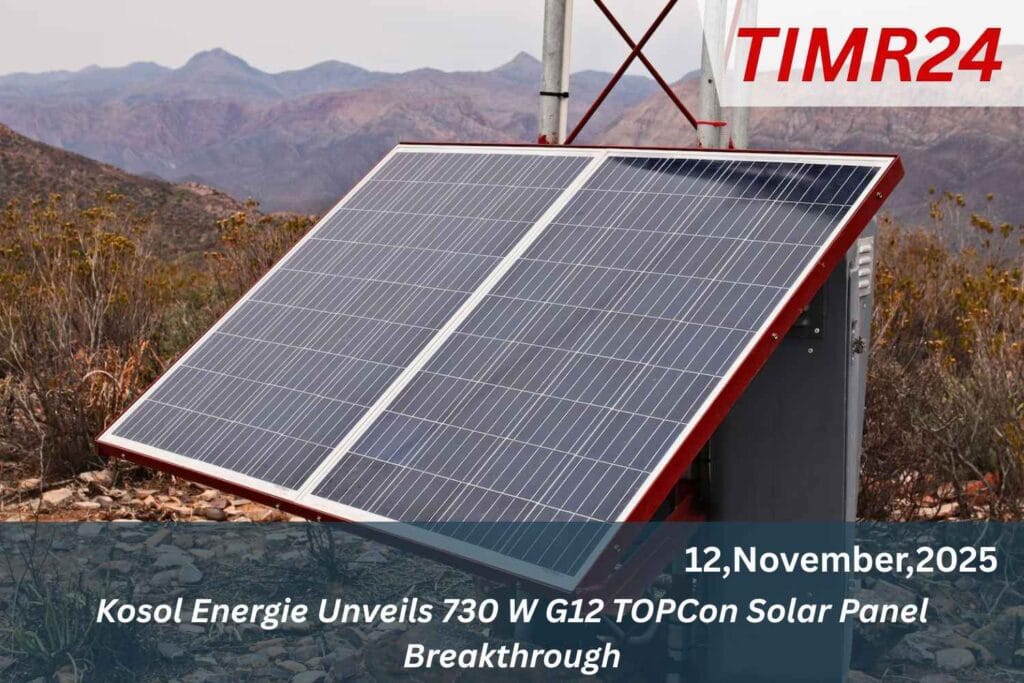
Kosol Energie launched a 730 W G12 TOPCon solar panel at the Renewable Energy India 2025 exhibition, aimed at commercial and utility-scale applications. The new panel features high-transparency glass and POE encapsulants to enhance durability, improve light transmission, and reduce material costs by 2-3%. Certification is underway, with commercial production expected by April or May 2026. The company, operating a 3 GW module manufacturing facility, plans to expand capacity to 9 GW by the end of 2026. Additionally, Kosol Energie is entering battery energy storage systems (BESS) manufacturing, targeting 3 GWh to 3.5 GWh annually, with unit capacities from 0.5 MWh to 5 MWh, leveraging proven US technology in its projects.
When Kosol Energie unveiled its 730 W G12 TOPCon solar module at the Renewable Energy India (REI) 2025 exhibition, it marked a notable move in the Indian and global solar manufacturing landscape The module uses the G12 wafer format, which is larger than the previous mainstream sizes, enabling higher output per module and thus reducing the number of modules needed for a given megawatt installation. Moreover, by adopting TOPCon cell architecture, Kosol is aligning with the industry’s shift toward higher-efficiency N-type and advanced cell technologies From a materials engineering perspective, the module is enhanced with high-transparency.
Glass and POE (polyolefin elastomer) encapsulants, which improve light transmission and module durability under harsh conditions. According to published sources, these innovations can reduce the bill of materials by about 2 – 3 % while also improving plant performance through increased power output and lower transport costs due to fewer modules being shipped The timing is strategic: as utility-scale solar installations grow in India and globally, cost per watt and logistics become critical differentiators. With a 730 W module, developers can achieve higher system output using fewer racks, fewer trackers, and less area (or at least less mounting structure) compared with older 600 W-class units. For large solar parks.
This can translate into meaningful savings in installation time, civil work and BOS (balance-of-system) costs It’s also noteworthy that commercial production is slated for April–May 2026, giving the market some lead time to plan orders and integrate the new modules into upcoming project timelines. Meanwhile, Kosol currently operates with a module manufacturing facility of 3 GW capacity (out-turn ~2 GW annually) and plans to expand by an additional 6 GW by late 2026, raising the total to 9 GW Beyond modules, the company’s move into battery energy storage systems (BESS) is a big part of the story. Recognizing that solar generation without storage still faces.
Strategic Implications for India’s Solar Industry
Intermittency and grid-integration challenges, Kosol is prepping an initial BESS annual production capacity of 3-3.5 GWh, with modular units ranging from 0.5 MWh to 5 MWh in each containerised system This full-spectrum approach (solar + storage) positions them to offer more than just modules it’s about turnkey clean-energy systems For developers in India, this announcement underlines the push toward higher-efficiency, larger-format modules that can bring down LCOE (levelized cost of electricity) and improve project economics. The availability of a 730 W module adds a new option for upcoming large-scale projects, especially those using single-axis trackers.
Or tracker-plus-bifacial configurations, where higher output per module matters. Also, for EPC (engineering-procurement-construction) contractors and module procurement teams, the prospect of fewer modules per MW means simpler logistics, fewer mounting points, and potentially reduced installation labour From a manufacturing viewpoint, Kosol’s capacity ramp-up to 9 GW by late 2026 is ambitious but reflective of the domestic policy push in India for solar module manufacturing (under Atmanirbhar Bharat and PLI schemes) and global supply-chain diversification. It signals that Kosol is aiming to compete not just locally but also in export markets.
What This Means for Buyers & Project Owners
The integrated solar + storage pathway hints at a shift: module makers are increasingly becoming system solution providers rather than just component suppliers. If you are a developer planning a ground-mounted solar park or a rooftop/industrial installation where space and output per area are at a premium, waiting for these 730 W modules may make sense provided they meet certification, price, supply-chain and warranty conditions. Key factors to evaluate include: certification status (since the modules are still under certification as of the announcement), price per watt compared with existing modules, BOS savings enabled by the larger format.
Warranty and degradation performance, and supply certainty (given the production ramp-up timeline industrial rooftop or C&I (commercial & industrial) installations, higher-output modules mean fewer racks/tracker segments and possibly less installation labor. However, roof structural loads, wind loading, and mechanical mounting design must still be verified for larger-format modules. In addition, (Solar) the module’s compatibility with inverters, trackers and mounting structure should be assessed As with any next-generation module announcement, there are some caveats. Certification and supply chain readiness will matter: although scheduled for April/May 2026, delays in certification or production.
Challenges & Considerations
Scale-up could impact project schedules. Also, cost comparisons should factor in potential premium for new modules vs. tried-and-tested modules. While the BoM savings estimate (2-3 %) is promising. the actual delivered cost savings at project-level will depend on many variables including shipping, handling, installation, tracker mounting, and integration with support systems. For tracking applications, shading, bifacial yield, and tracker layout are critical. The new module’s performance under real-world conditions (soiling, high temperature, low irradiance) will need to be validated. Buyers should check datasheets for degradation rate, temperature coefficient, warranty terms, mechanical loading (wind/snow), etc.
The unveiling of the 730 W G12 TOPCon module by Kosol Energie underlines a broader trend: solar modules are increasingly optimized for higher output per unit footprint, greater efficiency, and lower BOS cost not just cell efficiency alone. Large-format wafers (G12 and beyond), advanced cell architectures (TOPCon, HJT, etc.), improved materials (low-iron glass, POE encapsulants) and integrated system thinking (solar + storage) are shaping the next generation of solar solutions. For project developers, this means that module selection is no longer just about price per watt it’s about system-level optimisation: how many MWp can be installed, what is the yield per module, what are BOS and logistic savings.
How quickly can the system go live, what are warranty/degradation risks, and how future-ready is the technology for storage integration and grid-services. In the coming years, as modules like these become mainstream and storage systems become more accessible, solar parks and rooftop systems will increasingly act as full-scale energy assets generation + storage + control rather than just passive generation. For Kosol Energie, the dual trajectory of module launch plus BESS manufacturing showcases this shift clearly: the company is positioning itself to be more than a module supplier a clean-energy systems provider. As they ramp up manufacturing capacity and deliver these new modules and storage systems.
it will be important to monitor actual field performance, pricing trends, supply reliability and warranty performance. For buyers, staying informed on certification status, real-world pilot installations, yield data and integration experience will be key to making informed procurement decisions the 730 W G12 TOPCon module from Kosol Energie marks a significant step in solar (Solar) module evolution, offering higher output, system-level cost savings and aligning with the global move toward solar plus storage. For the Indian market especially, it presents a promising option for large-scale and commercial solar installations provided the project owner carefully evaluates all system-level aspects and waits for field-proven performance.
Q1. What is the new product from Kosol Energie?
The company has unveiled a 730 W G12 TOPCon solar panel designed for commercial and utility-scale applications.
Q2. What technology does the panel use?
It features G12-sized silicon wafers and TOPCon (Tunnel Oxide Passivated Contact) architecture, along with high-transparency glass and POE encapsulants for improved durability and light transmission.
Q3. When will it be commercially available?
Certification is underway and commercial production is expected to begin in around April or May 2026.
Q4. How does this panel benefit large-scale projects?
Higher power output per module (730 W) means fewer modules, reduced transport and logistics costs; the new materials also aim for 2-3 % bill-of-materials (BoM) savings and higher plant performance.
Q5. What else is the company doing besides solar modules?
Kosol Energie is expanding into battery energy storage systems (BESS), targeting an initial annual capacity of 3–3.5 GWh, to offer integrated solar plus storage solutions.