














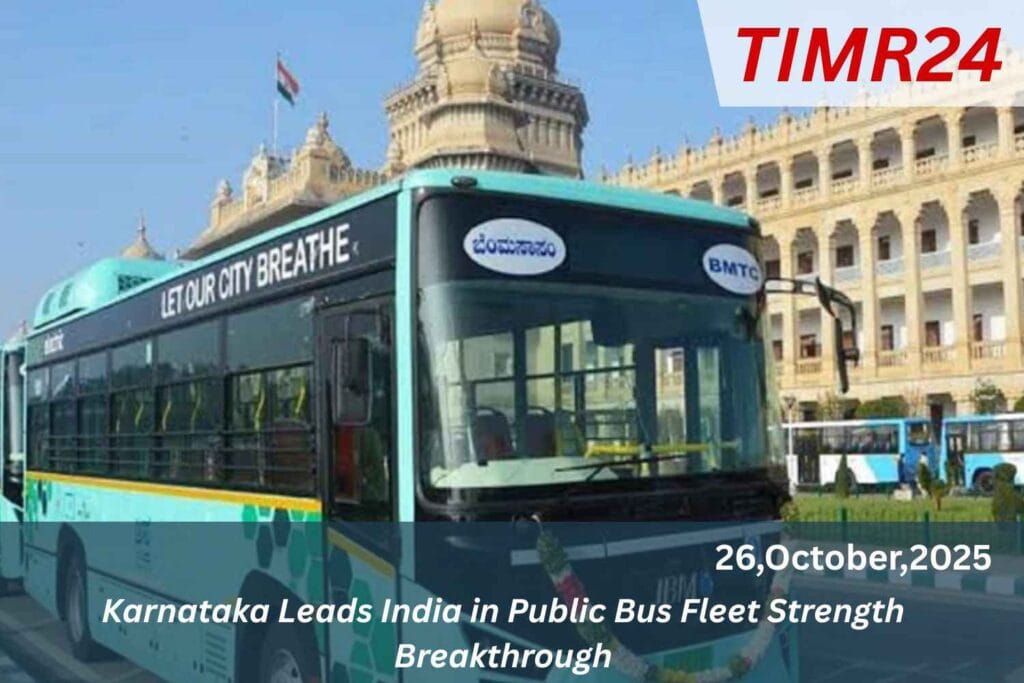
Karnataka leads India’s public transport sector with one of the largest bus fleets, supporting millions of daily commuters. The state government invests in improving public mobility and reducing dependence on private vehicles. Transport corporations focus on electrification and operational efficiency, aligning with India’s clean mobility and sustainable transport goals Karnataka has once again proven its dominance in India’s public transport ecosystem by becoming the leading state in public bus fleet strength in 2025. Through its consistent policies, technological advancement, and forward-thinking transport management, has achieved a milestone.
That sets a national benchmark for sustainable urban mobility. The state’s transport agencies — including the Karnataka State Road Transport Corporation (KSRTC), Bangalore Metropolitan Transport Corporation (BMTC), North West Road Transport Corporation (NWKRTC), and Kalyana Karnataka Road Transport Corporation (KKRTC) together form (Energy) (RENEWABLE ENERGY) one of the most extensive and efficient bus networks in the country. With a combined fleet exceeding 25,000 buses, including a rapidly growing number of electric and eco-friendly vehicles, Karnataka’s transport system reflects India’s progressive shift towards sustainability and modernization.
Q1. Why does Karnataka lead India in public bus fleet strength?
Consistent investment in transport infrastructure, technology, and green energy integration has positioned it as the leader in India’s public bus fleet growth.
Q2. How many buses are operated under KSRTC and BMTC?
As of 2025, the combined KSRTC and BMTC fleet exceeds 25,000 buses across Karnataka, including both diesel and electric variants.
Q3. What initiatives promote eco-friendly transport in Karnataka?
Karnataka’s EV Policy 2025, solar-powered depots, and partnerships with e-bus manufacturers promote sustainable mobility.
Q4. How does Karnataka’s public transport impact rural areas?
KSRTC connects 90% of rural villages, ensuring social inclusion, education access, and rural trade development.
Q5. What are Karnataka’s future public transport goals?
By 2030, aims for full electrification of its urban fleet and integrated multimodal smart ticketing.